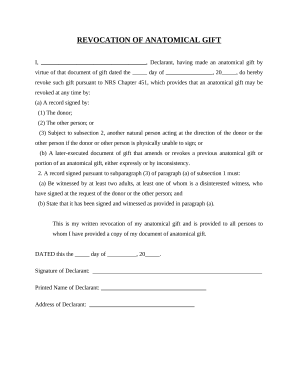
Get and manage Anatomical Donation Legal Documents online

Speed up your document operations with the Anatomical Donation Legal Documents online library with ready-made form templates that suit your requirements. Get the form, alter it, complete it, and share it with your contributors without breaking a sweat. Start working more efficiently with your forms.

How to use our Anatomical Donation Legal Documents:

  1. Open our Anatomical Donation Legal Documents and find the form you require.
  2. Preview your document to ensure it’s what you want, and click Get Form to start working on it.
  3. Change, include new text, or point out important information with DocHub tools.
  4. Complete your form and save the changes.
  5. Download or share your form with other people.

Examine all of the opportunities for your online file administration using our Anatomical Donation Legal Documents. Get a totally free DocHub profile right now!


Video Guide on Anatomical Donation Legal Documents management

video background

Commonly Asked Questions about Anatomical Donation Legal Documents

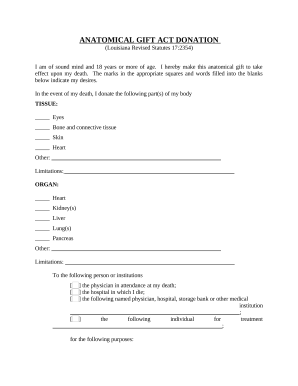
The act allows a decedent or surviving relatives to donate certain parts of the decedents organs for certain purposes, such as giving to those in need or for medical research.
Under existing law, a donor may make an anatomical gift (1) in a will or other document, (2) by signing an organ or tissue donor card, (3) by being included in a donor registry maintained by an organ or tissue procurement organization, or (4) by indicating the intent to donate on an operators license or license
Who decides who gets a donated organ? Fact: A national computer system and strict standards are in place to ensure ethical and fair distribution of organs. Organs are matched by blood and tissue typing, organ size, medical urgency, waiting time and geographic location.
Whole-body donation typically refers to the donation of the whole body to medical or scientific research. Once donated, the body may be used for surgical training, scientific research, and anatomy lessons for medical students, promoting the advancement of medical science.
Mandated choice is an alternative method for obtaining consent that would eliminate these problems by ensuring that adults prospectively address the question of organ donation for themselves (3-5).
Organ donation is when an organ (e.g., heart, lung, kidney) is removed from one person and transplanted into another person. Tissue donation is when tissues in the body (e.g., skin, corneas, bone) are removed from one person and transplanted into another person.
Introduction. Organ and tissue donation occurs after a person has died. Transplantable organs and tissue can be donated to help the lives of individuals in need. Anatomical gift means a donation of all or part of a human body, after death, for the purpose of transplantation, therapy, research or education.
The consent process for any potential living donor should include, but is not limited to: The assurance that the potential donor is willing to donate, free from inducement and coercion, and understands that he or she may decline to donate at any time.