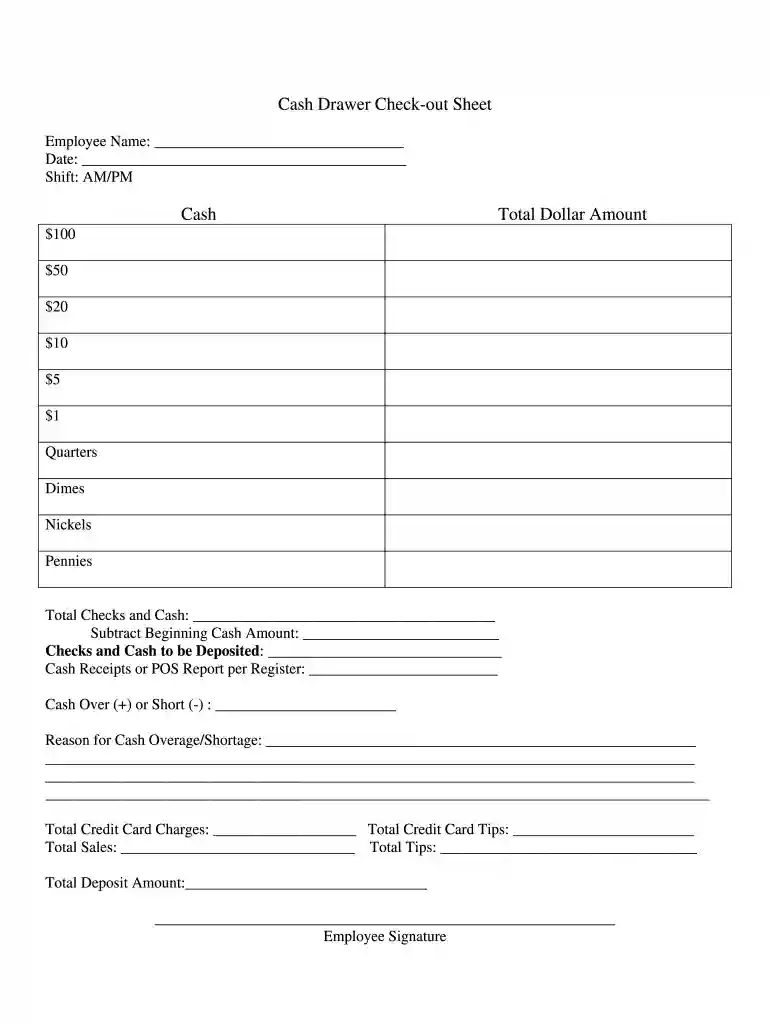
Cash drawer reconciliation template 2026

Get Form
cash register reconciliation template Preview on Page 1

Here's how it works

01. Edit your cash register reconciliation template online
Type text, add images, blackout confidential details, add comments, highlights and more.

02. Sign it in a few clicks
Draw your signature, type it, upload its image, or use your mobile device as a signature pad.

03. Share your form with others
Send cash drawer reconciliation sheet via email, link, or fax. You can also download it, export it or print it out.

Understanding the Cash Drawer Reconciliation Template

The cash drawer reconciliation template is a crucial financial tool used by businesses to ensure accurate tracking of cash and credit transactions. It helps employees record the money that flows in and out of the cash register, thereby preventing discrepancies between expected cash levels and the actual amount on hand. This template typically includes sections for cash denomination breakdowns, starting cash amounts, transaction summaries, and final cash totals, enabling businesses to maintain precise financial records.

Key Elements of the Cash Drawer Reconciliation Template

  • Sections for Cash Denominations: The template includes dedicated spaces for listing various cash denominations such as bills and coins. This helps in verifying the expected cash amounts.
  • Total Sales Summary: It aggregates total sales made during the shift, including cash and card transactions, providing a comprehensive view of revenue.
  • Discrepancy Reporting: Any balance discrepancies can be noted and explained, allowing for analysis of potential issues like theft or miscounting.
  • Deposits and Tips: The template tracks cash deposits and tips, ensuring all sources of income are accurately recorded.

These elements together create a structured and organized way to finalize cash counts effectively.

Steps to Complete the Cash Drawer Reconciliation Template

  1. Begin with the Cash Amount: Record the beginning cash amount taken into the drawer at the start of the shift.
  2. Log Transactions Regularly: Throughout the shift, make entries for each sale, including details for cash and card payments.
  3. Calculate Total Sales: At the end of the shift, tally all sales recorded, ensuring every transaction is accounted for.
  4. Count Physical Cash: Physically count the cash in the drawer and compare it with the sales totals calculated.
  5. Identify Discrepancies: If there are differences, note them, and provide potential explanations or corrective actions if necessary.

Following these steps ensures that the cash drawer is reconciled accurately and efficiently.

Advantages of Using a Cash Drawer Reconciliation Template

  • Accuracy in Financial Records: Regular use reduces discrepancies, maintaining trust in financial reporting.
  • Simplified Data Collection: Streamlined processes make it easier for staff to collect and enter cash data.
  • Enhanced Financial Accountability: By documenting all transactions and discrepancies, it reinforces responsibility among employees handling cash.
  • Quick Accessibility: The template allows for rapid assessment of cash flow, enabling quick adjustments.

Using this template offers structured methods for better managing cash, leading to improved financial health.

Who Typically Uses the Cash Drawer Reconciliation Template?

The cash drawer reconciliation template is primarily utilized by businesses that handle cash transactions daily. Common users include:

  • Retail Stores: Staff members reconcile their registers to ensure the cash matches sales.
  • Restaurants: Servers and cashiers utilize the template to report cash and credit card transactions at the end of their shifts.
  • Concession Stands: Cashiers use the template to keep accurate records of daily totals, which facilitate smoother operations during busy events.
  • Service Providers: Businesses that rely on cash payments, such as salons and repair shops, also benefit from this template to maintain proper financial documentation.

This template is essential for any organization where cash handling is involved.

decoration image ratings of Dochub

Examples of Using the Cash Drawer Reconciliation Template

In a retail setting, a cashier might use the cash drawer reconciliation template to record one hundred cash transactions worth $2,500 in total sales. After counting the cash at the end of the shift, they find $2,480 in the drawer. By noting the $20 discrepancy on the template, they can explore possible causes such as a customer miscount or errors during the transaction process.

In a restaurant, a server completes the reconciliation template at the end of their shift, compiling cash and credit sales and noting down tips. If the cash and tips combined totaled $150, but the cash drawer only holds $145, an investigation into possible miscalculations can be conducted, ensuring transparency in operations.

These examples illustrate the practical application of the template in real-world cash handling scenarios.

Digital vs. Paper Version of the Cash Drawer Reconciliation Template

When selecting between digital and paper versions of the cash drawer reconciliation template, businesses weigh several advantages:

  • Digital Format:

    • Ease of Use: Digital templates can be filled out quickly and stored conveniently online, minimizing physical clutter.
    • Integration with Software: Many digital templates can link with accounting software, allowing for seamless financial tracking and reporting.
    • Real-Time Collaboration: Multiple employees can access and update the document simultaneously, improving workflow efficiency.
  • Paper Format:

    • Tactile Experience: Some employees may prefer writing manually, as it allows for a deeper connection with the data being recorded.
    • Simplicity: A basic template that requires no digital skills can be effective for less tech-savvy staff members.

Choosing the appropriate format depends on the specific needs and preferences of the business and its employees.

Important Terms Related to Cash Drawer Reconciliation Template

  • End of Day Report: The summary report generated at the end of the shift or day, detailing all transactions.
  • Discrepancy: Any variance between the counted cash and the expected amount based on recorded transactions.
  • Begin Shift Count: The initial cash count used to establish the starting point for reconciliation.
  • Sales Summary: The breakdown of all cash and credit transactions that occurred during the shift.
  • Deposit: The act of taking cash from the drawer to a secure location, such as a bank.

Familiarity with these terms enhances understanding of the cash reconciliation process and contributes to effective cash management.

be ready to get more

Complete this form in 5 minutes or less

Get form

Security and compliance

At DocHub, your data security is our priority. We follow HIPAA, SOC2, GDPR, and other standards, so you can work on your documents with confidence.

Learn more
ccpa2
pci-dss
gdpr-compliance
hipaa
soc-compliance