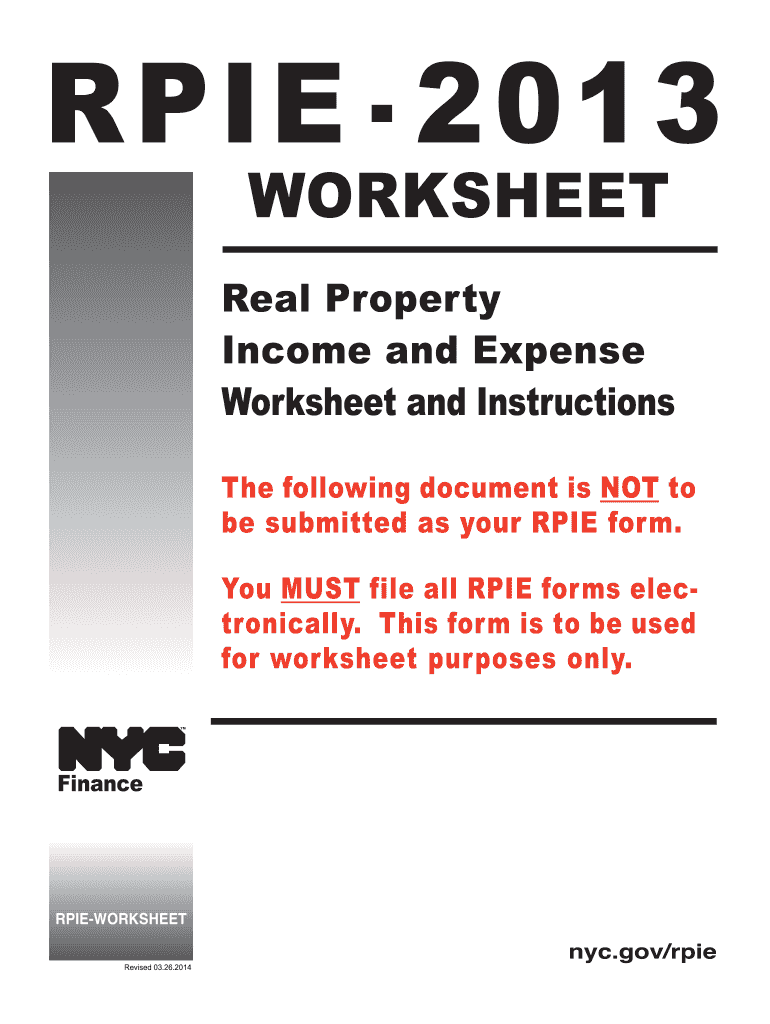
2013 rpie form-2026

Get Form
reuc rpie Preview on Page 1

Here's how it works

01. Edit your reuc rpie online
Type text, add images, blackout confidential details, add comments, highlights and more.
02. Sign it in a few clicks
Draw your signature, type it, upload its image, or use your mobile device as a signature pad.
03. Share your form with others
Send rpie form via email, link, or fax. You can also download it, export it or print it out.

How to use or fill out 2013 RPIE form with our platform

Form edit decoration
9.5
Ease of Setup
DocHub User Ratings on G2
9.0
Ease of Use
DocHub User Ratings on G2
  1. Click ‘Get Form’ to open the 2013 RPIE form in the editor.
  2. Begin with Part I: Owner and Property Information. Fill in the names of up to two property owners, along with their Employer Identification Numbers (EIN) or Social Security Numbers (SSN). Ensure accuracy as this information is crucial for tax administration.
  3. In Section B, provide contact information for someone who can answer questions about the filing. This includes a name, firm name, address, and phone number.
  4. Proceed to Section C if applicable. Here, indicate if you are filing for consolidated lots by checking the appropriate box and selecting your apportionment method.
  5. Complete Section D if you believe you qualify for an exclusion from filing. Check the relevant reasons that apply to your property.
  6. Continue filling out Sections E through K as required, providing detailed income and expense information based on your property type. Use dropdowns where available for ease of selection.
  7. Finally, review all entries for accuracy before clicking ‘Sign and Submit’ to certify your information and ensure compliance with filing requirements.

Start using our platform today to streamline your RPIE form completion process for free!

See more 2013 rpie form versions

We've got more versions of the 2013 rpie form form. Select the right 2013 rpie form version from the list and start editing it straight away!
Versions Form popularity Fillable & printable
2022 4.5 Satisfied (23 Votes)
2020 4.8 Satisfied (36 Votes)
2019 4.3 Satisfied (107 Votes)
2018 4.3 Satisfied (152 Votes)
2017 4.2 Satisfied (58 Votes)
2015 4.3 Satisfied (65 Votes)
2013 4.4 Satisfied (117 Votes)
2012 4.4 Satisfied (594 Votes)
2011 4.4 Satisfied (520 Votes)
2010 4.4 Satisfied (440 Votes)
be ready to get more

Complete this form in 5 minutes or less

Get form

Got questions?

We have answers to the most popular questions from our customers. If you can't find an answer to your question, please contact us.
Contact us
Real Property Income and Expense (RPIE) Statements.
Full year New York State residents must file Form IT-201, Resident Income Tax Return.
How to fill out the NYC RPIE Statement Online Filing User Guide? Visit the RPIE webpage at .nyc.gov/rpie. Use your NYC.ID to log in or create a new account if you dont have one. Select the appropriate filing instructions for your property type. Complete the RPIE statement with accurate income and expense data.
Who Is Required to File an RPIE? If you own an income-producing property with an actual assessed value greater than $40,000 on the Department of Finances tentative assessment roll, you are required to file an annual RPIE statement.
Who is required to file? Regular RPIE Filing: Owners of income-producing properties with an actual assessed value of more than $40,000 on the tentative assessment roll must file a Real Property Income and Expense statement or a claim of exclusion.

Security and compliance

At DocHub, your data security is our priority. We follow HIPAA, SOC2, GDPR, and other standards, so you can work on your documents with confidence.

Learn more
ccpa2
pci-dss
gdpr-compliance
hipaa
soc-compliance
be ready to get more

Complete this form in 5 minutes or less

Get form

People also ask

Residents. The estate of a New York State resident must file a New York State estate tax return if the following exceeds the basic exclusion amount: the amount of the residents federal gross estate, plus. the amount of any includible gifts.
Penalty Amount Owners who fail to file a claim of exclusion for three or more consecutive years will be fined $1,000. Owners of income-producing property who fail to file an RPIE statement for three consecutive years may be subject to a penalty of five percent of the final actual assessed value of the property.

Related links