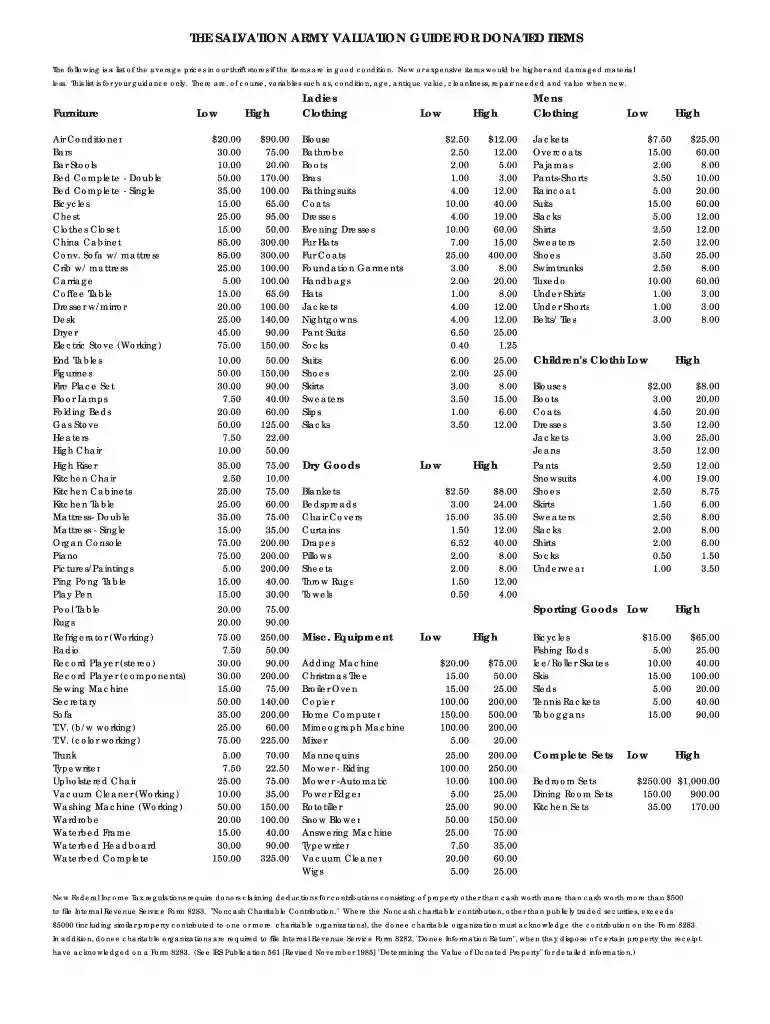
Salvation valuation form 2026

Get Form
salvation army donation guide Preview on Page 1

Here's how it works

01. Edit your salvation army donation guide online
Type text, add images, blackout confidential details, add comments, highlights and more.

02. Sign it in a few clicks
Draw your signature, type it, upload its image, or use your mobile device as a signature pad.

03. Share your form with others
Send printable donation value guide 2023 via email, link, or fax. You can also download it, export it or print it out.

Definition and Purpose of the Salvation Valuation Form

The salvation valuation form, often associated with charitable donations, is utilized primarily to assess the value of items donated to organizations such as The Salvation Army. This form is crucial for both the donors and the charitable organizations, as it serves to document and provide a standardized method for valuing donated goods. Donors typically require an accurate valuation of their donations for tax purposes, particularly when claiming deductions on their federal tax returns.

The primary purpose of this form is to ensure that donors can substantiate the value of their noncash contributions. The Internal Revenue Service (IRS) requires that all charitable donations be reported with a fair market value, which can be complex depending on the types of items donated. Thus, the salvation valuation form acts as a guide, offering specific values for various categories of goods, aiding donors in reporting accurate figures.

How to Complete the Salvation Valuation Form

To effectively complete the salvation valuation form, follow these steps:

  1. Gather Donated Items: Compile all items intended for donation, including clothing, furniture, appliances, and other goods.
  2. Utilize Valuation Guides: Reference a valuation guide, such as The Salvation Army donation guide, to select appropriate values for each item. This guide includes average prices for items in good condition and is essential for ensuring the accuracy of your reported values.
  3. Fill Out Required Information: Input personal information, such as your name, address, and the date of the donation, along with a detailed list of items and their respective values.

Important Considerations for Completing the Form

  • Condition of Items: Ensure that the condition of each item is clearly noted, as this impacts its value significantly.
  • Required Signatures: If applicable, ensure that you obtain any necessary signatures from the charitable organization acknowledging receipt and acceptance of the items.

By following these steps, donors can complete the form accurately, enhancing the simplicity of reporting for tax purposes.

Legal Use of the Salvation Valuation Form

The legal use of the salvation valuation form is primarily associated with IRS compliance. The IRS allows taxpayers to claim deductions for charitable contributions, provided they adhere to specific regulations. This form should be maintained with tax records as evidence of the donation's value if your noncash contributions exceed $500.

IRS Guidelines on Valuing Donations

  • Fair Market Value: Donations must be valued at fair market value, defined as the price that the donated item would sell for on the open market.
  • Documentation Requirement: For items over $250, donors are required to have written acknowledgment from the charitable organization, specifying the amount and date of the contribution.

Proper completion and preservation of the salvation valuation form safeguard donors against potential disputes with the IRS regarding the legitimacy of their deducted amounts.

Key Elements of the Salvation Valuation Form

Understanding the key elements of the salvation valuation form is integral for accurate completion and submission. These elements include:

  • Donor Information: Names, addresses, and contact details of donors.
  • Item Descriptions: Detailed categories and descriptions of donated items, categorized by type.
  • Valuation Information: Fair market values as outlined in the donation value guide.
  • Acknowledgment Receipt: A section for the charitable organization to provide written acknowledgment of the donation.

Each part plays a vital role in ensuring that the donation is properly documented and tax-deductible.

Importance of Accurate Valuation for Donations

Accurate valuation of donated items holds significant importance for both donors and charitable organizations. Here are several reasons:

  • Maximizing Tax Benefits: Donors can maximize their tax deductions by accurately reporting the value of their donations based on established guidelines.
  • Transparency: Providing a clear record of donated items fosters transparency between donors and organizations, helping maintain trust.
  • Organizational Accountability: Charitable organizations can keep accurate records of donations received, essential for both financial reporting and compliance with tax regulations.

An accurate and well-documented salvation valuation form ensures that the donation process remains trustworthy and beneficial for all parties involved.

Examples of Using the Salvation Valuation Form

Practical scenarios exemplifying the use of the salvation valuation form can clarify its application:

  1. Clothing Donation: A donor preparing to give a large box of gently used clothing checks the value using The Salvation Army donation guide, lists each item on the valuation form, and specifies their conditions, ensuring a fair market value is established.

  2. Furniture Contribution: For a sofa and several chairs, the donor references the valuation guide’s furniture section, logs the items on the form, and attaches the form to their tax documents when filing for deductions.

These examples highlight how the form simplifies the donation process, facilitating honest reporting and compliance with IRS guidelines.

Who Typically Uses the Salvation Valuation Form

The salvation valuation form is used by a diverse group of individuals and organizations. Primarily, it is intended for:

  • Individual Donors: People donating items for tax deductions.
  • Charitable Organizations: Entities like The Salvation Army that require documentation for items received.
  • Tax Professionals: Experts assisting clients with proper reporting for noncash donations on tax filings.

Understanding the various users of the salvation valuation form helps clarify its purpose and reinforces its utility in both personal and organizational practices.


decoration image ratings of Dochub

See more salvation valuation form versions

We've got more versions of the salvation valuation form form. Select the right salvation valuation form version from the list and start editing it straight away!
Versions Form popularity Fillable & printable
2013 4.5 Satisfied (62 Votes)
2004 4.9 Satisfied (32 Votes)
be ready to get more

Complete this form in 5 minutes or less

Get form

Got questions?

We have answers to the most popular questions from our customers. If you can't find an answer to your question, please contact us.
Contact us
Substantiation. If you want to take a charitable contribution deduction on your income-tax return, you need to substantiate your gifts. You must have the charitys written acknowledgment for any charitable deduction of $250 or more.
The are basically four ways to determine FMV: Selling price or cost. The price at which an asset that has recently been bought or sold can be a solid indicator of the assets FMV. Sales of comparable assets. Price of replacement. Expert opinion.
Its 23% overhead spending means that for every dollar donated, 77 cents are available to go to the cause.
In general, the Salvation Army Thrift Stores cannot accept: Any appliances that have mechanical difficulties, missing power cord or is rusty or dirty. Large console model televisions and stereos. Televisions older than 5 years. Built in appliances (Ovens, Stoves, Dishwashers, microwave etc.)
How much can I deduct for household items and clothing? You can deduct the amount based on a percentage of your Adjusted Gross Income. The fair market value of donated items in good or used condition can be claimed as a deduction on your tax return. You can claim a deduction of up to 60% of your Adjusted Gross Income.

Security and compliance

At DocHub, your data security is our priority. We follow HIPAA, SOC2, GDPR, and other standards, so you can work on your documents with confidence.

Learn more
ccpa2
pci-dss
gdpr-compliance
hipaa
soc-compliance

People also ask

How much can you deduct for the gently used goods you donate to Goodwill? The IRS allows you to deduct fair market value for gently-used items. The quality of the item when new and its age must be considered. The IRS requires an item to be in good condition or better to take a deduction.
Physical property: You could also donate property like cars, boats, furniture, food, clothing, and other goods a charity might need. For household items like furniture and clothing in good used condition, you cannot deduct more than $500 without an appraisal.
For noncash (in-kind) donations, most of the time its the fair market value (FMV) of the item. But if the FMV is higher than the amount you paid, you must use the original cost of the item. You can get the FMV of your donation by looking at similar items for sale on eBay, Craigslist, or your local thrift store.

printable donation value guide 2023 pdf