How to wa comprehensive assessment 2026

Get Form
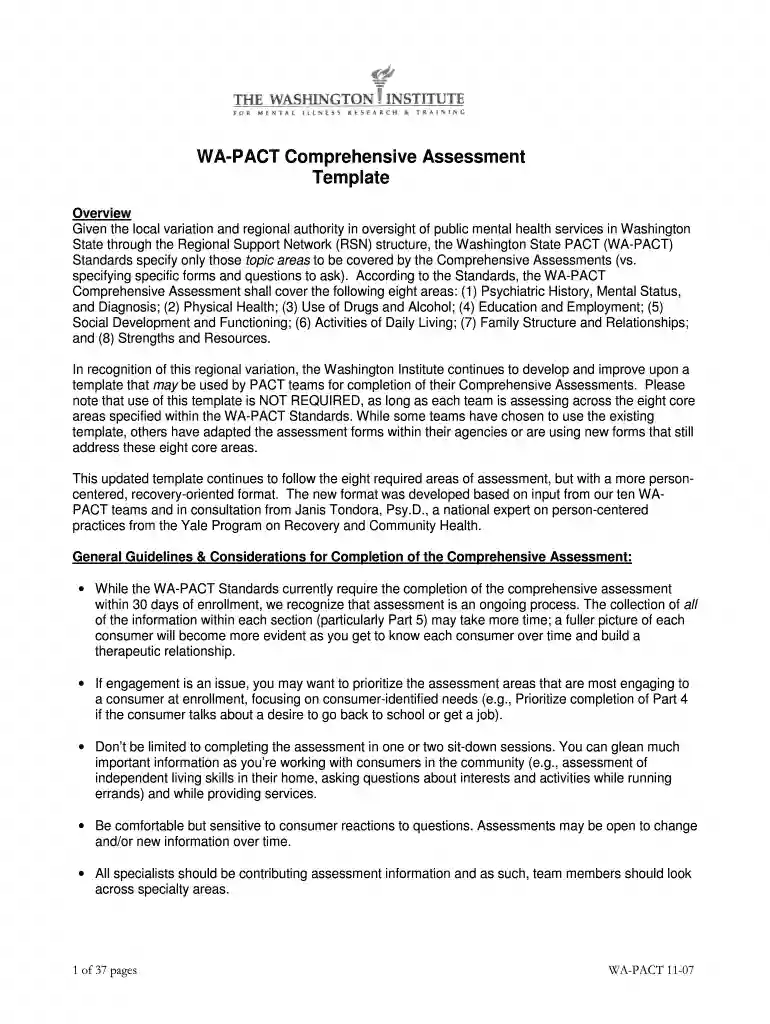
pact wa Preview on Page 1

Here's how it works

01. Edit your pact wa online
Type text, add images, blackout confidential details, add comments, highlights and more.

02. Sign it in a few clicks
Draw your signature, type it, upload its image, or use your mobile device as a signature pad.

03. Share your form with others
Send wa pact via email, link, or fax. You can also download it, export it or print it out.

How to use or fill out the WA-PACT Comprehensive Assessment with our platform

Form edit decoration
9.5
Ease of Setup
DocHub User Ratings on G2
9.0
Ease of Use
DocHub User Ratings on G2
  1. Click ‘Get Form’ to open it in the editor.
  2. Begin with Part 1: Mental Health & Psychiatric Symptoms. Fill in your psychiatric history, including symptoms and coping strategies. Be honest about barriers and goals.
  3. Proceed to Part 2: Physical Health. Document any medical concerns, current medications, and family health history. This section is crucial for understanding overall well-being.
  4. In Part 3: Use of Drugs or Alcohol, reflect on how substances affect your life. Answer the assessment questions thoughtfully to provide a clear picture of your situation.
  5. Continue to Parts 4 through 8, addressing finances, employment, social development, daily living activities, family relationships, and personal strengths. Take your time; these sections are vital for a comprehensive view.
  6. Utilize direct quotes from clients where possible to enhance accuracy in assessments throughout the form.

Start filling out your WA-PACT Comprehensive Assessment today for free using our platform!

See more how to wa comprehensive assessment versions

We've got more versions of the how to wa comprehensive assessment form. Select the right how to wa comprehensive assessment version from the list and start editing it straight away!
Versions Form popularity Fillable & printable
2007 4.9 Satisfied (443 Votes)
be ready to get more

Complete this form in 5 minutes or less

Get form

Got questions?

We have answers to the most popular questions from our customers. If you can't find an answer to your question, please contact us.
Contact us
Five steps to completing assessments Analyse. The key to understanding the writing requirements of any assignment topic is to identify the instruction words and keywords. Brainstorm and research. Organise and plan. Write. Edit.
In conclusion, a comprehensive assessment is a thorough evaluation process that encompasses various methods to gauge a students knowledge, skills, and competencies. It provides a holistic view of a learners progress by integrating multiple assessment types, such as formative, summative, and diagnostic assessments.
A comprehensive system includes different types of assessment tools and processes, used for different purposes at different levels of the system: national, state, district, school, and classroom.
Physical Examination A comprehensive physical examination is conducted to assess various bodily systems, including cardiovascular, respiratory, musculoskeletal, and neurological systems. This examination typically includes measuring vital signs such as blood pressure, heart rate, and body mass index (BMI).
A comprehensive health assessment addresses the patients lifestyle and physical and mental health. The three basic steps in the assessment include a general health survey, the patients medical history, and a head-to-toe physical examination.

Security and compliance

At DocHub, your data security is our priority. We follow HIPAA, SOC2, GDPR, and other standards, so you can work on your documents with confidence.

Learn more
ccpa2
pci-dss
gdpr-compliance
hipaa
soc-compliance
be ready to get more

Complete this form in 5 minutes or less

Get form

People also ask

A Comprehensive Screening and Assessment System is the coordinated effort of gathering information across multiple measures to support decision making at the system and student level for the whole child.
A comprehensive assessment is a complete, head-to-toe physical examination, and should be done when first encountering your patient or when changes to their health status occur. Methods of comprehensive assessment include inspection, percussion, palpation, and auscultation.

wcap portal