




01. Edit your ua 5498 online
Type text, add images, blackout confidential details, add comments, highlights and more.

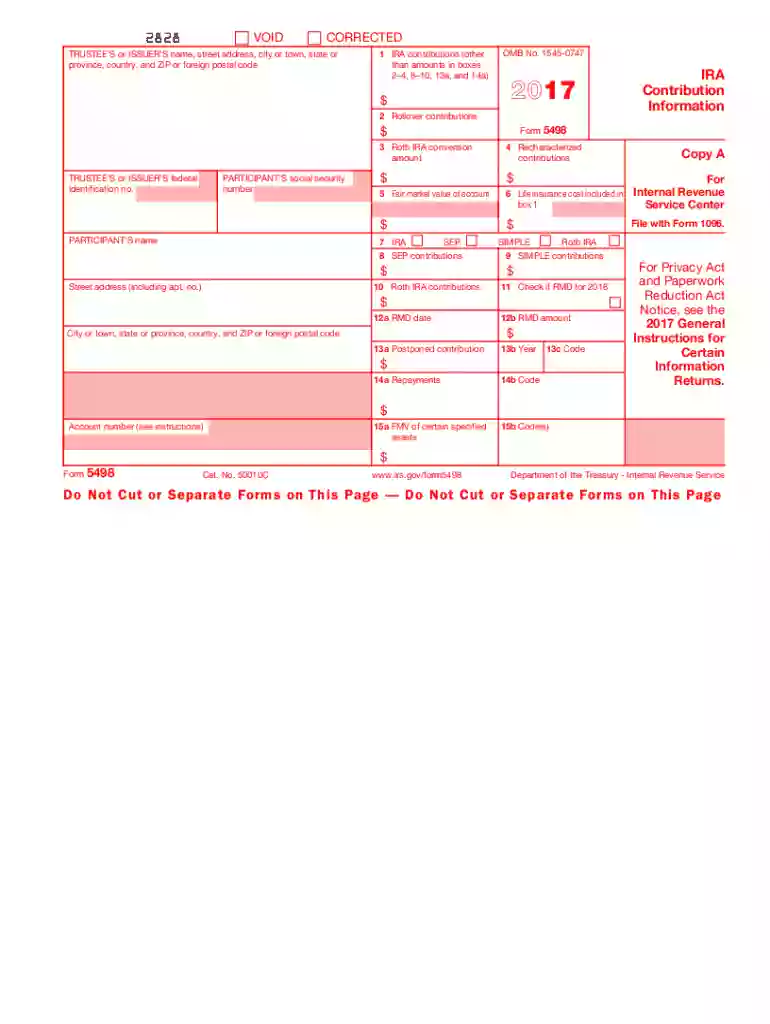
Type text, add images, blackout confidential details, add comments, highlights and more.

Draw your signature, type it, upload its image, or use your mobile device as a signature pad.

Send 2017 form 5498 via email, link, or fax. You can also download it, export it or print it out.
IRS Form 5498 is used to report contributions, including rollovers, to individual retirement arrangements (IRAs) to the Internal Revenue Service (IRS). The form details the amounts that have been contributed to an individual's IRA account throughout the tax year, which includes traditional IRAs, Roth IRAs, SEP IRAs, and SIMPLE IRAs. It provides important information regarding required minimum distributions (RMDs) and fair market value (FMV), ensuring tax compliance for both the account holder and the IRS.
Completing IRS Form 5498 involves several critical steps:
Identify Account Information: Ensure that the account number and the pertinent details of the account owner are correctly inputted. Double-check the taxpayer identification number and address for accuracy and consistency.
Report Contributions: Include all contributions made to the IRA account within the tax year, such as regular contributions, rollover amounts, and conversion amounts.
Detail Distribution Information: If applicable, report the necessary RMDs designated for the account holder who reached the age of RMD by the end of the tax year.
Calculate Fair Market Value: Accurately report the FMV of the IRA as of December 31 of the tax year. This ensures transparency in account valuation for IRS purposes.
Check for Accuracy: Review all entries on the form for accuracy. Any discrepancies should be aligned with the financial records maintained by the IRA custodian.
One of the key aspects of IRS Form 5498 is adhering to the prescribed filing deadlines to avoid penalties. The form must be furnished to the IRS and the account holder by May 31 of the year following the tax year to which it pertains. The deadline accounts for the typical due date for contributions to be made to IRAs for the prior year, which ends on the regular filing date for taxes, typically April 15.
Form 5498 is primarily utilized by custodians and trustees of IRAs to report contributions made by or on behalf of account holders. The individual taxpayers – the IRA account holders – benefit from receiving this form as it assists them in verifying contributions for personal tax returns, ensuring that contributions are within allowable limits, and providing a record for future financial planning.
The Form 5498 carries significant legal implications, as it verifies adherence to IRS regulations regarding IRA contributions and related tax benefits. It helps in determining eligibility for deductions and substantiating contributions for tax credit claims. The legal requirement necessitates accurate reporting since inaccuracies could result in penalties, audits, or disqualification of tax advantages.
Form 5498 is composed of several key sections such as:
The IRS provides specific guidelines ensuring that this form is completed correctly:
The process of completing and filing Form 5498 can be streamlined using various tax preparation software, such as TurboTax and QuickBooks, which are often compatible with official IRS forms. The completed Form 5498 can be submitted electronically to the IRS through the Filing Information Returns Electronically (FIRE) system, ensuring fast, secure transmission. Alternatively, it can be mailed using IRS-approved methods, keeping deadlines in mind to avoid late submission penalties.
Failure to file a correct Form 5498 by the due date, or supplying it incomplete or with inaccuracies, may result in penalties from the IRS. These penalties may include financial fines and increased scrutiny during audits. Accurate completion and timely submission are imperative to comply with IRS regulations and avoid unnecessary fines.
Consider an example where an individual made a $5,000 contribution to a Roth IRA and received a $2,000 rollover from another plan. The form will detail these amounts to ensure compliance with contribution limits and accurate tax reporting. Another scenario involves tracking the required minimum distribution for an account holder turning 72 who must withdraw a specific amount to meet IRS retirement requirements.
We've got more versions of the ua 5498 form. Select the right ua 5498 version from the list and start editing it straight away!
| Versions | Form popularity | Fillable & printable |
|---|---|---|
| 2025 | 4.9 Satisfied (40 Votes) | |
| 2024 | 4.8 Satisfied (51 Votes) | |
| 2023 | 4.4 Satisfied (59 Votes) | |
| 2022 | 4.3 Satisfied (47 Votes) | |
| 2021 | 4.8 Satisfied (88 Votes) | |
| 2020 | 4.4 Satisfied (203 Votes) | |
| 2019 | 4.3 Satisfied (176 Votes) | |
| 2018 | 4.1 Satisfied (74 Votes) | |
| 2017 | 4.5 Satisfied (21 Votes) | |
| 2017 | 4.2 Satisfied (54 Votes) | |
| 2016 | 4.4 Satisfied (94 Votes) | |
| 2015 | 4.1 Satisfied (42 Votes) | |
| 2014 | 4.2 Satisfied (30 Votes) | |
| 2013 | 4.2 Satisfied (69 Votes) | |
| 2012 | 4 Satisfied (28 Votes) |
At DocHub, your data security is our priority. We follow HIPAA, SOC2, GDPR, and other standards, so you can work on your documents with confidence.
May 8, 2019 Form 5498-SA -- which shows the total amount of contributions made to an HSA from any source for the previous plan year (2018 in this case)
Feb 8, 2018 An ABLE program issues this form to you to re- port all distributions made from your ABLE account. Form 5498-QA, ABLE Account Contribution InforRead more
The information on Form 5498 is submitted to the Internal Revenue Service by the trustee or issuer of your individual retirement arrangement (IRA) to report.Read more


