




01. Edit your 1901 bir form online
Type text, add images, blackout confidential details, add comments, highlights and more.

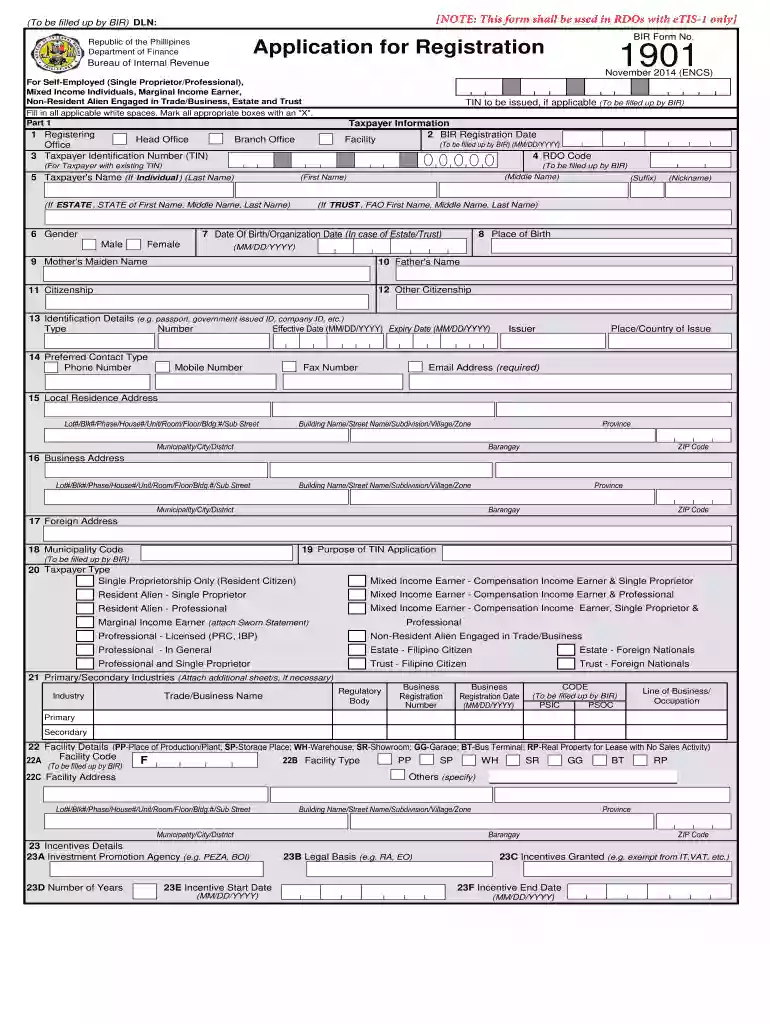
Type text, add images, blackout confidential details, add comments, highlights and more.

Draw your signature, type it, upload its image, or use your mobile device as a signature pad.

Send bir form 1901 via email, link, or fax. You can also download it, export it or print it out.
BIR Form 1901 is a crucial document in the Philippines, particularly for self-employed individuals, mixed-income earners, non-resident aliens engaged in business, estates, and trusts. This form is primarily utilized for the application of registration with the Bureau of Internal Revenue (BIR).
The purpose of BIR Form 1901 is to provide essential taxpayer information necessary for proper registration, including personal details, business addresses, tax types, and supporting documents.
Filling out BIR Form 1901 requires attention to detail to ensure accuracy. Follow these steps to complete the form effectively:
Gather Required Information:
Fill in Personal Information:
Specify Business Activity:
Review and Validate Information:
Sign and Submit:
Understanding the key elements of BIR Form 1901 helps ensure a smoother registration process. The following components are essential:
Personal Details Section:
Tax Classification Information:
Business Details:
Signature Block:
When filling out BIR Form 1901, specific documents must accompany your application to support the information you provide:
Identification Documents:
Proof of Business:
Taxpayer Identification:
Collecting these documents beforehand can speed up the registration process with the BIR.
Different taxpayer scenarios can influence the completion and submission of BIR Form 1901. Here are some typical instances:
Self-Employed Individuals:
Mixed-Income Earners:
Non-Residents:
This form serves as an essential tool to ensure compliance and appropriate tax assessment across varying taxpayer situations.
When considering how to submit BIR Form 1901, it is essential to know the choices available regarding the format in which you can file:
Paper Submission:
Digital Submission:
Using the appropriate submission method will depend on personal preference and specific BIR requirements.
Understanding the penalties associated with the failure to complete or submit BIR Form 1901 is essential for all taxpayers:
Late Registration Penalties:
Consequences of Incorrect Information:
Awareness of these penalties can motivate timely and accurate completion of BIR Form 1901.
To assist with clarity, reviewing filled-out examples of BIR Form 1901 can illustrate how to navigate the specifics of the document:
Sample Scenario for a Freelance Graphic Designer:
Example for a Retail Business Owner:
Utilizing established examples can provide invaluable insight, reducing errors when submitting your own BIR Form 1901.
We've got more versions of the 1901 bir form form. Select the right 1901 bir form version from the list and start editing it straight away!
Yes, a typed name is recognized as a legitimate electronic signature when you create it on your form utilizing a compliant solution like DocHub. Simply add your bir 1901 form to our editor, click Sign in the top tool pane → Create your signature → Type your name in the appropriate tab, and choose how it will look on your document.
You may complete and eSign your 1901 bir form purpose on the internet, even on a tight deadline. All you need to access top-notch editing instruments on any device is a DocHub profile, which you can register within a couple of moments. Once you register, upload your document or find what you are searching for in our catalog, complete it utilizing the editing instruments you need, and put your electronic signature on it at the end.
At DocHub, your data security is our priority. We follow HIPAA, SOC2, GDPR, and other standards, so you can work on your documents with confidence.
Forms (Including Standard Contracts) ; UM 1590, Accounts Payable and Unrecorded Expenses Reporting Form (xlsx) Form info ; UM1684, Accounts Receivable PaymentRead more
1901 It is strongly recommended that you add your employees in alphabetical order to aid in searching on the Payroll Form Select Employee dropdown.Read more


