Interview rating form 2026

Get Form
interview rating scale example Preview on Page 1

Here's how it works

01. Edit your interview rating scale example online
Type text, add images, blackout confidential details, add comments, highlights and more.

02. Sign it in a few clicks
Draw your signature, type it, upload its image, or use your mobile device as a signature pad.

03. Share your form with others
Send interview rating sheet comments via email, link, or fax. You can also download it, export it or print it out.

Definition and Meaning of the Interview Rating Form

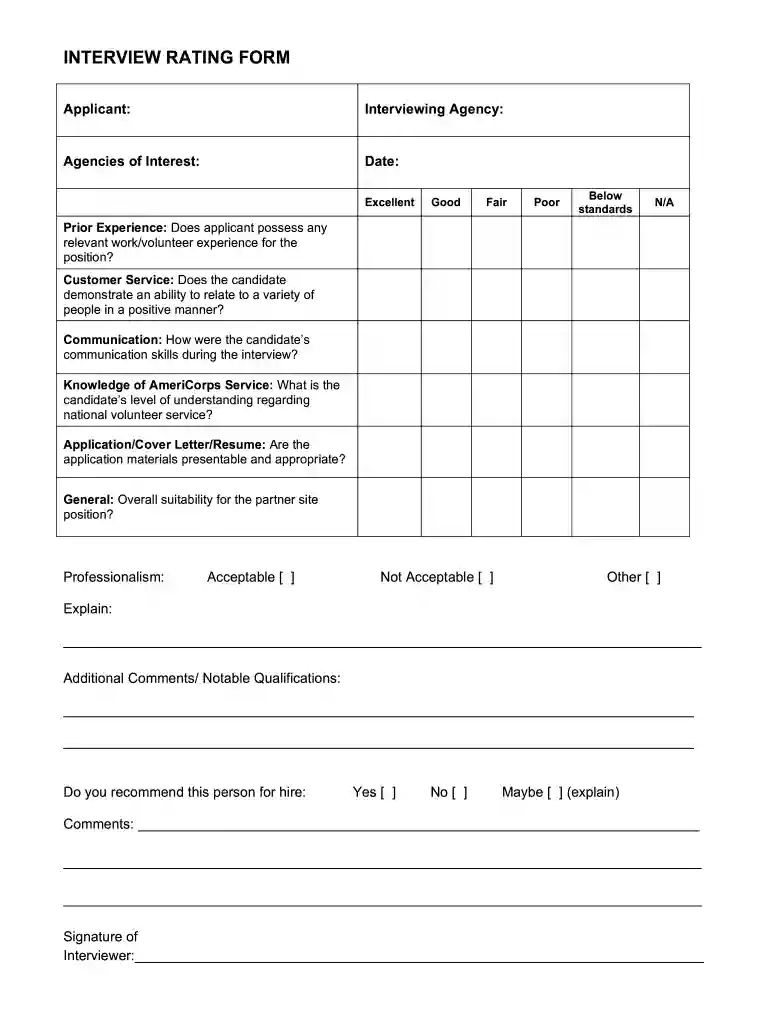
The interview rating form is a structured tool used by hiring organizations to assess the performance and qualifications of candidates during the interview process. This form typically includes a rating scale to evaluate various aspects of a candidate's fit for the position. Key focus areas often include:

  • Prior Experience: Evaluates the relevance and depth of the candidate's work history in relation to the position.
  • Customer Service Skills: Assesses the candidate’s ability to interact positively with customers and manage inquiries or complaints effectively.
  • Communication Abilities: Measures verbal and written communication skills, along with interpersonal interactions during the interview.
  • Knowledge of AmeriCorps Service: For positions related to AmeriCorps, this section gauges the candidate's familiarity with the program and its requirements.
  • Overall Professionalism: An overall assessment focusing on the candidate's demeanor, attire, and attitude throughout the interview process.

By quantifying these attributes, hiring managers can make more informed decisions when selecting candidates for roles within their organizations.

Key Elements of the Interview Rating Form

A comprehensive interview rating form typically consists of several critical components. Each element plays a pivotal role in evaluating candidates uniformly and effectively. Important components include:

  • Rating Scale: A numerical or descriptive scale that allows interviewers to provide consistent feedback on candidate responses and behaviors, often ranging from one (poor) to five (excellent).
  • Candidate Information Section: Provides space for basic details such as the candidate’s name, interview date, and position applied for.
  • Evaluator Information: Identifies the interviewer, which can help in collecting feedback from multiple assessors and ensures accountability.
  • Comments Section: Space reserved for additional notes, observations, and recommendations that may not be captured by the numerical rating, adding qualitative insights to the evaluation.

These elements are designed to facilitate a thorough and systematic assessment process, promoting clarity and consistency in candidate evaluations.

How to Use the Interview Rating Form

Using the interview rating form effectively requires careful planning and execution throughout the interview process. The steps typically include:

  1. Prepare Before the Interview: Familiarize yourself with the rating criteria set forth in the form. Review job descriptions and desired qualifications to align your evaluation criteria.
  2. Conduct the Interview: Engage with the candidate in a structured discussion, ensuring that you explore each pertinent topic. Take note of observations related to each rating criterion.
  3. Complete the Rating Form Immediately After: While the interview is fresh in your mind, fill out the form. Use the rating scale to assess the candidate’s performance on each criterion and provide specific comments that support your ratings.
  4. Review and Finalize the Form: After completing the ratings, review your comments and scores. Ensure your evaluations reflect a fair and honest assessment of the candidate’s abilities.

This structured approach ensures that every candidate is evaluated on equal footing, and helps mitigate biases that can arise during the interview process.

Who Typically Uses the Interview Rating Form

Various stakeholders in the recruitment process find the interview rating form beneficial. Individuals and entities that typically utilize this form include:

  • Hiring Managers: They use the form to systematically gauge candidates against specific job requirements and objectives.
  • Human Resources Personnel: HR teams often rely on these forms for standardization across candidate evaluations, particularly when coordinating panels of interviewers.
  • Interview Panels: Groups of interviewers may collaboratively use the form to consolidate evaluations, making it easier to reach a consensus on candidate suitability.
  • Recruitment Agencies: Agencies may implement interview rating forms for various client assessments to ensure they present well-evaluated candidates to employers.

This tool enhances the overall interview experience for all parties by ensuring a fair review process.


decoration image ratings of Dochub

Examples of Using the Interview Rating Form

The application of the interview rating form can vary based on the specific context and desired outcomes of an organization. Here are a few practical examples:

  • Nonprofit Organizations: A nonprofit seeking AmeriCorps members might use a tailored interview rating form that emphasizes community service experience and commitment to mission-driven work.
  • Corporate Hiring: A large corporation evaluating candidates for customer service roles might have a more detailed form, focusing on technical skills alongside traditional soft skills like communication and teamwork.
  • Educational Institutions: Schools hiring for administrative roles could utilize the interview rating form to assess candidates’ knowledge of educational policies and procedures, ensuring alignment with institutional goals.

In each example, the interview rating form adapts to meet the needs of the organization while maintaining key evaluative criteria.

Important Terms Related to the Interview Rating Form

Understanding the terminology surrounding the interview rating form can enhance its effectiveness and implementation. Key terms include:

  • Applicant Tracking System (ATS): Software used by organizations to streamline the hiring process, where interview rating forms may be integrated for ease of evaluation.
  • Scoring Rubric: A guide detailing how to interpret the ratings on the form, providing clarity on what constitutes a score at each level of the rating scale.
  • Feedback Loop: A process where interviewers discuss their evaluations to provide a comprehensive understanding of candidate strengths and weaknesses.

Familiarity with these terms can aid interviewers in navigating the complexities of the selection process and using the rating form to its fullest potential.

See more interview rating form versions

We've got more versions of the interview rating form form. Select the right interview rating form version from the list and start editing it straight away!
Versions Form popularity Fillable & printable
2010 4.6 Satisfied (67 Votes)
be ready to get more

Complete this form in 5 minutes or less

Get form

Got questions?

We have answers to the most popular questions from our customers. If you can't find an answer to your question, please contact us.
Contact us
Here are a few examples: Your responses were well thought out, but sometimes they seemed brief. You mentioned some impressive skills you acquired throughout the interview. Though your resume is impressive, it would be beneficial to alter it ing to the post you are applying to.
A rating scale is the basis on which all candidates are evaluated. An interview rating scale can provide a quantitative basis for comparison between interviewers, enabling you to validate your perceptions with your colleagues and learn where your ratings may be outside of the norm.
Dear [Interviewers Name], I hope you are doing well. My name is [Your Name], and I recently interviewed for the [Job Position] at [Company Name] on [Interview Date]. I wanted to take a moment to express my gratitude for the opportunity to meet with you and learn more about the exciting projects at [Company Name].
Be Honest: Choose a rating that reflects your true self-assessment. Avoid inflating your abilities. Provide Context: Explain why you chose that rating. Highlight your strengths and areas for improvement. Show Growth Mindset: Emphasize your willingness to learn and develop.
Interview feedback questions In what areas of the interview did I do well? In what areas of the interview can I improve? If you were the actual interviewer, would you recommend me for more interviews? What 3 adjectives would you use to describe your impression of me during this interview and why?

Security and compliance

At DocHub, your data security is our priority. We follow HIPAA, SOC2, GDPR, and other standards, so you can work on your documents with confidence.

Learn more
ccpa2
pci-dss
gdpr-compliance
hipaa
soc-compliance

People also ask

Heres a breakdown to guide you in providing feedback thats actually useful for the candidate and reflects well on your company. Be Honest and Direct. Highlight Strengths Clearly. Offer Constructive Suggestions. Choose the Right Medium for Feedback. Be Prompt and Prepared.
Creating an interview evaluation form in 6 steps Clearly define the job role and its requirements. Refer to your organizations job description and roles and responsibilities template to understand the skills, qualifications, and experiences needed. Consider technical skills, soft skills, and cultural fit.
What to include in your interview feedback Take a clear stance: To hire or not? Describe your experience with the candidate. Include notes on each criterion for hiring. Keep in mind dos and donts. Use a scoring sheet. Indeed interview notes feedback. Expand on your responses. Be inclusive.

Related links