




01. Edit your form 8938 pdf online
Type text, add images, blackout confidential details, add comments, highlights and more.

Type text, add images, blackout confidential details, add comments, highlights and more.

Draw your signature, type it, upload its image, or use your mobile device as a signature pad.

Send it via email, link, or fax. You can also download it, export it or print it out.
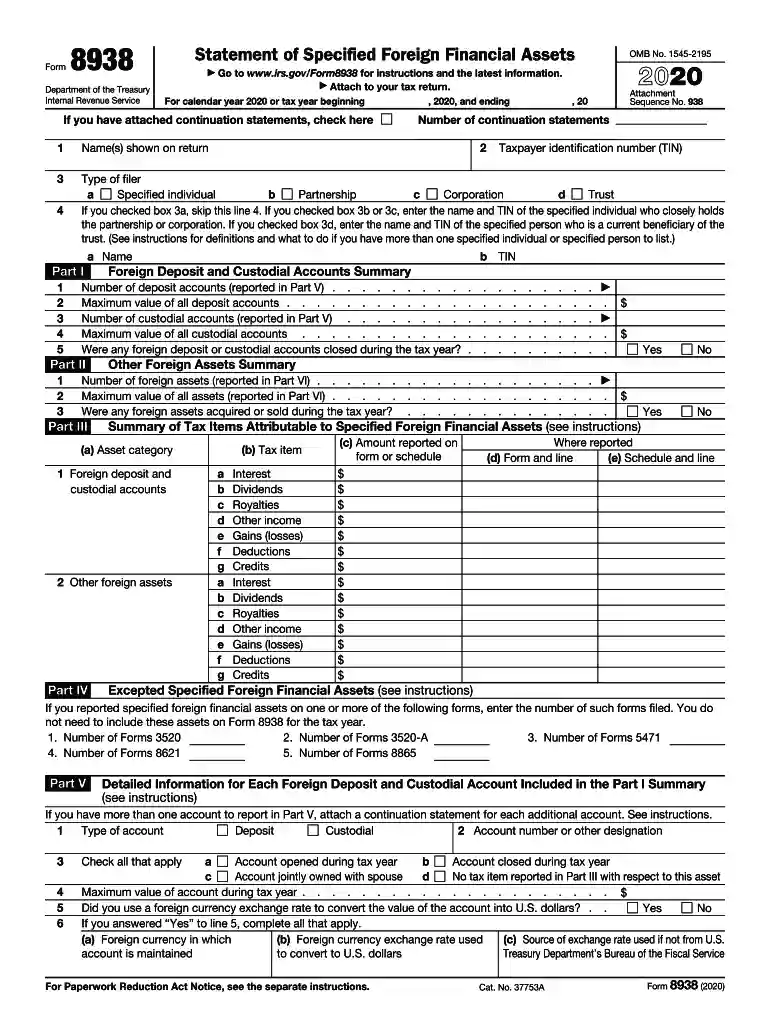
Form 8938, officially titled "Statement of Specified Foreign Financial Assets," is a critical document for U.S. taxpayers who hold foreign financial assets. This form is used to report these assets to the Internal Revenue Service (IRS) and ensure compliance with U.S. tax laws. It requires detailed information about foreign deposit and custodial accounts and other foreign assets, including their maximum values and any transactions during the year. The goal is to enhance transparency and prevent tax avoidance through undisclosed overseas accounts.


Form 8938 is primarily used by specified individuals, including U.S. citizens, resident aliens, and certain non-resident aliens, who have an interest in specified foreign financial assets. The obligation to file also extends to domestic entities such as partnerships, corporations, and trusts. Eligibility thresholds vary based on filing status and whether a taxpayer lives in the U.S. or abroad:
Form 8938 consists of several critical sections that taxpayers must complete accurately to avoid penalties:
Completing Form 8938 involves several meticulous steps. Each requires an understanding of the categories and details that must be reported:
Form 8938 is submitted along with your annual federal income tax return, following the standard tax year deadlines. For most individual taxpayers, this deadline is April 15. Extensions to file can be requested, potentially moving the due date to October 15; however, filing Form 8938 late or failing to file incurs substantial penalties, so timely submission is crucial.
Failure to file Form 8938 or providing incomplete or inaccurate information may result in strict penalties enforced by the IRS. The non-compliance penalty starts at $10,000, with an additional $10,000 for each 30 days of non-filing after receiving an IRS notice, up to a maximum of $50,000. Underreporting assets may result in further penalties, including a 40% penalty of the understatement of tax due to undisclosed foreign financial assets.
The IRS has outlined specific guidelines to help taxpayers comply with Form 8938 requirements, emphasizing the importance of accurate reporting of foreign financial assets. According to these guidelines, transparency is key, and taxpayers are encouraged to consult IRS resources or seek professional tax advice to ensure full compliance. The IRS provides FAQs and additional documentation to assist in understanding and fulfilling the obligations associated with Form 8938.
Various tax preparation software, including popular options like TurboTax and QuickBooks, support Form 8938. These platforms facilitate the accurate completion and submission of the form by guiding users through the required fields and complex calculations, reducing the risk of errors. Proper integration ensures that the software complies with the latest IRS guidelines, helping taxpayers manage their foreign asset reporting efficiently and accurately.
We've got more versions of the form 8938 pdf form. Select the right form 8938 pdf version from the list and start editing it straight away!
| Versions | Form popularity | Fillable & printable |
|---|---|---|
| 2021 | 4.8 Satisfied (53 Votes) | |
| 2020 | 4.4 Satisfied (75 Votes) | |
| 2019 | 4.2 Satisfied (96 Votes) | |
| 2018 | 4.3 Satisfied (56 Votes) | |
| 2017 | 4.4 Satisfied (63 Votes) | |
| 2016 | 4.3 Satisfied (48 Votes) | |
| 2015 | 4 Satisfied (59 Votes) | |
| 2014 | 4.3 Satisfied (66 Votes) | |
| 2013 | 4 Satisfied (36 Votes) | |
| 2012 | 4 Satisfied (51 Votes) | |
| 2011 | 4 Satisfied (35 Votes) |
At DocHub, your data security is our priority. We follow HIPAA, SOC2, GDPR, and other standards, so you can work on your documents with confidence.
A specified person that has any interest in a specified foreign financial asset during the taxable year must attach Form 8938, Statement of Specified ForeignRead more
Form 8938 (FATCA) Threshold (living abroad): $200,000 end of year or $300,000 at any time What to report: Foreign accounts, foreign stocks, foreignRead more
Jan 23, 2026 Use Form 8938 to report your specified foreign financial assets if the total value of all the specified foreign financial assets in which youRead more


