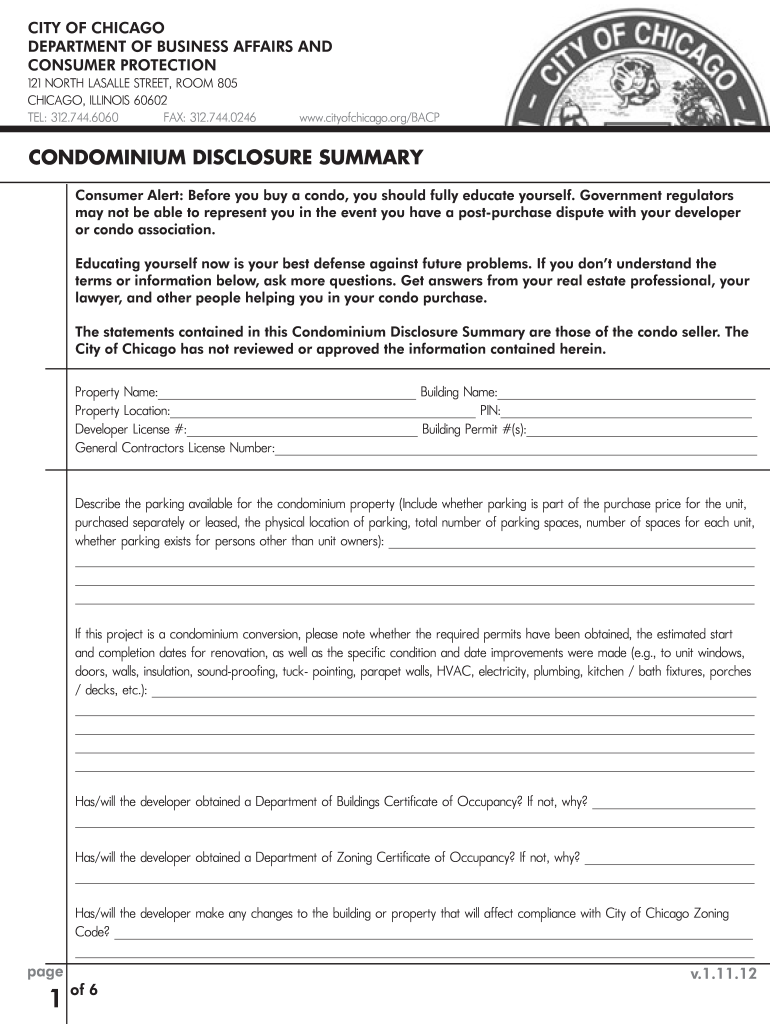
CONDOMINIUM DISCLOSURE SUMMARY - City of Chicago - cityofchicago 2026

Get Form
section 9 1 a of the illinois condominium property act Preview on Page 1

Here's how it works

01. Edit your section 9 1 a of the illinois condominium property act online
Type text, add images, blackout confidential details, add comments, highlights and more.
02. Sign it in a few clicks
Draw your signature, type it, upload its image, or use your mobile device as a signature pad.
03. Share your form with others
Send homeowners association audit chicago via email, link, or fax. You can also download it, export it or print it out.

How to use or fill out CONDOMINIUM DISCLOSURE SUMMARY - City of Chicago

Form edit decoration
9.5
Ease of Setup
DocHub User Ratings on G2
9.0
Ease of Use
DocHub User Ratings on G2
  1. Click ‘Get Form’ to open it in the editor.
  2. Begin by filling in the 'Property Name' and 'Building Name' fields. Ensure that you provide accurate information as this is crucial for identification.
  3. Next, complete the 'Property Location' and 'PIN' sections. This information helps in locating the property within city records.
  4. In the parking section, describe the available parking options, including whether they are included in the purchase price or leased separately.
  5. For condominium conversions, indicate if required permits have been obtained and provide details on renovation timelines and conditions.
  6. Continue through each section, providing detailed responses about construction materials, warranties, amenities, and any restrictions on unit usage.
  7. Finally, review all entries for accuracy before submitting your completed form via email to BACPcondos@cityofchicago.org.

Start using our platform today to fill out your Condominium Disclosure Summary easily and for free!

be ready to get more

Complete this form in 5 minutes or less

Get form

Got questions?

We have answers to the most popular questions from our customers. If you can't find an answer to your question, please contact us.
Contact us
On average, Chicago owners should expect to pay $300-$400 per month in condo fees. Fees and assessments help cover the cost of shared property and amenities, so the more amenities an HOA has to offer and the better its location, the higher the fees will be.
Condominium associations in Chicago are primarily regulated by state law, specifically the Illinois Condominium Property Act (ICPA). This act governs the creation, management and dissolution of condominiums in Chicago and throughout Illinois.
Declaration of Covenants, Conditions and Restrictions, or CCRs The Declaration of Covenants, Conditions and Restrictions, or CCRs, is the primary and most important governing document for a condominium or planned development, and is required for all condominiums and planned developments.
Under Section 19 of the Illinois Condominium Property Act (765 ILCS 605/19), the board of managers for a condo association is required to keep and maintain certain records, or copies of those records, at the associations principal office.
Common issues that condo rules might address Common areas. There will always be a set of rules to determine the use and maintenance of common areas. Noise and nuisances. Garbage disposal. Recreational areas. Vandalism. Operating and parking vehicles. Architectural maintenance.

Security and compliance

At DocHub, your data security is our priority. We follow HIPAA, SOC2, GDPR, and other standards, so you can work on your documents with confidence.

Learn more
ccpa2
pci-dss
gdpr-compliance
hipaa
soc-compliance
be ready to get more

Complete this form in 5 minutes or less

Get form

People also ask

Four types of legal governing documents are typically associated with subdivisions such as condominiums and planned developments: the Declaration of Covenants, Conditions and Restrictions (or CCRs), the Bylaws, the Articles of Incorporation, and the Rules.
What Are HOA Rules and Regulations? HOA Rules and Regulations are a community document that outlines the rules homeowners must follow to participate in the association. Theyre created to cultivate your communitys aesthetic, preserve the value of the property and lay out behavioral guidelines for neighbors.

who is responsible for pipes in condo walls illinois