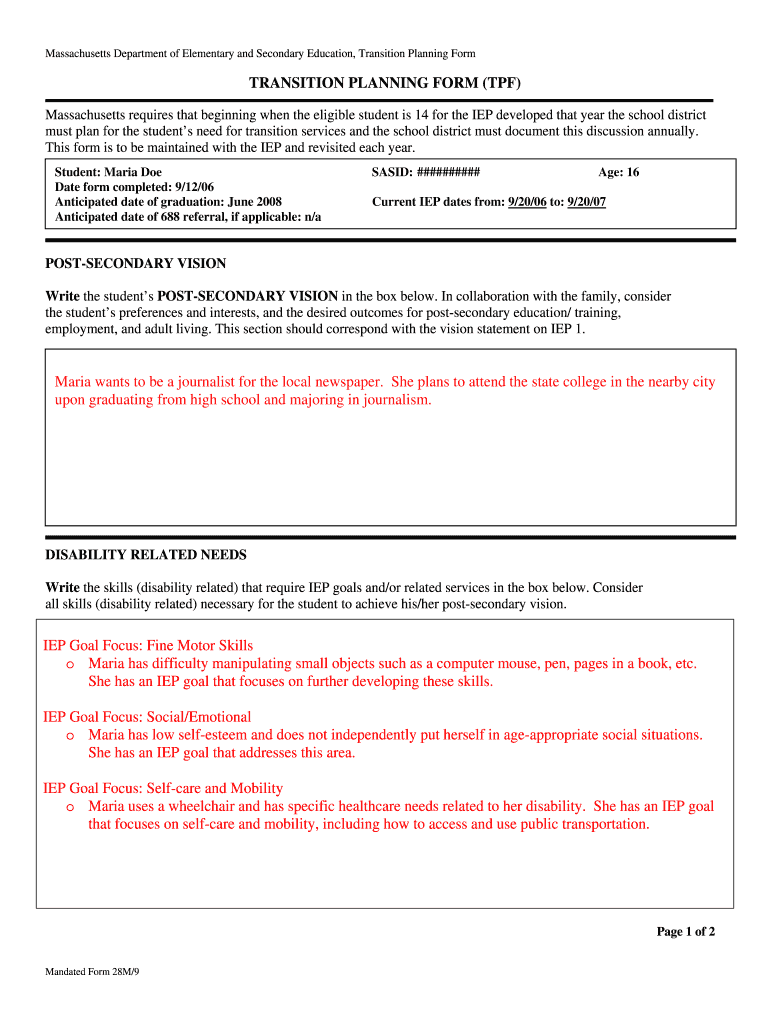







Definition and Meaning of Transition Plan Example IEP
A transition plan example IEP outlines the educational strategy for students with disabilities as they prepare to move from high school to post-secondary life. This legally required component of an Individualized Education Program (IEP) is designed to ensure that students are equipped with the necessary skills, experiences, and support to succeed in their next steps, whether that be further education, employment, or independent living. The plan identifies the student’s goals, needed services, and activities that will facilitate their transition.
Key Components Include:
- Post-secondary Goals: These reflect what the student aspires to achieve after high school, such as pursuing a vocational program or starting a job.
- Present Level of Performance: A summary of the student’s current abilities, strengths, and areas needing improvement.
- Transition Services: Specific activities, such as internships or job training, aimed at addressing the student’s individual needs and goals.
- Course of Study: An educational pathway that aligns with the student's interests and post-secondary goals.
- Individuals Involved: The roles of teachers, counselors, and family members in supporting the student’s transition.
How to Use the Transition Plan Example IEP
To effectively utilize a transition plan example IEP, stakeholders must collaboratively address the unique needs of the student. It serves as a living document that is regularly updated and reviewed. The following steps can ensure proper implementation:
- Collaborative Development: Gather input from the student, family, teachers, and other relevant professionals to ensure the plan reflects the student’s aspirations.
- Goal Setting: Clearly define actionable, measurable goals that are aligned with the student’s interests and required skills.
- Resource Allocation: Identify necessary services and supports, including special education services, community resources, and vocational training.
- Regular Review: Schedule periodic meetings to evaluate the student’s progress and make adjustments to the plan as needed.
An example of using the transition plan could involve a student interested in a culinary career. The transition plan may include goals such as enrolling in a culinary arts program, obtaining part-time work at a local restaurant, and participating in community service related to food service.
Steps to Complete the Transition Plan Example IEP
Creating a transition plan example IEP involves a systematic approach. Key steps include:
- Assess the Student’s Needs: Begin with a thorough evaluation of the student's strengths, weaknesses, preferences, and interests.
- Define Post-secondary Goals: Establish clear outcomes that focus on education, employment, and independent living.
- Identify Transition Activities: List activities that will help achieve these goals, such as job shadowing, skills training, or college preparatory courses.
- Determine Responsible Parties: Specify who will oversee each action item, ensuring accountability among team members.
- Monitor and Reassess: Continuously track the student's progress and revise the plan according to changes in goals or circumstances.
Each aspect of this process must be documented, ensuring clarity and focus for all team members involved.
Important Terms Related to Transition Plan Example IEP
Understanding key terminology related to a transition plan example IEP is essential for effective implementation. Some important terms include:
- IEP: Individualized Education Program, a legal document outlining educational goals and services for students with disabilities.
- Transition Services: A coordinated set of activities designed to facilitate a student’s movement from school to post-school activities.
- Self-Determination: The ability of the student to make choices and decisions about their life, a crucial element in the transition planning process.
- Agency Involvement: Refers to support from various agencies that may provide services or resources, such as vocational rehabilitation.
Educators and families must work together to familiarize themselves with these terms, ensuring effective communication and shared understanding of goals.
Legal Use of the Transition Plan Example IEP
The transition plan example IEP is mandated by the Individuals with Disabilities Education Act (IDEA), which requires that all students with disabilities receive transition planning by the age of 16. Compliance is essential as non-compliance can lead to legal ramifications. Here are vital legal considerations:
- Age Requirement: Transition planning should begin by age 16, but states may require earlier initiation.
- Parental Involvement: Parents must be involved in the planning process and provide consent for services.
- Documentation: Detailed records of the transition planning process must be maintained as part of the student’s educational record.
- Rights of the Student: The student’s voice and preferences should be central to the transition plan, aligning with their rights under IDEA.
Adhering to these legal requirements ensures that students receive appropriate support during their transition.
Examples of Using the Transition Plan Example IEP
Several real-world scenarios illustrate how transition plans can be effectively tailored to meet individual needs. Common examples include:
- College Aspirant: A student aiming for higher education may have goals centered around academic performance, applications, and college readiness workshops.
- Work-Ready Individual: A student interested in entering the workforce might focus on vocational training, resume writing workshops, and interview preparation to secure employment.
- Independent Living: For a student planning to live independently, the transition plan can include life skills coaching, financial literacy seminars, and housing assistance programs.
Providing these examples can help clarify the potential applications of the transition plan and foster better understanding among parents, educators, and other stakeholders.