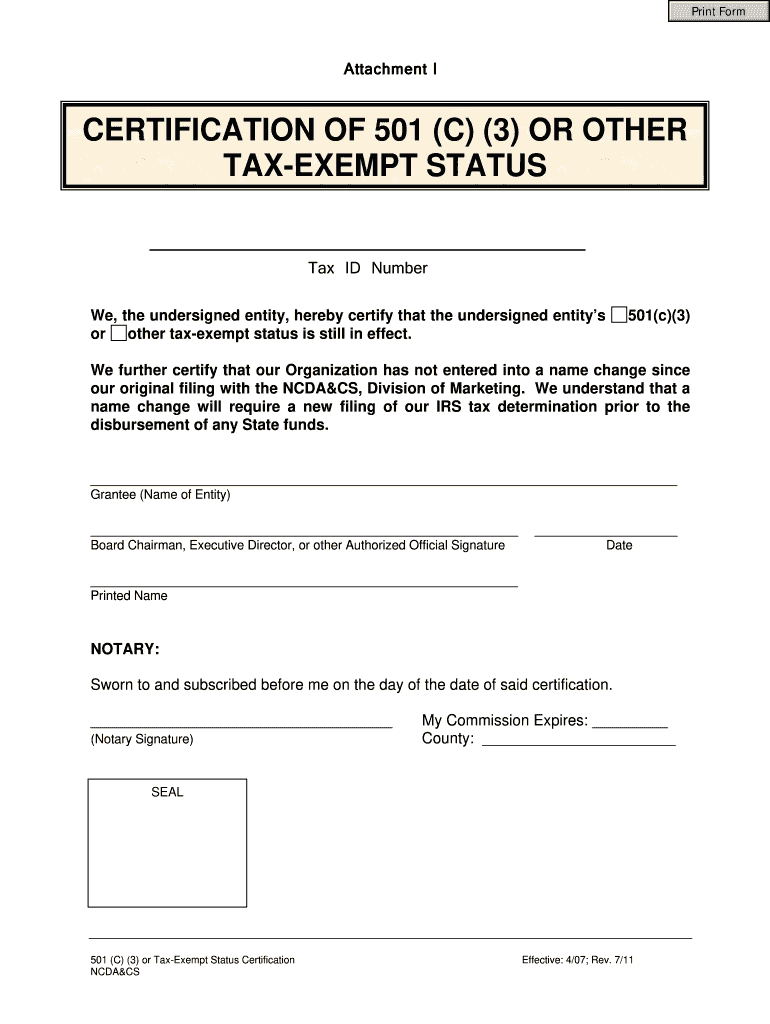







Definition and Meaning of the NC Certification 501(c)(3) Form
The NC certification 501(c)(3) form is an official document that confirms an entity's tax-exempt status under Section 501(c)(3) of the Internal Revenue Code. This designation applies to nonprofit organizations that operate for charitable, educational, religious, or scientific purposes. The certification not only clarifies an organization's purpose but also allows donors to claim tax deductions for their contributions. It serves as evidence of compliance with federal and state requirements to solicit donations and qualifies the entity for various grants and funding opportunities.
Key Elements of the NC Certification 501(c)(3) Form
- Tax ID Number: This unique identifier is essential for any tax-exempt organization and must be included in the form.
- Declaration of No Name Changes: Organizations must affirm that there have been no changes to their name since the original filing to maintain consistency in their legal status.
- Signature Requirements: The form requires signatures from authorized representatives of the organization; this includes key officials who attest to the accuracy of the information provided.
- Notarization: A notary public must verify the authenticity of the signatures, which adds an extra layer of validation.
Understanding these key elements is crucial for organizations to ensure they are properly maintaining their tax-exempt status.
Steps to Complete the NC Certification 501(c)(3) Form
Completing the NC certification 501(c)(3) form requires careful attention to detail and thorough knowledge of your organization’s existing status. The following steps outline the process:
-
Gather Necessary Information:
- Collect your entity’s Tax ID number.
- Review original incorporation documents to verify name consistency.
- Compile previous financial statements and mission statements.
-
Fill Out the Form:
- Enter accurate information, including your organization’s legal name, address, and Tax ID number.
- Make sure to declare that there have been no changes to the name since the initial application.
-
Obtain Signatures:
- Have the authorized officials of the organization sign the form. This typically includes the president, treasurer, and secretary.
-
Notarization:
- Visit a notary public to get the signatures officially notarized. This step is necessary to validate the authenticity of the signatures.
-
Submission of the Form:
- Once fully completed and notarized, submit the form via the appropriate method, whether online, by mail, or in person, depending on the specific guidelines applicable in North Carolina.
Following these steps closely helps ensure that the NC certification 501(c)(3) form is correctly completed and submitted, maintaining your organization's tax-exempt status.
Important Terms Related to the NC Certification 501(c)(3) Form
Familiarity with important terminology is essential for understanding the NC certification 501(c)(3) form. Here are several key terms:
- 501(c)(3): This refers to the tax code section that provides for federal tax exemption for certain types of nonprofit entities.
- Tax Exempt: Organizations that do not have to pay certain federal income taxes because of their nonprofit status.
- Nonprofit Organization: An entity that operates for a purpose other than to make a profit, frequently focused on charity, education, or social welfare.
- Donor Contributions: Funds or resources given by individuals, corporations, or foundations to support nonprofit organizations, which can be tax-deductible under 501(c)(3) status.
- Grant Funding: Financial assistance given by governments or foundations to support specific projects or general operations of nonprofit organizations.
Understanding these terms enhances comprehension of the form and its implications for nonprofit organizations.
Legal Use of the NC Certification 501(c)(3) Form
The legal use of the NC certification 501(c)(3) form is crucial for compliance with both state and federal regulations that govern nonprofit organizations. Here are important aspects to consider:
- Verification of Tax-Exempt Status: The form is used to prove an organization’s tax-exempt status to potential donors, grantors, and government entities. This certification is necessary to solicit donations legally and maintain eligibility for certain grants.
- Regulatory Compliance: Organizations must comply with IRS guidelines to retain their 501(c)(3) designation. Failing to file the certification correctly can lead to the loss of tax-exempt status.
- Public Trust: Filing the NC certification 501(c)(3) form demonstrates transparency and accountability, which fosters public trust in the organization. This is especially important in fundraising efforts where potential donors want assurance their contributions are going to legitimate organizations.
These legal considerations underline the necessity of accurately completing and submitting the NC certification 501(c)(3) form.
Who Typically Uses the NC Certification 501(c)(3) Form?
The NC certification 501(c)(3) form is primarily used by nonprofit organizations that fall into various categories, including:
- Charitable Organizations: Entities engaged in activities that provide relief to the poor, advance education or religion, or promote social welfare.
- Educational Institutions: Schools, colleges, and universities that operate not for profit and seek tax-exempt status to enhance funding opportunities and eligibility for grants.
- Religious Entities: Churches and other religious organizations that qualify under the 501(c)(3) provision, allowing them to receive tax-deductible contributions from their parishioners.
- Cultural and Artistic Organizations: Nonprofits dedicated to the arts, culture, and public sciences that may rely on donations and grants to support programming and operations.
Understanding the typical users of this form helps identify the broader nonprofit landscape that relies on it for maintaining tax-exempt status in North Carolina.