Homestead related tax exemptions 2026

Get Form
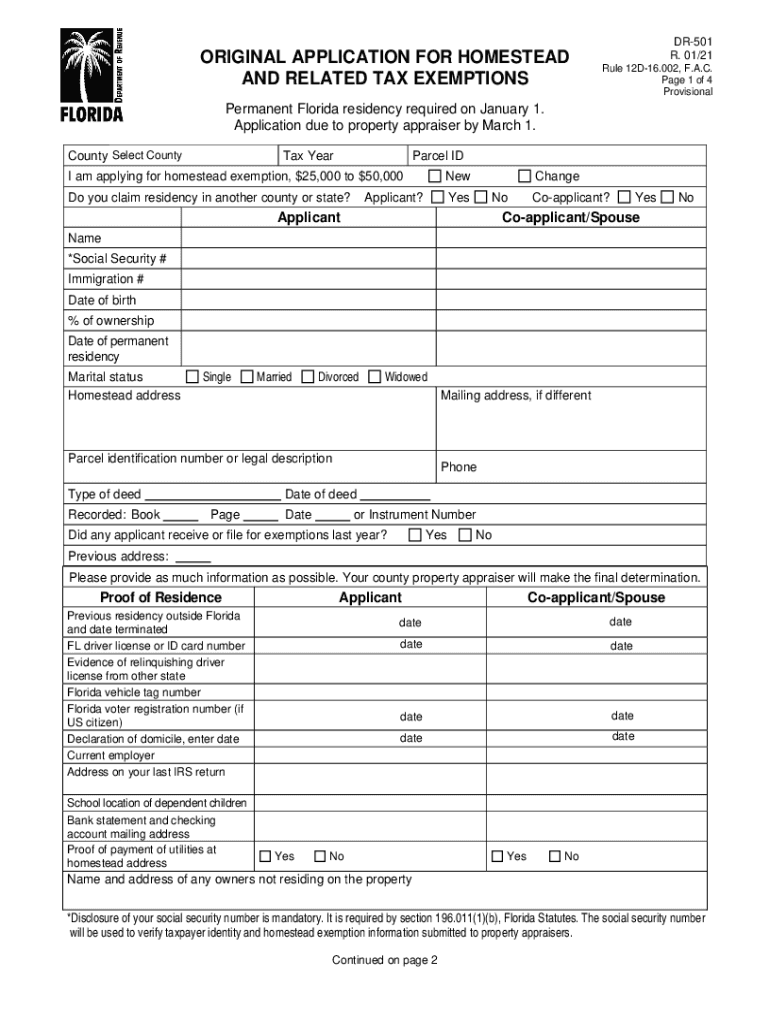
homestead related tax exemptions Preview on Page 1

Here's how it works

01. Edit your form online
Type text, add images, blackout confidential details, add comments, highlights and more.
02. Sign it in a few clicks
Draw your signature, type it, upload its image, or use your mobile device as a signature pad.
03. Share your form with others
Send it via email, link, or fax. You can also download it, export it or print it out.

How to use or fill out homestead related tax exemptions with our platform

Form edit decoration
9.5
Ease of Setup
DocHub User Ratings on G2
9.0
Ease of Use
DocHub User Ratings on G2
  1. Click ‘Get Form’ to open the Original Application for Homestead and Related Tax Exemptions in the editor.
  2. Begin by selecting your county and entering the tax year and parcel ID. This information is crucial for processing your application.
  3. Indicate whether you are applying for a new exemption or making changes. Fill in your personal details, including name, Social Security number, and date of birth.
  4. Provide proof of residency by filling out the required fields regarding previous addresses, Florida driver license number, and other relevant documentation.
  5. If applicable, check any additional benefits you are applying for, such as age-related exemptions or disability discounts. Ensure all necessary supporting documents are attached.
  6. Review all entered information for accuracy before signing the application. Once complete, submit it to your local property appraiser.

Start using our platform today to easily fill out your homestead tax exemption application online for free!

See more homestead related tax exemptions versions

We've got more versions of the homestead related tax exemptions form. Select the right homestead related tax exemptions version from the list and start editing it straight away!
Versions Form popularity Fillable & printable
2023 4.6 Satisfied (46 Votes)
2023 4.2 Satisfied (47 Votes)
2021 4.8 Satisfied (70 Votes)
2021 4.4 Satisfied (45 Votes)
2018 4.3 Satisfied (113 Votes)
2018 4.3 Satisfied (104 Votes)
2014 4.4 Satisfied (339 Votes)
2012 4.1 Satisfied (67 Votes)
be ready to get more

Complete this form in 5 minutes or less

Get form

Got questions?

We have answers to the most popular questions from our customers. If you can't find an answer to your question, please contact us.
Contact us
Ohios Homestead Exemption protects the first $25,000 of your homes value from taxation. For example, if your home is worth $100,000, you will be taxed as if the home were worth $75,000. On average, those who qualify for the exemption save $400 a year.
Who is eligible for the Homestead Exemption program? Those eligible must be 65 years of age or older or be permanently or totally disabled, meet annual state set income requirements, and own the home where they live as of January 1st or the year in which they apply.
Social Security income is exempt and not considered income for Homestead. Applicants must be one of the categories below: 65 or older. Please note: It doesnt matter what date you turn 65, apply the year you turn 65.
The Homestead Exemption is a statewide program that allows qualifying homeowners the opportunity to shield up to $25,000 of the market value of their homestead (a dwelling and up to one acre of land) from property taxation.
You do not have to do it every year unless you have a deed change, become disabled or become 65. 14. What do I need to bring to file for homestead exemption?

Security and compliance

At DocHub, your data security is our priority. We follow HIPAA, SOC2, GDPR, and other standards, so you can work on your documents with confidence.

Learn more
ccpa2
pci-dss
gdpr-compliance
hipaa
soc-compliance

People also ask

The Homestead exemption offers all eligible homeowners the opportunity to shield up to $28,000 of the market value of their homestead from property taxation. That means a home valued at $100,000 will generally be taxed as if it was valued at $72,000.
The Homestead Exemption program allows senior citizens and permanently and totally disabled Ohioans that meet annual state set income requirements to reduce their property tax burden by shielding some of the market value of their home from taxation.

Related links