




01. Edit your 02 8917 0032 online
Type text, add images, blackout confidential details, add comments, highlights and more.

Type text, add images, blackout confidential details, add comments, highlights and more.

Draw your signature, type it, upload its image, or use your mobile device as a signature pad.

Send it via email, link, or fax. You can also download it, export it or print it out.
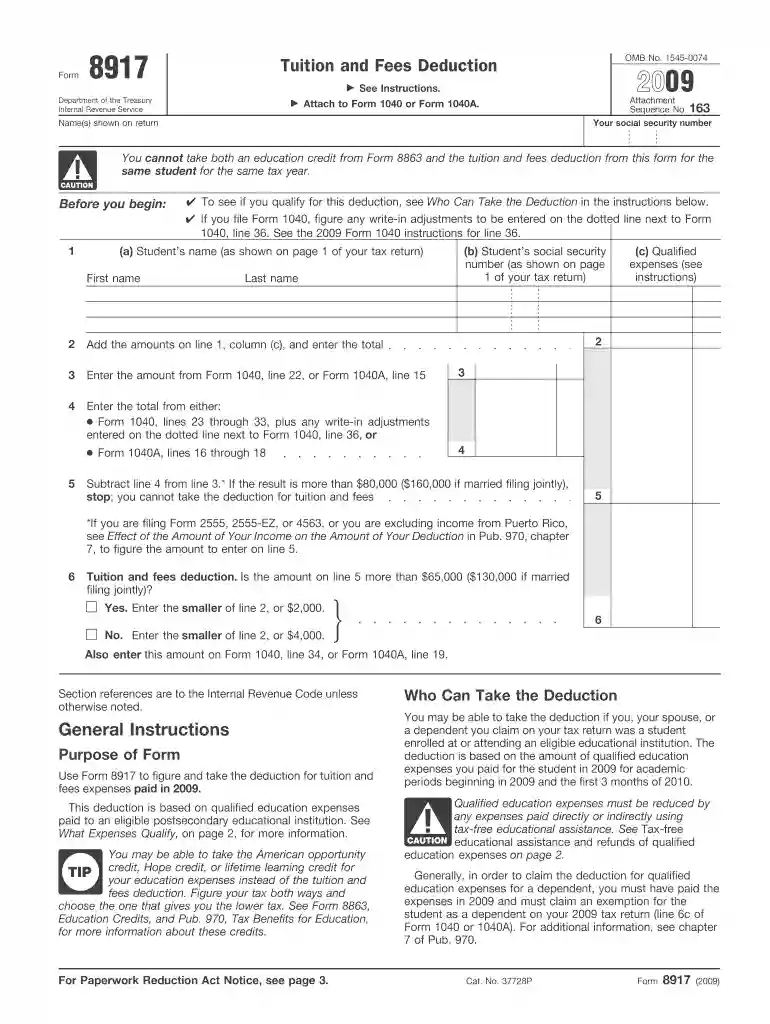
The 2009 Form 8917 is primarily designed for taxpayers to claim the tuition and fees deduction for qualified education expenses. This form is used for the 2009 tax year and helps delineate the criteria under which taxpayers can reduce their taxable income by the amount of qualified expenses paid for higher education. The primary objective is to provide tax relief to those who have incurred educational expenses, thereby making education more affordable for taxpayers and their dependents.
Qualified education expenses include tuition and certain related expenses required for enrollment and attendance at an eligible educational institution. These institutions typically include accredited postsecondary schools. Notably, expenses for personal, living, or family items do not qualify under this deduction, ensuring clarity on what can and cannot be deducted.
To be eligible to use the 2009 Form 8917, taxpayers must meet specific income thresholds and filing status criteria. The deduction is phased out for taxpayers whose modified adjusted gross income (MAGI) exceeds certain limits, which were set by the IRS for the 2009 tax year. Understanding these limits is crucial for determining eligibility.


These thresholds help ensure that the benefit is targeted towards middle-income families who need financial relief for educational expenses.
Completing the 2009 Form 8917 involves several specific steps to accurately report and claim deductions:
Gather Necessary Documents: Collect tuition payment receipts, Form 1098-T from educational institutions, and any other relevant documentation.
Fill in Personal Information: Provide your name, Social Security Number, and filing status at the top of the form.
Calculate Qualified Expenses: Enter the total amount of tuition and fees paid, ensuring these align with IRS definitions of qualified expenses.
Determine Deduction Limit: The maximum deduction is $4,000, but this depends on your MAGI and filing status.
Complete the Form: Follow the instructions on the form to carry over applicable amounts to your tax return.
Review for Accuracy: Double-check all figures and make sure documentation supports your claims, as errors can delay processing or result in rejections.
Understanding the language used in Form 8917 can aid in accurate completion. Terms such as "qualified education expenses," "modified adjusted gross income," and "phase-out range" are integral to correctly assessing eligibility and potential benefits.
The IRS provides comprehensive guidelines to assist in the correct completion of Form 8917. Adhering to these guidelines is essential to avoid any non-compliance issues, which can result in penalties or denial of the deduction.
The 2009 Form 8917 can be completed either in digital format or on paper. Many taxpayers opt for the digital version due to the convenience and efficiency it offers, especially when integrated with tax software.
Consider a family with a dependent student attending college, paying $3,500 in qualified tuition fees for the year. By using Form 8917, they could reduce their taxable income by these expenses, provided they meet the income thresholds and other criteria. Practical scenarios like this highlight the form's utility for applicable taxpayers.
We've got more versions of the 02 8917 0032 form. Select the right 02 8917 0032 version from the list and start editing it straight away!
| Versions | Form popularity | Fillable & printable |
|---|---|---|
| 2020 | 4.8 Satisfied (51 Votes) | |
| 2018 | 4.3 Satisfied (241 Votes) | |
| 2017 | 4.4 Satisfied (86 Votes) | |
| 2016 | 4.4 Satisfied (587 Votes) | |
| 2015 | 3.9 Satisfied (46 Votes) | |
| 2014 | 4 Satisfied (51 Votes) | |
| 2013 | 4 Satisfied (42 Votes) | |
| 2012 | 4 Satisfied (34 Votes) | |
| 2011 | 3.9 Satisfied (36 Votes) | |
| 2010 | 4 Satisfied (28 Votes) | |
| 2009 | 4 Satisfied (60 Votes) |
At DocHub, your data security is our priority. We follow HIPAA, SOC2, GDPR, and other standards, so you can work on your documents with confidence.
This deduction, reported on Form 8917 (PDF), Tuition and Fees Deduction, is taken as an adjustment to income. This means you can claim this deduction evenRead more
Overview. Following last years project, our BUCT-China team has been focusing on the use of synthetic biology and tissue engineering techniques to realizeRead more
Mar 30, 2026 Product Number Form 8917 Title Tuition and Fees Deduction, Revision Date 2016. Product Number Form 8917 Title Tuition and Fees DeductionRead more


