




01. Edit your 2017 form 8965 online
Type text, add images, blackout confidential details, add comments, highlights and more.

Type text, add images, blackout confidential details, add comments, highlights and more.

Draw your signature, type it, upload its image, or use your mobile device as a signature pad.

Send form 8965 via email, link, or fax. You can also download it, export it or print it out.
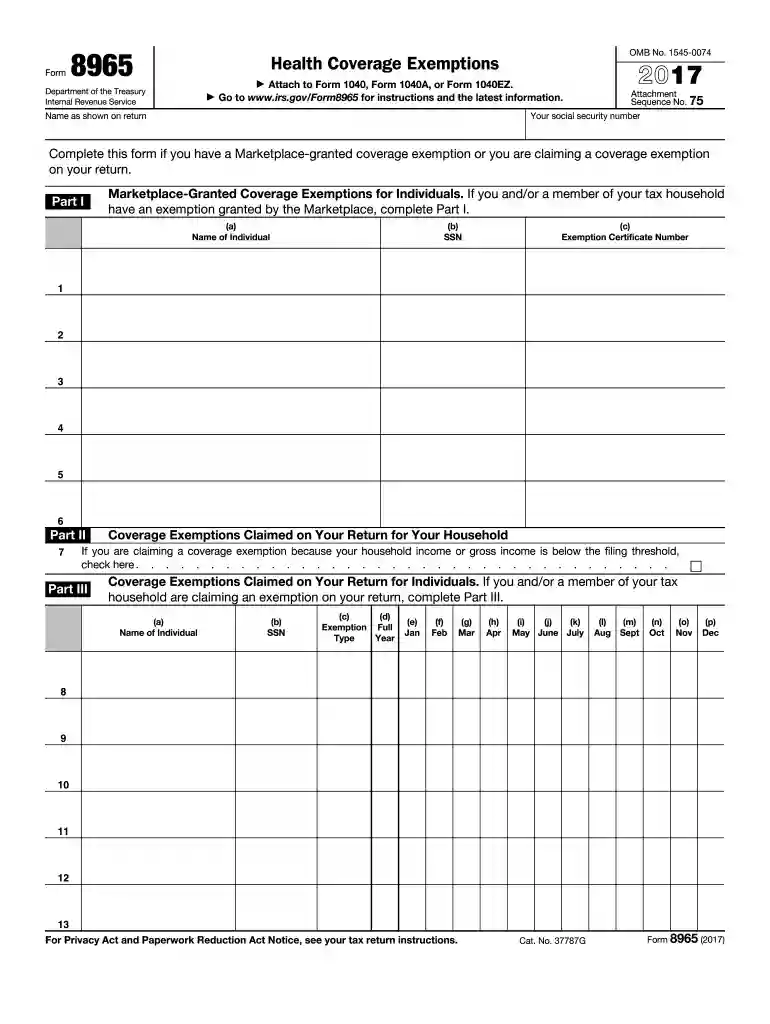
IRS Form 8965 for 2017 is a tax document used primarily to report exemptions from health coverage requirements as mandated by the Affordable Care Act (ACA). This form is essential for taxpayers who were exempt from having minimum essential health coverage or who qualified for a coverage exemption.
To effectively use IRS Form 8965, you need to:
Completing IRS Form 8965 is crucial for accurately reporting your health coverage status and avoiding unnecessary tax penalties.
Collect Personal Information: Begin by ensuring all details, such as names and Social Security numbers for each member of your tax household, are available.
Review Exemptions: Familiarize yourself with the exemptions available, including those related to income level, citizenship status, or Marketplace determinations.
Fill Out Part I, II, and III:
Submit the Form: Attach IRS Form 8965 to your federal tax return prior to submission.
Eligibility for using IRS Form 8965 primarily revolves around not having health coverage for part or all of 2017. Exemptions can be due to various reasons such as:
These criteria are carefully evaluated to determine whether a taxpayer is granted an exemption from the health coverage requirements.


Minimum Essential Coverage: The type of health insurance coverage an individual needs to avoid paying the penalty.
Marketplace-granted Exemptions: Exemptions you must apply for through the Health Insurance Marketplace.
Income-related Exemptions: Exemptions granted based on the cost of coverage being too high relative to your income.
Understanding these terms aids in effectively navigating and completing the form.
Consider a scenario where a taxpayer, John, lost his job in 2017 and could not afford COBRA or individual market health insurance. John may qualify for an affordability exemption. By accurately completing Form 8965, John's exemption would prevent any penalties for lacking health coverage during his period of financial hardship.
IRS Form 8965 must be filed along with your individual tax return. Typically, the tax filing deadline is April 15th of the following tax year unless extended by the IRS. It is imperative to be aware of these deadlines to avoid unnecessary penalties.
Failing to submit IRS Form 8965 when required can lead to penalties associated with the ACA's health coverage mandate. These penalties could significantly impact the amount of taxes owed, hence the importance of accurate and timely form completion.
Non-compliance penalties are assessed based on the number of months you or your dependents lacked health coverage without a valid exemption.
Taxpayers have the option to submit IRS Form 8965 electronically or via paper. While electronic filing is faster and often more secure, some individuals may prefer or require paper submissions due to their specific circumstances or preferences. When opting for digital submission, ensure that your tax software is compatible with IRS forms for the most seamless experience.
We've got more versions of the 2017 form 8965 form. Select the right 2017 form 8965 version from the list and start editing it straight away!
At DocHub, your data security is our priority. We follow HIPAA, SOC2, GDPR, and other standards, so you can work on your documents with confidence.
Complete this form if you have a Marketplace-granted coverage exemption or you are claiming a coverage exemption on your return. Part I. Marketplace-GrantedRead more
Mar 14, 2016 As we look to the future, in 2017 and beyond, we expect to achieve meaningful growth and higher earnings for our businesses and shareholders.Read more
This form contains detailed information about your health care coverage. The IRS will use the information reported on your 1095-C to determine whether you willRead more


