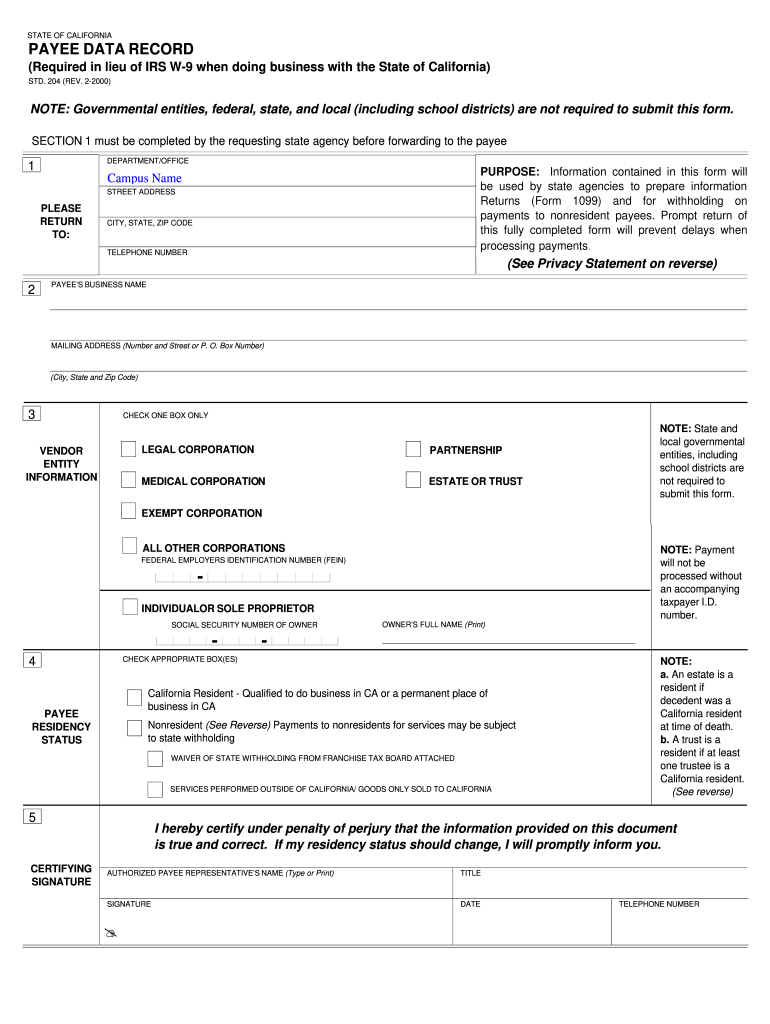
Csu payee data record 2000 form-2026

Get Form
csu payee data record 2000 form Preview on Page 1

Here's how it works

01. Edit your form online
Type text, add images, blackout confidential details, add comments, highlights and more.
02. Sign it in a few clicks
Draw your signature, type it, upload its image, or use your mobile device as a signature pad.
03. Share your form with others
Send it via email, link, or fax. You can also download it, export it or print it out.

How to use or fill out csu payee data record 2000 form with our platform

Form edit decoration
9.5
Ease of Setup
DocHub User Ratings on G2
9.0
Ease of Use
DocHub User Ratings on G2
  1. Click ‘Get Form’ to open the csu payee data record 2000 form in the editor.
  2. In Section 1, enter the requesting state agency's department/office name, street address, city, state, zip code, and telephone number. This section must be completed before forwarding the form.
  3. In Section 2, provide the payee’s business name and mailing address. Ensure that all details are accurate to avoid processing delays.
  4. For Section 3, check only one box that corresponds to your entity type (e.g., vendor, corporation). If applicable, include your Federal Employer Identification Number (FEIN) or Social Security Number.
  5. In Section 4, indicate your residency status by checking the appropriate box. This is crucial for tax withholding purposes.
  6. Finally, complete Section 5 by providing your certifying signature along with your printed name, title, date, and telephone number. Make sure all information is true and correct.

Start using our platform today to fill out your csu payee data record 2000 form easily and for free!

See more csu payee data record 2000 form versions

We've got more versions of the csu payee data record 2000 form form. Select the right csu payee data record 2000 form version from the list and start editing it straight away!
Versions Form popularity Fillable & printable
2021 4.8 Satisfied (67 Votes)
2019 4.2 Satisfied (38 Votes)
2018 4.4 Satisfied (61 Votes)
2003 4.4 Satisfied (570 Votes)
2000 4.3 Satisfied (60 Votes)
be ready to get more

Complete this form in 5 minutes or less

Get form

Got questions?

We have answers to the most popular questions from our customers. If you can't find an answer to your question, please contact us.
Contact us
A completed Payee Data Record, STD. 204, is required for payments to all non-governmental entities and will be kept on file at each State agency. Since each State agency with which you do business must have a separate STD. 204 on file, it is possible for a payee to receive this form from various State agencies.
Form is used to provide remittance address information if different than the mailing address on the STD 204 - Payee Data Record. Use this form to provide additional remittance addresses and additional Authorized Representatives of the Payee not identified on the STD 204.)
A completed Payee Data Record, STD 204 form, is required for all payees (non-governmental entities or individuals) entering into a transaction that may lead to a payment from the state.
Both state and federal laws require that all reportable payments be identified and reported in the Payee Data Record (STD 204) form. This includes any state department that participates in a transaction resulting in a payment to any individual or entity that is not a governmental entity.
Complete name, title, e-mail address, telephone number, date, and handwritten or electronic signature of the payees authorized representative. This signature certifies the accuracy of the information provided. All data on the submitted STD 204 must be unalterable including the signature.

Security and compliance

At DocHub, your data security is our priority. We follow HIPAA, SOC2, GDPR, and other standards, so you can work on your documents with confidence.

Learn more
ccpa2
pci-dss
gdpr-compliance
hipaa
soc-compliance

People also ask

204 form is to obtain payee information for income tax reporting and to ensure tax compliance with federal and state law. The STD. 204 is required for any non-governmental entity or individual entering into a transaction that may lead to a payment from the state.
Payers that file information returns and furnish payee statements must request from the payee and include on the form the payees taxpayer identification number (TIN). The IRS uses the payees TIN to associate and verify amounts reported to the IRS with corresponding amounts on the payees tax return.

Related links