




01. Edit your boeing meda form online
Type text, add images, blackout confidential details, add comments, highlights and more.

Type text, add images, blackout confidential details, add comments, highlights and more.

Draw your signature, type it, upload its image, or use your mobile device as a signature pad.

Send time aircraft via email, link, or fax. You can also download it, export it or print it out.
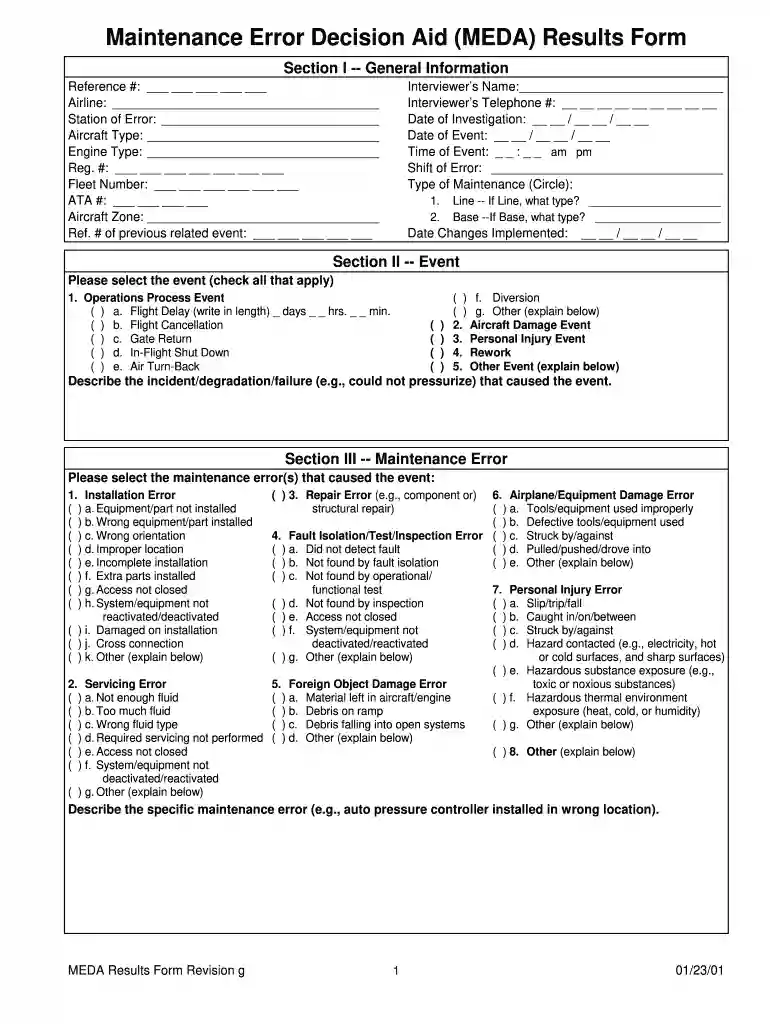
The Boeing Maintenance Error Decision Aid (MEDA) form is a structured document that serves as a critical tool in aviation safety management. This form is specifically designed for the identification and analysis of maintenance-related errors within Boeing operations. It captures detailed information about maintenance incidents, enabling stakeholders to trace the root causes and develop strategies for prevention.
The primary objective of the MEDA form is to facilitate a systematic investigation into maintenance errors, characterized by its capacity to catalog key data points including:
The MEDA form plays a vital role in improving not only safety but also operational efficiency in the aviation sector by ensuring that all maintenance errors are thoroughly investigated and documented.
Using the Boeing MEDA form effectively requires a structured approach that prioritizes accuracy and comprehensiveness. The process involves several key steps:
By following these steps, users can ensure that the MEDA form serves its intended purpose—supporting enhanced safety and operational reliability within the Boeing maintenance framework.
Understanding the essential components of the Boeing MEDA form is critical for effective completion and use. The form includes several key sections that must be addressed meticulously:
By meticulously filling out these sections, maintenance personnel can contribute valuable insights into operational safety practices.
Completing the Boeing MEDA form is a detailed process that necessitates accuracy and thoroughness. The following are step-by-step guidelines to ensure proper completion:
By adhering to these steps, users can ensure the MEDA form is not only completed correctly but is also a powerful tool for enhancing aviation maintenance protocols.
The Boeing MEDA form can be applied in various scenarios to enhance safety and operational awareness. Here are a few practical examples:
Scenario One: During a routine inspection, a technician discovers that the incorrect torque specifications were applied to a critical component. The completed MEDA form documents the oversight, identifies contributing factors such as miscommunication regarding specifications, and offers training recommendations for future maintenance staff.
Scenario Two: A maintenance error results in a failed component after takeoff. The MEDA form is utilized to analyze the incident, revealing a lack of procedural adherence in the inspection process. The form leads to the implementation of stricter compliance measures and additional oversight to ensure critical tasks are consistently performed according to standard operating procedures.
Scenario Three: Following a series of minor incidents, maintenance teams collaboratively complete the MEDA form to discern patterns. The collective insights drawn from multiple MEDA reports guide changes in maintenance practices and contribute to a culture of continuous improvement.
Through these examples, it is clear that the MEDA form is integral not only for individual incidents but also for broader organizational learning and development in aviation safety practices.
We've got more versions of the boeing meda form form. Select the right boeing meda form version from the list and start editing it straight away!
| Versions | Form popularity | Fillable & printable |
|---|---|---|
| 2001 | 4.9 Satisfied (525 Votes) |
At DocHub, your data security is our priority. We follow HIPAA, SOC2, GDPR, and other standards, so you can work on your documents with confidence.
Apr 22, 2026 This document presents a structured approach for analyzing maintenance errors in aviation systems, focusing on the Maintenance Error Decision Aid (MEDA)Read more
Describe specifically how the selected individual factors contributed to the system failure. Recommendations to correct the Contributing FactorsRead more


