




01. Edit your form online
Type text, add images, blackout confidential details, add comments, highlights and more.

Type text, add images, blackout confidential details, add comments, highlights and more.

Draw your signature, type it, upload its image, or use your mobile device as a signature pad.

Send it via email, link, or fax. You can also download it, export it or print it out.
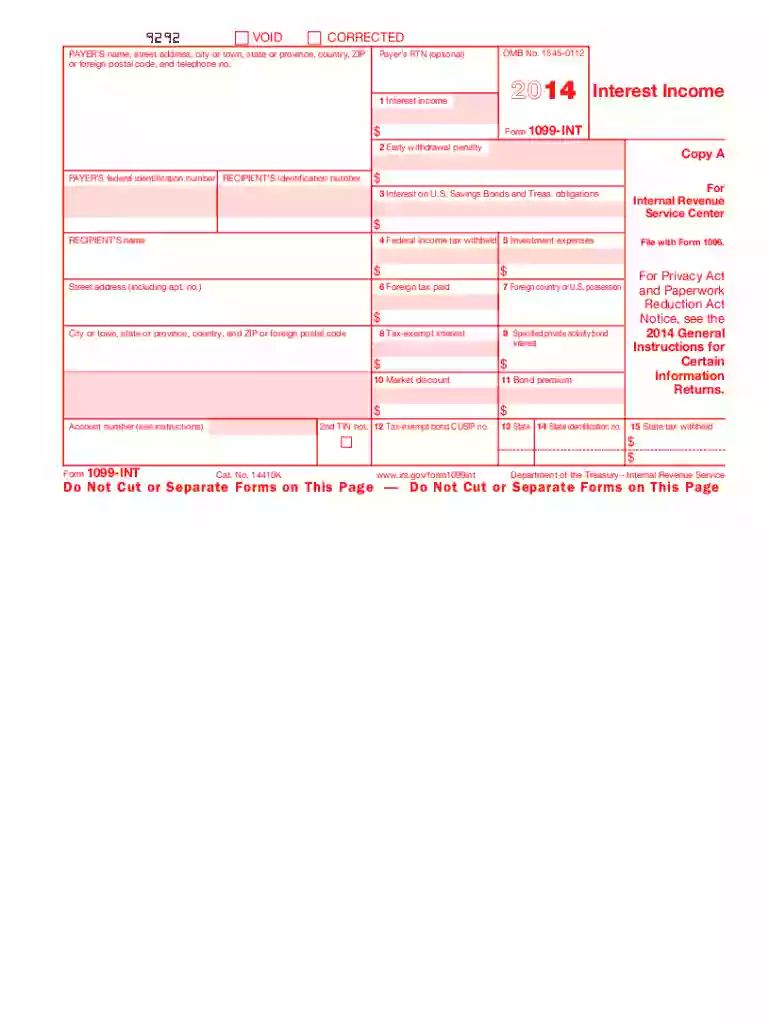
Form 1099-INT is an important tax document used to report interest income to the Internal Revenue Service (IRS). Financial institutions are required to send this form to any taxpayer who has earned interest over a certain threshold during the tax year. The form details the amount of interest earned and any tax withheld at the federal or state level.
Using the 2014 Form 1099-INT involves understanding how to accurately report the interest income specified on the form within your tax return. The form should be used by individuals to ensure all earned interest is appropriately declared.
Form 1099-INT for the year 2014 can be obtained as follows:
Completing Form 1099-INT generally involves the following steps:
It is crucial to double-check each entry for accuracy to avoid discrepancies when filing your taxes.
Filing the 1099-INT form correctly is critical for both the taxpayer and the issuer for several reasons:
The typical users of Form 1099-INT include:


Several elements are critical when examining a Form 1099-INT:
Ensure you understand each box and its implications for your tax responsibilities.
The IRS provides specific guidelines for Form 1099-INT:
These guidelines ensure uniformity and compliance in reporting processes.
Adhering to the deadlines associated with Form 1099-INT is crucial:
Failing to comply with Form 1099-INT requirements can result in penalties:
State-specific rules may influence how Form 1099-INT is reported:
By ensuring users understand the above areas to their fullest extent, Form 1099-INT can be leveraged effectively to achieve full tax compliance and transparency.
We've got more versions of the 2014 1099 int form form. Select the right 2014 1099 int form version from the list and start editing it straight away!
| Versions | Form popularity | Fillable & printable |
|---|---|---|
| 2024 | 4.3 Satisfied (34 Votes) | |
| 2022 | 4.8 Satisfied (138 Votes) | |
| 2021 | 4.3 Satisfied (257 Votes) | |
| 2020 | 4.4 Satisfied (1530 Votes) | |
| 2019 | 4.4 Satisfied (645 Votes) | |
| 2018 | 4.4 Satisfied (244 Votes) | |
| 2017 | 4.4 Satisfied (28 Votes) | |
| 2016 | 4.4 Satisfied (300 Votes) | |
| 2015 | 4.2 Satisfied (49 Votes) | |
| 2014 | 4.1 Satisfied (63 Votes) | |
| 2013 | 4.4 Satisfied (38 Votes) | |
| 2012 | 4.3 Satisfied (71 Votes) | |
| 2011 | 4 Satisfied (44 Votes) | |
| 2010 | 4 Satisfied (40 Votes) | |
| 1994 | 4 Satisfied (48 Votes) |
At DocHub, your data security is our priority. We follow HIPAA, SOC2, GDPR, and other standards, so you can work on your documents with confidence.





Feb 25, 2015 1099-INT form from your bank outlines earned interest (if any). 1099-DIV outlines dividend interest on investments (if any). 1042-SRead more
Jan 3, 2014 You are not required to file Form. 1099-INT for payments made to certain payees including but not limited to a corporation, a tax-exemptRead more
Apr 15, 2015 as Form 1099-INT, Form 1099-DIV, or similar substitute statements. 5. You held the stock or bonds on which the dividends or interest were.Read more


