




01. Edit your 2017 form 990 online
Type text, add images, blackout confidential details, add comments, highlights and more.

Type text, add images, blackout confidential details, add comments, highlights and more.

Draw your signature, type it, upload its image, or use your mobile device as a signature pad.

Send form 990 2017 via email, link, or fax. You can also download it, export it or print it out.
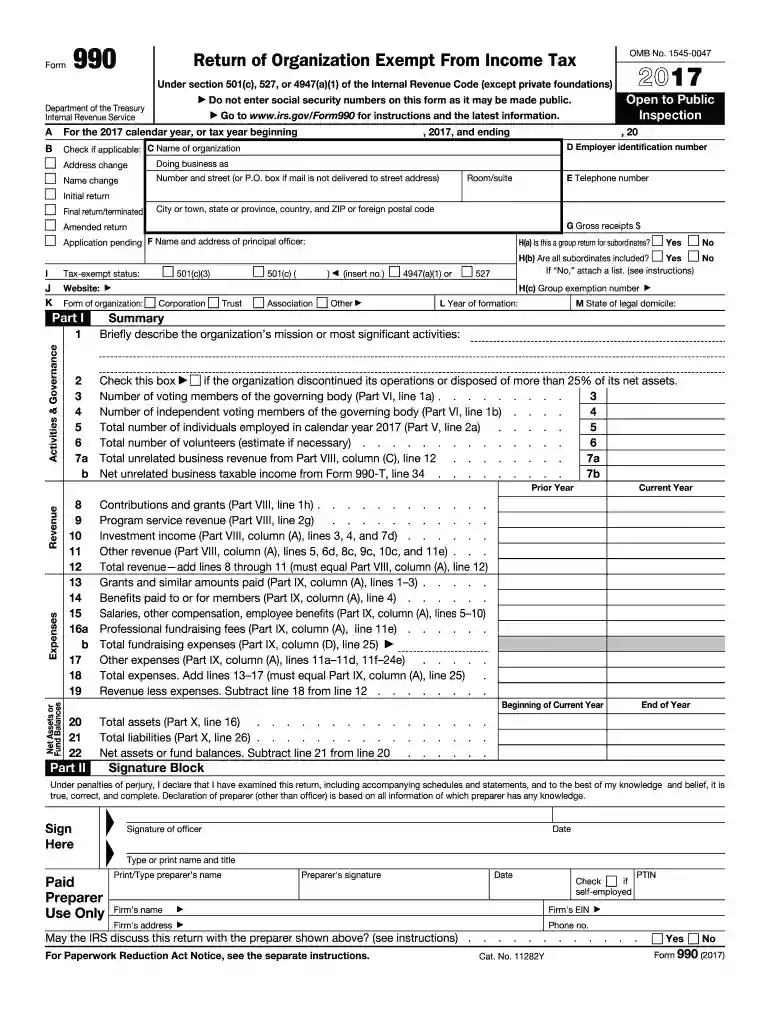
The Form 990, specifically for the year 2017, is a tax document that must be filed by organizations exempt from income tax under several sections, including 501(c), 527, or 4947(a)(1) of the Internal Revenue Code. It serves to provide detailed information on the organization's mission, governance, and financial activities. The form ensures transparency by making the organization's records available to the public, thereby fostering accountability among tax-exempt entities.
To use the Form effectively, organizations must first gather comprehensive financial data. This involves collecting details of their revenue sources, expenditures, and any changes in their organizational structure or operations since their last filing. Once all necessary data is prepared, the form must be completed with accuracy to reflect the organization's activities correctly. It is essential to consult the IRS guidelines to ensure compliance with all reporting standards and to include any required disclosures specific to the organization’s operations and financial transactions.
The Form is generally due on the 15th day of the 5th month after the close of the organization's fiscal year. For a calendar year filer, this typically falls on May 15th. Extensions can be sought using Form 8868, granting an additional six months to file if approved.
The IRS provides specific guidelines that organizations must follow when preparing the 990 form. These regulations include maintaining accurate and complete financial records, adhering to public disclosure rules, and ensuring timely submission. It's crucial to review these guidelines annually as updates or changes may occur, impacting compliance requirements.
Failing to file a complete and accurate 990 form by the designated deadline can result in penalties. Organizations may incur monetary fines, and persistent non-compliance could lead to the revocation of tax-exempt status. If inaccuracies are found, the IRS may require corrective measures or impose additional scrutiny on the organization’s future filings.
Software programs like TurboTax and QuickBooks can assist in preparing the form by streamlining data collection and ensuring compliance with IRS guidelines. These programs often offer step-by-step instructions and automatic error checks, making it easier to complete the form accurately. Compatibility with commonly used accounting software enhances efficiency and reduces the likelihood of errors in reporting.
We've got more versions of the 2017 form 990 form. Select the right 2017 form 990 version from the list and start editing it straight away!
| Versions | Form popularity | Fillable & printable |
|---|---|---|
| 2025 | 4.6 Satisfied (50 Votes) | |
| 2024 | 4.6 Satisfied (53 Votes) | |
| 2023 | 3.4 Satisfied (37 Votes) | |
| 2022 | 4.3 Satisfied (30 Votes) | |
| 2021 | 4.8 Satisfied (102 Votes) | |
| 2020 | 4.4 Satisfied (60 Votes) | |
| 2019 | 4.3 Satisfied (102 Votes) | |
| 2018 | 4.3 Satisfied (128 Votes) | |
| 2017 | 4.3 Satisfied (133 Votes) | |
| 2016 | 4.4 Satisfied (565 Votes) | |
| 2015 | 4 Satisfied (61 Votes) | |
| 2015 | 4.5 Satisfied (22 Votes) | |
| 2014 | 4 Satisfied (49 Votes) | |
| 2013 | 4.1 Satisfied (45 Votes) | |
| 2012 | 4 Satisfied (27 Votes) |
At DocHub, your data security is our priority. We follow HIPAA, SOC2, GDPR, and other standards, so you can work on your documents with confidence.




1. Contributions, gifts, grants, etc., received (attach schedule). 2. Check ▷ if the foundation is not required to attach Sch. B.Read more
All Form 990 filers are required to complete Schedule O. 38. Form 990 (2017). Page 5. Form 990 (2017).Read more
3b. Schedule A (Form 990 or 990-EZ) 2017 of its supported organizations? If Yes, describe in Part VI the role played by the organization in this regardRead more


