




2010 form 1120 schedule g-2025

Get Form
2010 form 1120 schedule g Preview on Page 1

Here's how it works

01. Edit your form online
Type text, add images, blackout confidential details, add comments, highlights and more.
02. Sign it in a few clicks
Draw your signature, type it, upload its image, or use your mobile device as a signature pad.
03. Share your form with others
Send it via email, link, or fax. You can also download it, export it or print it out.

Definition and Purpose of 2010 Form 1120 Schedule G

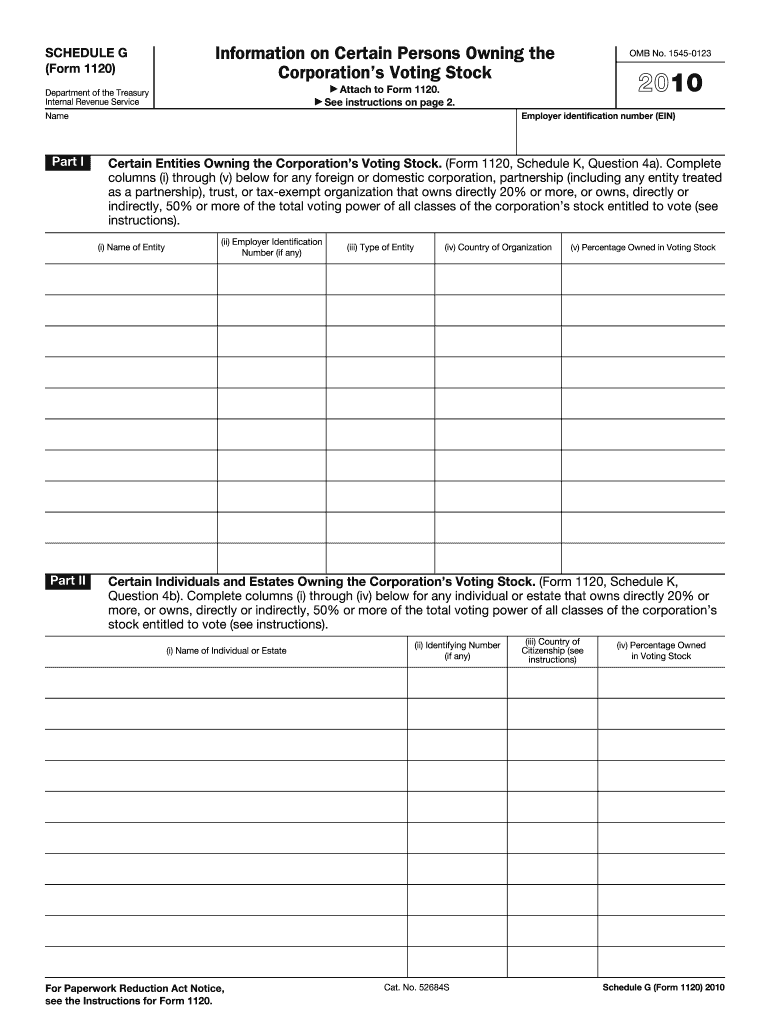
Schedule G (Form 1120) is an essential document mandated by the IRS for corporations operating in the United States. This schedule requires corporations to disclose their ownership structure by reporting information related to entities, individuals, and estates that hold significant ownership stakes in the corporation's voting stock. Specifically, it serves to identify those who own 20 percent or more of the voting power directly or 50 percent indirectly.

The schedule consists of two main parts. In Part I, corporations must provide details about entities that meet the ownership thresholds. Here, they are required to furnish information such as the names of these entities, their identification numbers, and the countries of organization. In Part II, individuals or estates are similarly required to disclose their ownership percentages and personal details. The information collected through this form is used by the IRS to monitor compliance with tax laws and maintain transparency in corporate ownership.

Understanding the definition and the requirements of Schedule G is crucial for corporations to avoid potential penalties and ensure compliance with IRS regulations.

Steps to Complete the 2010 Form 1120 Schedule G

Filling out Schedule G accurately is vital for corporations to ensure compliance with IRS regulations. The following steps highlight how to complete the form effectively:

  1. Gather Necessary Information: Collect all relevant data about the ownership stakes of entities and individuals. This includes:

    • Names of entities or individuals
    • Identification numbers (EINs or Social Security Numbers)
    • Percentage of voting stock owned
    • Countries of organization or citizenship
  2. Access the Form: The form can be obtained through the IRS website or collected from tax preparation software that includes IRS forms.

  3. Fill Out Part I: For entities with significant ownership stakes, provide detailed information by filling in:

    • The legal name of the entity
    • The entity’s identification number
    • The country of incorporation or organization
    • The percentage of voting stock owned directly
  4. Fill Out Part II: For individuals or estates, the same type of information must be reported. Include:

    • The full name of the individual or estate
    • Social Security Number (for individuals) or identification number (for estates)
    • Percentage of voting stock owned
    • Citizenship or residency status
  5. Review and Confirm: Double-check all entered information for accuracy and completeness to minimize errors or omissions.

  6. Submit the Schedule: Once filled out, Schedule G should be submitted alongside Form 1120, ensuring that the entire tax return package is complete.

Completing the form with precision not only facilitates accurate reporting but also helps prevent legal repercussions and promotes transparency in corporate ownership.

Important Terms Related to 2010 Form 1120 Schedule G

Understanding key terminology associated with Schedule G (Form 1120) is essential for accurate reporting and compliance. Here are some important terms that are frequently encountered:

  • Voting Stock: Shares that provide owners the right to vote on corporate matters, such as electing board members or making significant corporate decisions.

  • Ownership Percentage: This refers to the proportion of voting stock held by an entity or individual, expressed as a percentage.

  • Entity: A legal structure, such as a corporation, partnership, or limited liability company (LLC), recognized by law as having its own rights and obligations.

  • Identification Number: The unique number assigned to an individual (Social Security Number) or organization (Employer Identification Number) for tax reporting purposes.

  • Indirect Ownership: When an individual or entity holds voting stock through another entity, rather than holding it directly.

  • Part I and Part II: The sections of Schedule G that require different types of ownership information. Part I is for entities, and Part II is for individuals or estates.

Familiarity with these terms allows taxpayers to navigate the complexities of Schedule G accurately, ensuring compliance and correctness in their tax reporting.

Legal Use of 2010 Form 1120 Schedule G

The legal significance of Schedule G (Form 1120) cannot be overstated. It plays a fundamental role in ensuring corporate transparency and compliance with federal tax regulations. Here are key points regarding its legal use:

  • Tax Compliance: Corporations must file Schedule G to correctly report their ownership structures as mandated by the IRS. Failure to file can result in penalties and audit risks.

  • Disclosure Requirements: Schedule G enforces disclosure that assists the IRS in monitoring related-party transactions and ensuring that corporations are not unfairly avoiding taxes through controlled entities.

  • Legal Protection: Accurate reporting can protect corporations and their officers from liability related to tax evasion or fraud allegations, as it demonstrates compliance with applicable tax laws.

  • Foundation for Other Legal Documents: Information provided on Schedule G may be referenced in future legal and financial documents, such as mergers, acquisitions, or during disputes involving ownership stakes.

The legal implications of using Schedule G extend beyond mere compliance; they establish a responsible corporate governance framework and promote ethical business practices.

Filing Deadlines for 2010 Form 1120 Schedule G

Being aware of critical filing deadlines for Schedule G (Form 1120) is crucial for corporations to avoid penalties and ensure timely compliance:

  • Standard Deadline: Generally, taxpayers must file Form 1120 and its associated schedules, including Schedule G, by the 15th day of the fourth month after the end of the corporation’s tax year. For most corporations with a calendar year-end, this means the due date is April 15.

  • Extension Options: Corporations may apply for a six-month extension to file by submitting Form 7004. However, this extension does not apply to tax payments, which must be made by the original due date to avoid interest and penalties.

  • Fiscal Year Entities: Corporations that operate on a fiscal year instead of a calendar year will have differing deadlines aligned with their fiscal year-end.

  • State-specific Deadlines: Corporations should also consider any state filing deadlines that apply, as they may differ from federal deadlines, potentially requiring separate submissions.

Adhering to these deadlines is essential for maintaining good standing with the IRS and avoiding unnecessary financial penalties.

See more 2010 form 1120 schedule g versions

We've got more versions of the 2010 form 1120 schedule g form. Select the right 2010 form 1120 schedule g version from the list and start editing it straight away!
Versions Form popularity Fillable & printable
2011 4.9 Satisfied (40 Votes)
2010 4.1 Satisfied (61 Votes)
2009 4.9 Satisfied (61 Votes)
be ready to get more

Complete this form in 5 minutes or less

Get form

Got questions?

We have answers to the most popular questions from our customers. If you can't find an answer to your question, please contact us.
Contact us
Schedule G (Form 990) is used by an organization that files Form 990 or Form 990-EZ to report professional fundraising services, fundraising events, and gaming.
In essence, while Form 1120 reports the overall financial and tax position of the corporation, Schedule G focuses on disclosing docHub ownership relationships. This ensures that the IRS has clear visibility into entities that may exert substantial influence over the corporation or benefit from its operations.
Schedule G exempts noncareer, political positions of a policy-making or policy-advocating character from the competitive service, allowing these positions to be hired without competitive examination.
Generally, a corporation must complete Schedule G if it: The corporation must report any individual or estate that owns directly 20% or more, or owns, directly or indirectly, 50% or more of the total voting power of all classes of the corporations stock entitled to vote.
The Form 1099G tax document reports the total taxable income we issue to you in a calendar year. EDD payments are reported to the Internal Revenue Service (IRS) and must be included on your federal tax return. You do not need to report EDD payments on your California state income tax return.
be ready to get more

Complete this form in 5 minutes or less

Get form

People also ask

Use Schedule G (Form 1120) to provide information applicable to certain entities, individuals, and estates that own, directly, 20% or more, or own, directly or indirectly, 50% or more of the total voting power of all classes of the corporations stock entitled to vote.

Related links