




01. Edit your form online
Type text, add images, blackout confidential details, add comments, highlights and more.

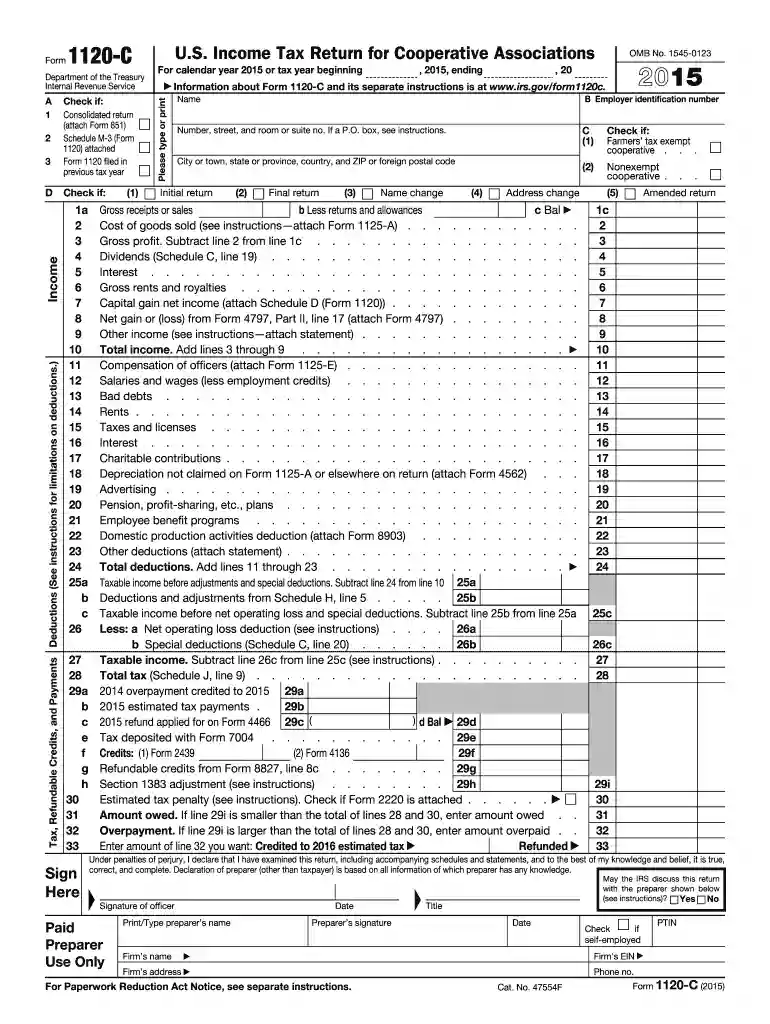
Type text, add images, blackout confidential details, add comments, highlights and more.

Draw your signature, type it, upload its image, or use your mobile device as a signature pad.

Send it via email, link, or fax. You can also download it, export it or print it out.
Form 1120-C, known as the U.S. Income Tax Return for Cooperative Associations, is specifically designed for cooperative associations to report their annual income, deductions, and credits. The form encompasses a variety of sections, detailing gross receipts, the cost of goods sold, and taxable income calculations. Cooperative associations use this form to declare their financial activities for the tax year 2015, complying with IRS regulations. The completion of Form 1120-C helps ensure accurate reporting and determination of tax obligations, aligning with the cooperative's unique tax structure.
Filing Form 1120-C involves a structured process to ensure all financial aspects of the cooperative are accurately reported. To complete the form, cooperatives must gather precise financial information and address different sections as required. Here’s a breakdown of how to navigate the form:
The preparation of Form 1120-C requires methodical steps to ensure completeness and accuracy. These steps outline how cooperative associations can correctly file their tax return:
The Form 1120-C must be filed by cooperative associations that engage in business in the U.S. and meet specific tax criteria. Eligibility is determined by factors such as the type of business and filing status. Cooperatives owned by members who use its goods or services typically need to file this form. Understanding these parameters helps in determining if a cooperative must comply by utilizing Form 1120-C.
The IRS provides guidelines that outline how cooperative associations need to file Form 1120-C. Compliance with these instructions ensures the cooperative is adhering to federal tax laws. The comprehensive guidelines delineate the types of income to report, deductible expenses, and other tax-related obligations specific to cooperatives.
For the 2015 tax year, it is critical to adhere to the deadline for filing Form 1120-C. Missing these key dates can result in penalties, adding unnecessary financial burden on the cooperative. Knowing the deadlines also ensures that the cooperative can organize and file all necessary paperwork in advance.
When preparing Form 1120-C, specific documents are necessary to ensure the accuracy and compliance of financial reporting. These documents provide the basis for calculations and entries made on the form, serving as proof of financial transactions.
Cooperatives that fail to comply with IRS requirements when filing Form 1120-C may face penalties. These can include financial fines for late submissions or inaccuracies in reported information. Understanding these penalties encourages accurate and timely filing by cooperative associations.
We've got more versions of the 2015 form 1120 c form. Select the right 2015 form 1120 c version from the list and start editing it straight away!
| Versions | Form popularity | Fillable & printable |
|---|---|---|
| 2025 | 4.6 Satisfied (37 Votes) | |
| 2024 | 4.7 Satisfied (24 Votes) | |
| 2023 | 4.4 Satisfied (31 Votes) | |
| 2022 | 4.4 Satisfied (36 Votes) | |
| 2021 | 4.8 Satisfied (181 Votes) | |
| 2020 | 4.4 Satisfied (138 Votes) | |
| 2019 | 4.1 Satisfied (81 Votes) | |
| 2018 | 4.3 Satisfied (301 Votes) | |
| 2017 | 4.3 Satisfied (105 Votes) | |
| 2016 | 4.3 Satisfied (55 Votes) | |
| 2015 | 4.1 Satisfied (59 Votes) | |
| 2014 | 4.2 Satisfied (40 Votes) | |
| 2013 | 4.4 Satisfied (37 Votes) | |
| 2012 | 4 Satisfied (42 Votes) | |
| 2011 | 4 Satisfied (30 Votes) |
At DocHub, your data security is our priority. We follow HIPAA, SOC2, GDPR, and other standards, so you can work on your documents with confidence.
Instructions for Completing the Business/Farm Supplement. This form should be completed by the owner for each business or farm. Use your 2015 and 2016 IRS taxRead more
Comparison of MRI/ultrasound fusionguided biopsy with ultrasound-guided biopsy for the diagnosis of prostate cancer. JAMA. 2015;313:390-7. Ahmed H, Bosaily A,Read more
If Yes, attach a statement showing: (a) name and employer identification number (EIN), (b) percentage owned, and (c) taxable income or. (loss) before NOL andRead more


