




Here's how it works

01. Edit your et 133 instructions online
Type text, add images, blackout confidential details, add comments, highlights and more.

02. Sign it in a few clicks
Draw your signature, type it, upload its image, or use your mobile device as a signature pad.

03. Share your form with others
Send it via email, link, or fax. You can also download it, export it or print it out.
How to use or fill out nys et 133 2013 form with our platform

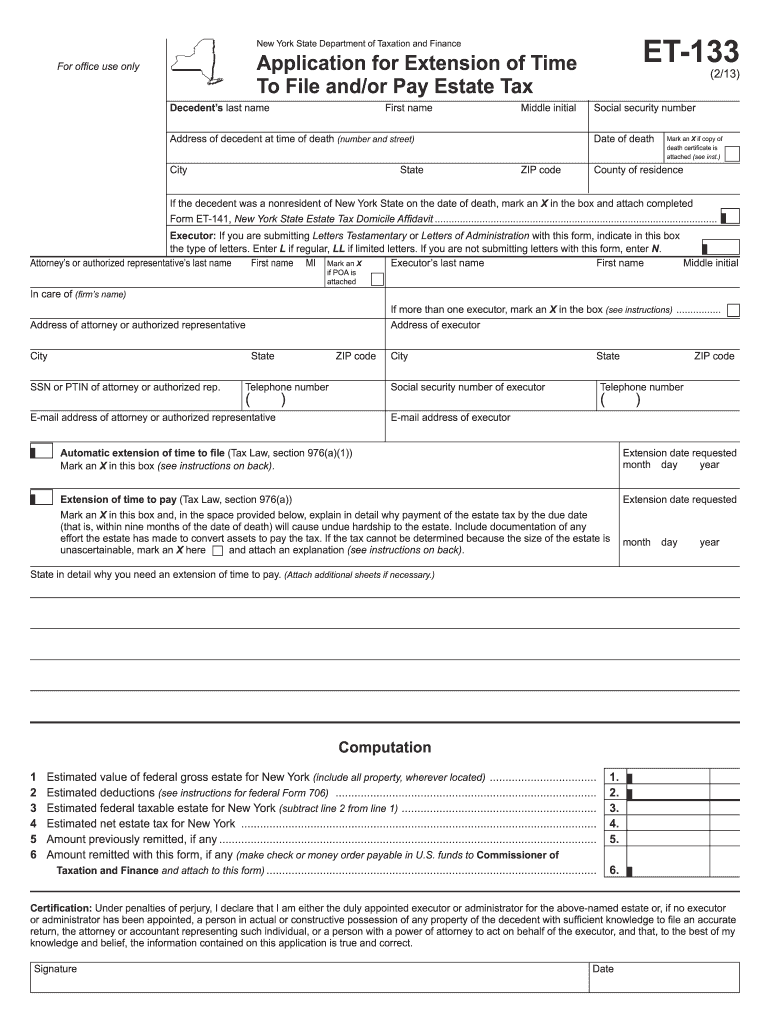
- Click ‘Get Form’ to open the NYS ET-133 form in the editor.
- Begin by entering the decedent's last name, first name, middle initial, and social security number in the designated fields.
- Fill in the address of the decedent at the time of death, including city, county of residence, state, and ZIP code.
- Indicate if a copy of the death certificate is attached by marking an X in the appropriate box.
- If applicable, mark an X for non-residency and attach Form ET-141. Provide details about the executor and authorized representative as required.
- Complete sections regarding extensions for filing and payment. Clearly explain any hardships that necessitate an extension.
- In the computation section, accurately estimate values for federal gross estate and deductions. Ensure all calculations are correct before submission.
- Finally, certify your information by signing and dating where indicated. Review all entries for accuracy before submitting your form.
Start using our platform today to streamline your document editing and form completion process for free!
Fill out nys et 133 2013 form online
It's free
It's free
See more nys et 133 2013 form versions
We've got more versions of the nys et 133 2013 form form. Select the right nys et 133 2013 form version from the list and start editing it straight away!
Got questions?
We have answers to the most popular questions from our customers. If you can't find an answer to your question, please contact us.
Contact us
What is the NYS estate tax exemption?
In New York, the estate tax exclusion amount for 2025 is set at $7.16 million (up from $6.94 million in 2024). Unlike the federal system, New Yorks estate tax includes a cliff that can result in estates slightly exceeding the exemption amount being taxed on the entire estate value, not just the excess.
Do I have to file an estate tax return in NY?
Residents. The estate of a New York State resident must file a New York State estate tax return if the following exceeds the basic exclusion amount: the amount of the residents federal gross estate, plus. the amount of any includible gifts.
Who has to file a NYS estate tax return?
Filing Requirements Residents: The estate of a New York resident must file a New York State estate tax return if the amount of the residents federal gross estate, plus the amount of any includible gifts, exceeds the basic exclusion amount applicable at the date of death.
How to get New York State tax forms?
Online Visit the Department of Taxation and Finance website. Download State tax forms. Learn about Tax Warrants.
Who is responsible for filing an estate tax return?
The personal representative is responsible for filing any final individual income tax return(s) and the estate tax return of the decedent when due. You may need to file Form 56, Notice Concerning Fiduciary Relationship to notify the IRS of the existence of a fiduciary relationship.
Security and compliance
At DocHub, your data security is our priority. We follow HIPAA, SOC2, GDPR, and other standards, so you can work on your documents with confidence.
Learn more


People also ask
Does everyone have to file an estate tax return?
An estate tax return (Form 706) must be filed if the gross estate of the decedent (who is a U.S. citizen or resident), increased by the decedents adjusted taxable gifts and specific gift tax exemption, is valued at more than the filing threshold for the year of the decedents death, as shown in the table below.
What is the threshold for NY estate tax?
The exemption threshold represents an estates maximum value before being subject to estate tax. In 2024, New Yorks estate tax exemption threshold was $6.58 million. However, this threshold is adjusted annually for inflation. For the upcoming year, the threshold is set at $7.16 million.
What is the form for estate tax return in NY?
You must file Form ET-706 within nine months after the decedents date of death, unless you receive an extension of time to file the return. An extension of time to file the estate tax return may not exceed six months, unless the executor is out of the country.