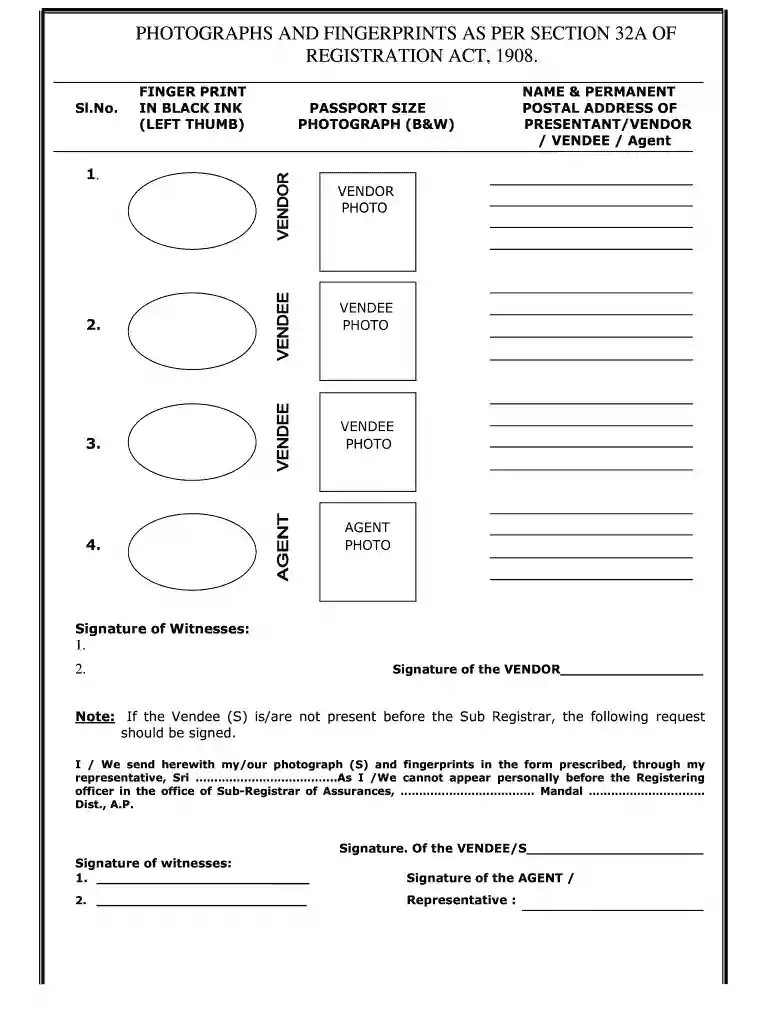
Definition and Meaning of Section 32 A of Registration Act 1908
Section 32 A of the Registration Act, 1908, pertains to the requirements and procedures for the registration of certain types of documents in India, specifically in the context of real estate transactions. This section lays down the framework for the registration process, including stipulations regarding the presentation of documents, authentication, and the roles of various parties in the transaction.
- Purpose: The primary aim of Section 32 A is to ensure transparency and legal validity in the transfer of properties. It mandates that specific documents must be registered to safeguard the interests of both parties involved in a transaction.
- Scope: This section applies to various types of documents, including agreements for sale, conveyance deeds, and leases that exceed a certain period, thus making it critical for real estate dealings.
- Benefits: Utilizing Section 32 A in real estate transactions helps to establish clear ownership rights and can serve as legal evidence in disputes concerning property ownership or transfer.
Steps to Complete the Section 32 A Registration Process
Completing the registration process as per Section 32 A involves several systematic steps. Understanding these steps ensures compliance and smooth processing.
- Gather Required Documents: Collect all necessary documents such as identity proof, address proof, and the original document intended for registration.
- Prepare the Document: Ensure that the document to be registered is accurately drafted and includes all requisite details. For instance, the document should delineate the parties involved, property description, and consideration amount.
- Submission at the Relevant Office: Present the document at the local sub-registrar's office. Ensure the presence of both parties to the transaction, as their signatures are crucial.
- Payment of Fees: Pay the requisite stamp duty and registration fees, which may vary by state.
- Acknowledgment: After verification, the registrar will issue an acknowledgment of the transaction, which can be essential for future reference.
- Obtain the Registered Document: Once processed, obtain the registered copy of the document, which serves as proof of the transaction.
Important Terms Related to Section 32 A
Understanding key terminology associated with Section 32 A can facilitate a clearer comprehension of real estate registration processes:
- Deed: A legal document that represents the transfer of property ownership.
- Stamp Duty: A tax applicable on the transfer of property, which must be paid for the registration to be valid.
- Sub-Registrar: The government official responsible for overseeing the registration of documents.
- Execution: The formal signing of a document by the parties involved, signifying their agreement.
- Registration: The official recording of a document with the relevant authority, providing it legal standing.
Who Typically Uses Section 32 A
The application of Section 32 A extends across various stakeholders in real estate transactions, including:
- Property Buyers and Sellers: Individuals or businesses engaged in buying or selling real estate need to comply with Section 32 A to ensure legal transfer.
- Real Estate Agents: Agents act on behalf of buyers and sellers, guiding them through the document preparation and registration process.
- Legal Professionals: Lawyers and legal advisors assist clients in understanding their rights and obligations under this section.
- Financial Institutions: Banks and lenders may require registration under Section 32 A as a condition for property financing.
State-Specific Rules for Section 32 A
While Section 32 A provides a national framework, individual states may have additional rules or variations concerning property registration:
- Stamp Duty Rates: Different states impose varying rates of stamp duty, affecting the overall cost of registration.
- Operational Guidelines: Certain states may have specific guidelines regarding the documentation required or the processing timelines at sub-registrar offices.
- Local Practices: Practices may differ based on regional legal customs, which can influence the registration process and associated requirements.
Understanding these variations is crucial for compliance and seamless property transactions across different states.
Examples of Using Section 32 A in Real Estate Transactions
Real-world applications of Section 32 A exemplify its significance in property transactions:
- Sale of Residential Property: When an individual sells their home, both the seller and buyer ensure that the sale deed is registered under Section 32 A, providing legal security for the new owner.
- Commercial Lease Agreements: For long-term commercial leases exceeding a specified duration, landlords and tenants follow Section 32 A to register the lease, thereby safeguarding both parties' rights.
- Transfer of Agricultural Land: In many states, the sale of agricultural land necessitates adherence to Section 32 A to ensure that the transfer is recognized legally and can be defended in potential disputes.
Required Documents for Section 32 A Registration
To successfully register documents under Section 32 A, specific documentation is necessary:
- Identity Proof: Government-issued identification for all parties, such as a driver's license or passport.
- Proof of Ownership: Documents proving the seller's ownership, like earlier title deeds or agreements.
- Property Details: Any legal surveys, maps, or documentation highlighting property boundaries and dimensions.
- Financial Proof: Evidence of payment or financial transactions related to the property, which aids in validating the sale consideration.
These documents facilitate a smooth registration process and help avoid legal hurdles.
Understanding these aspects of Section 32 A not only streamlines legal compliance but also fosters informed decision-making in real estate transactions.