




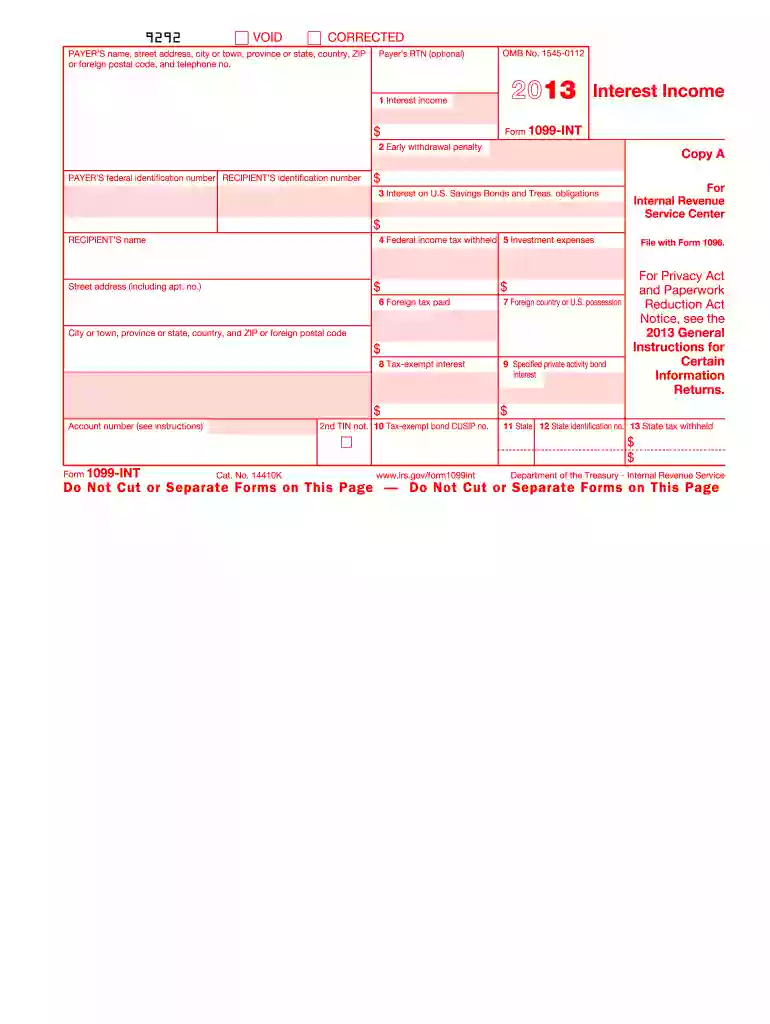
01. Edit your irs form 1099 int rev 10 2013 online
Type text, add images, blackout confidential details, add comments, highlights and more.

Type text, add images, blackout confidential details, add comments, highlights and more.

Draw your signature, type it, upload its image, or use your mobile device as a signature pad.

Send form 1099 int rev 10 2013 from irs via email, link, or fax. You can also download it, export it or print it out.
Form 1099-INT is a tax document used by banks, savings institutions, and other financial entities to report interest income paid to individuals or entities. When a person earns more than $10 in interest during the tax year, the payer is required to file Form 1099-INT with the IRS and provide a copy to the payee. This form is essential in tax reporting to ensure accuracy in reflecting interest income, which is taxable.
Interest reported includes savings accounts, certificates of deposit (CDs), and other interest-bearing accounts, making this form crucial for those with diverse financial portfolios.
Completing the 2013 Form 1099-INT involves several key steps, ensuring that all required information is accurately entered.
Gather Required Information:
Fill Out Part I – Interest Income:
Complete Box 4 – Federal Tax Withheld:
Double-Check Additional Boxes:
Submit to the IRS and Recipient:
The recipients of Form 1099-INT primarily include individual taxpayers and distinct business entities that earn interest income exceeding the $10 threshold.


Financial institutions, principal middlemen, and nominees acting for individuals or entities are commonly responsible for issuing the form.

The IRS provides detailed guidelines to ensure proper compliance when filing Form 1099-INT.
Understanding these guidelines helps taxpayers and payers avoid penalties and ensure accuracy in reporting.
Failing to comply with IRS regulations for Form 1099-INT can result in severe penalties.
Compliance is paramount, ensuring that taxpayers report interest income correctly and without incurring additional penalties.
Both digital and paper versions of Form 1099-INT are available, each with distinct advantages.
Taxpayers can utilize various software solutions to prepare and submit Form 1099-INT, enhancing efficiency.
Proper use of these tools improves the preciseness of tax reporting and streamlines the filing process.
We've got more versions of the irs form 1099 int rev 10 2013 form. Select the right irs form 1099 int rev 10 2013 version from the list and start editing it straight away!
| Versions | Form popularity | Fillable & printable |
|---|---|---|
| 2024 | 4.3 Satisfied (34 Votes) | |
| 2022 | 4.8 Satisfied (138 Votes) | |
| 2021 | 4.3 Satisfied (257 Votes) | |
| 2020 | 4.4 Satisfied (1530 Votes) | |
| 2019 | 4.4 Satisfied (645 Votes) | |
| 2018 | 4.4 Satisfied (244 Votes) | |
| 2017 | 4.4 Satisfied (28 Votes) | |
| 2016 | 4.4 Satisfied (300 Votes) | |
| 2015 | 4.2 Satisfied (49 Votes) | |
| 2014 | 4.1 Satisfied (63 Votes) | |
| 2013 | 4.4 Satisfied (38 Votes) | |
| 2012 | 4.3 Satisfied (71 Votes) | |
| 2011 | 4 Satisfied (44 Votes) | |
| 2010 | 4 Satisfied (40 Votes) | |
| 1994 | 4 Satisfied (48 Votes) |
At DocHub, your data security is our priority. We follow HIPAA, SOC2, GDPR, and other standards, so you can work on your documents with confidence.



Form 1099-INT. 2013 Interest Income. Copy B. For Recipient. Department of the Treasury - Internal Revenue Service. This is important tax information and is.Read more
Sep 16, 2013 The Internal Revenue Bulletin is the authoritative instrument of the Commissioner of Internal Revenue for announcing official rulings andRead more
You should use the 2013 General Instructions for. Certain Information Returns and the 2013 Instructions for. Forms 1099-INT and 1099-OID to complete Form 1099-Read more


