Type text, add images, blackout confidential details, add comments, highlights and more.
02. Sign it in a few clicks
Draw your signature, type it, upload its image, or use your mobile device as a signature pad.
03. Share your form with others
Send it via email, link, or fax. You can also download it, export it or print it out.
How to use or fill out Energy Audit Workbook - energy wsu with our platform
Ease of Setup
DocHub User Ratings on G2
Ease of Use
DocHub User Ratings on G2
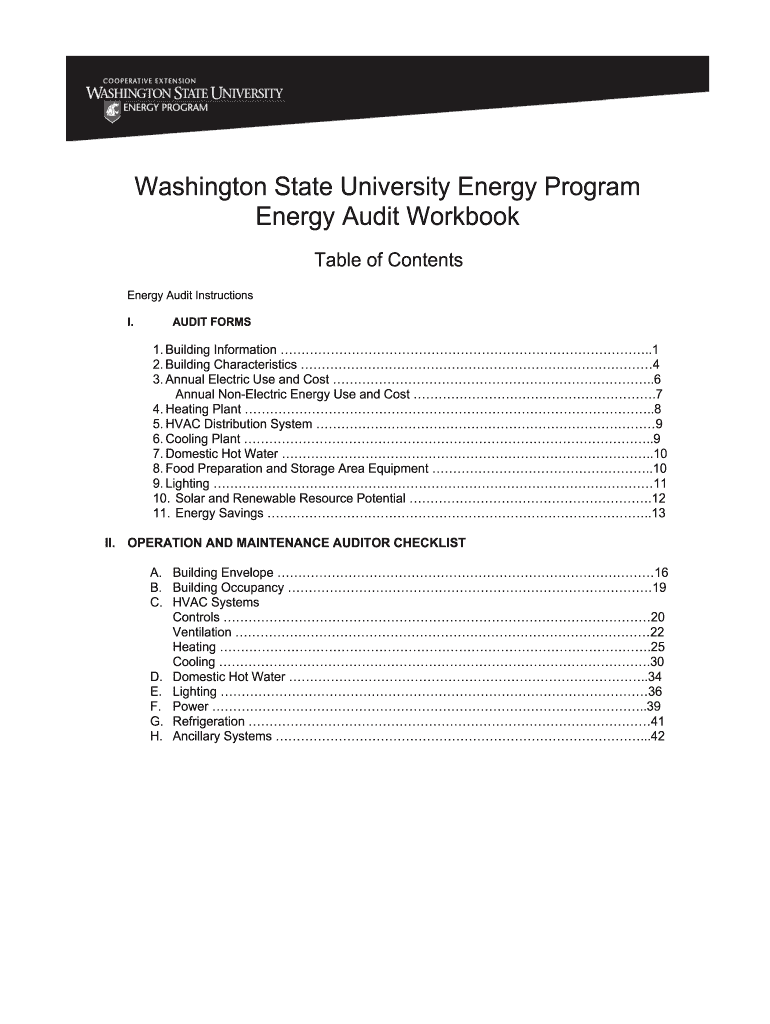
Click ‘Get Form’ to open the Energy Audit Workbook in the editor.
Begin with the 'Building Information' section. Fill in details such as the name of the institution, address, and contact information for the building manager and energy management coordinator.
Proceed to 'Building Characteristics'. Here, you will input data regarding gross floor area, door areas, and insulation types. Ensure all measurements are accurate for effective energy analysis.
In the 'Annual Electric Use and Cost' section, enter your utility account number and meter readings. This data is crucial for calculating energy efficiency.
Continue through each section systematically, including HVAC systems, lighting, and renewable resources potential. Utilize our platform's features to highlight or annotate important fields as needed.
Once completed, review all entries for accuracy before saving or exporting your filled workbook for submission.
Start using our platform today to streamline your Energy Audit Workbook process for free!
Fill out Energy Audit Workbook - energy wsu online It's free
Energy audit workbook energy wsu pdfEnergy audit workbook energy wsu pdf freeEnergy audit workbook energy wsu 2022Wsu renewable energy program2021 Energy Credit worksheetWSU energy codeWsu energy code worksheet 2021 pdfWashington state Energy
Security and compliance
At DocHub, your data security is our priority. We follow HIPAA, SOC2, GDPR, and other standards, so you can work on your documents with confidence.
The WSU RESNET HERS program is a fee based service. The WSU program charges home energy auditors. $200 for administrative overview, required third partyRead more
PE A - Indoor Air Vapor Intrusion Mitigation Approaches
Table of Contents. 1 PURPOSE. 2 INTRODUCTION. 2.1 Subject and Intended Audience. 2.2 Overview of Contaminant Entry into Structures and Mitigation.Read more
Cookie consent notice
This site uses cookies to enhance site navigation and personalize your experience.
By using this site you agree to our use of cookies as described in our Privacy Notice.
You can modify your selections by visiting our Cookie and Advertising Notice.