




01. Edit your eleot observation tool pdf online
Type text, add images, blackout confidential details, add comments, highlights and more.

Type text, add images, blackout confidential details, add comments, highlights and more.

Draw your signature, type it, upload its image, or use your mobile device as a signature pad.

Send eleot login via email, link, or fax. You can also download it, export it or print it out.
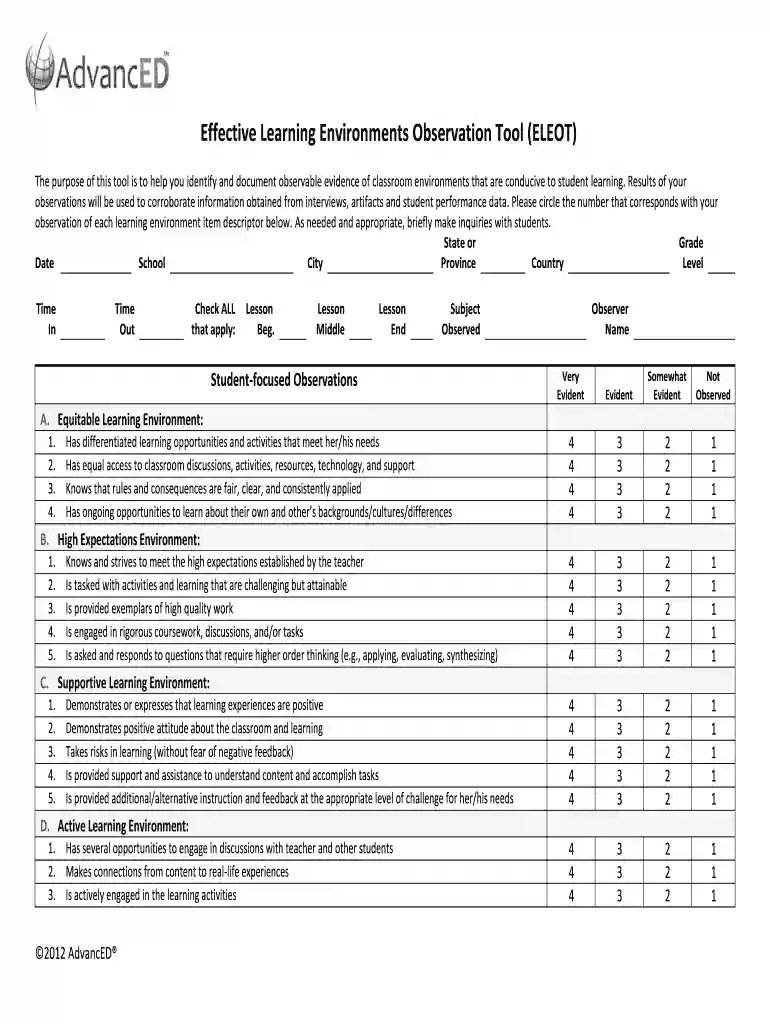
The Effective Learning Environments Observation Tool (ELEOT) serves as a critical instrument for assessing classroom environments that facilitate student learning. It provides a standardized framework that enables educators and administrators to evaluate various dimensions of the learning experience. These dimensions include equity, high expectations for all students, student engagement, active learning, effective progress monitoring, classroom management, and the integration of digital tools. Using the ELEOT, observers can identify strengths and areas for improvement within educational settings, thus contributing to enhanced learning outcomes.
Observations documented through the ELEOT are supported by a rating scale that allows evaluators to assign qualitative metrics to different aspects of classroom dynamics. This evaluation method is important for fostering environments that prioritize not only academic achievement but also social and emotional development among students. The model is grounded in the principles of equity and inclusivity, making it a valuable resource for schools committed to comprehensive educational practices.
Preparation: Before the observation begins, ensure the necessary context is set. This includes understanding the classroom environment, the lesson plan, and the specific objectives of the observation. Collect any background materials that may enhance your assessment.
Access the ELEOT PDF: Obtain the latest version of the ELEOT observation tool PDF, ensuring it reflects any recent updates. The document can often be accessed through educational institutions or official training programs.
Conduct Observations: During classroom observations, utilize the rating scale within the PDF to document your findings. Focus on each aspect of learning described in the tool. Jot down specific examples to support your evaluations.
Aggregate Data: After the observation, compile the data collected, translating your ratings into actionable insights. This could include identifying patterns, strengths, and target areas for improvement.
Share Feedback: Present your findings to relevant stakeholders, such as teachers and administrators. Constructive feedback should aim at fostering an environment of continuous improvement based on the observations made.
Accessing the ELEOT observation tool PDF can typically be achieved through several avenues:
Educational Institutions: Many educational entities provide direct access to the ELEOT PDF for their staff. Check with the administration or the educational department within your institution.
Official Websites: The ELEOT is often available for download on educational service organization websites, such as Cognia. These platforms usually host essential resources for educators.
Training Workshops: Participate in workshops or training sessions focused on educational assessment techniques. Participants often receive copies of the necessary forms, including the ELEOT PDF.
Professional Development Courses: Enroll in ongoing professional development that explores classroom evaluation tools. These courses may provide access to the ELEOT as part of their curriculum.
The ELEOT observation tool is structured around several key elements that guide evaluators in their observations:
High Expectations: Observers assess whether the classroom demonstrates an expectation for all students to excel, indicating a growth mindset set by educators.
Equity: Evaluators look for practices that ensure all students have access to learning resources and opportunities.
Active Engagement: This element evaluates how actively students participate in their own learning process, including collaboration and inquiry.
Supportive Environment: Assessments consider the overall classroom climate and support systems available for students, promoting a safe and productive learning space.
Digital Integration: Observers examine how technology is integrated into instruction and whether it supports learning objectives effectively.
Using the ELEOT tool can manifest in various practical scenarios across educational settings:
Professional Learning Communities (PLCs): Educators may use the ELEOT to collaboratively review observations from multiple classrooms, improving their instructional practice collectively.
Formal Evaluations: School administrators often employ the ELEOT during formal evaluation periods to provide structured feedback based on direct observations.
Program Development: The insights gained from using the ELEOT can inform professional development programs tailored to specific needs within a school or district.
Continuous Improvement Plans: Data collected via the ELEOT can support the development of school improvement plans that address identified weaknesses in teaching practices or learning environments.
Understanding the terminology associated with the ELEOT observation tool is essential for effective use:
Observation Framework: The underlying structure that guides how observations are conducted and assessed.
Rating Scale: A method used to quantify qualitative observations, translating subjective evaluations into measurable data points.
Learning Environment: Refers to the physical and psychological spaces in which learning occurs, influencing student outcomes.
Stakeholder Feedback: Input from educators, students, and parents that can shape the context and implementation of the observations.
These terms help ensure all users communicate effectively and understand the context and intention behind each observation and evaluation.
We've got more versions of the eleot observation tool pdf form. Select the right eleot observation tool pdf version from the list and start editing it straight away!
| Versions | Form popularity | Fillable & printable |
|---|---|---|
| 2012 | 4.8 Satisfied (110 Votes) |
At DocHub, your data security is our priority. We follow HIPAA, SOC2, GDPR, and other standards, so you can work on your documents with confidence.
Feb 20, 2026 Cognias Effective Learning Environments Observation Tool (eleot) is a learner-centric classroom observation tool that comprises 28 itemsRead more
The observation component of the 2019-2020 case study for initial completers was conducted using the. Effective Learning Environment Observation Tool (eleotTM).Read more
We started late (traffic). with an all male group, with no Huntington materials (shipping snafu), and general panic. The only high point at the.


