




01. Edit your pediatric registration form online
Type text, add images, blackout confidential details, add comments, highlights and more.

Type text, add images, blackout confidential details, add comments, highlights and more.

Draw your signature, type it, upload its image, or use your mobile device as a signature pad.

Send new patient form template via email, link, or fax. You can also download it, export it or print it out.
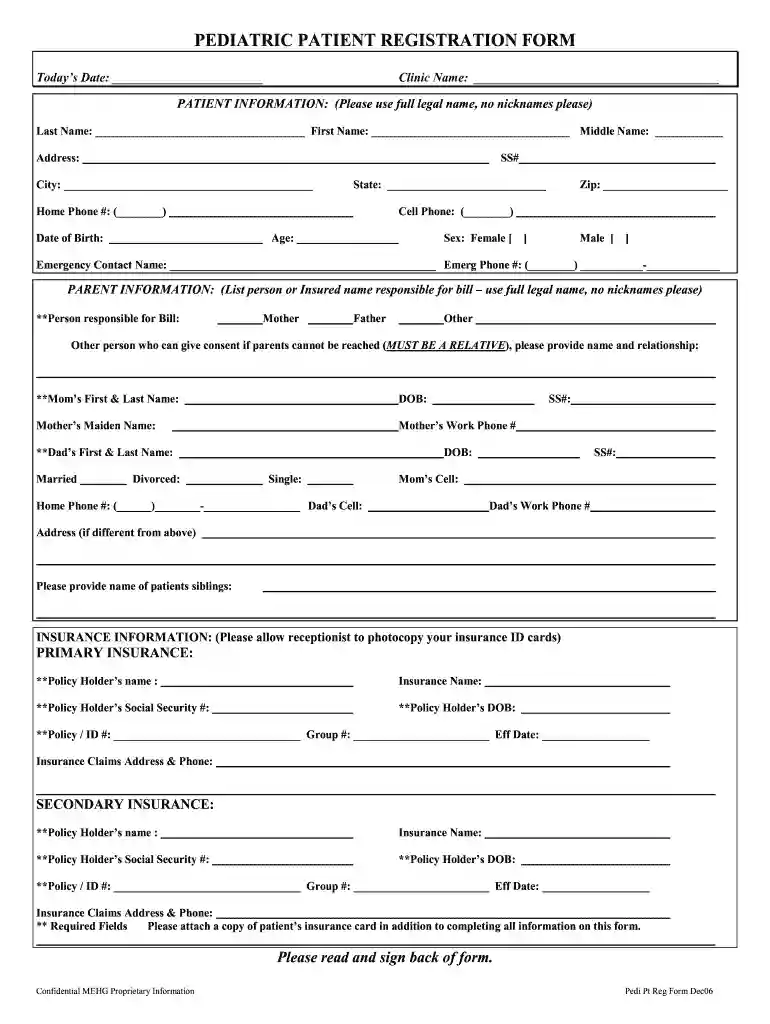
The pediatric patient registration form template is a standardized document designed to collect essential information about young patients who are seeking medical care. This form serves as the initial step in the patient onboarding process and captures data necessary for effective treatment, billing, and record management. Typically, the form requests information that includes:
The pediatric patient registration form is not only critical for establishing a medical record but also plays a significant role in ensuring compliance with laws governing healthcare operations, such as HIPAA. This template ensures that healthcare providers obtain the necessary consent to share and handle sensitive health information appropriately.
Understanding the key elements of a pediatric patient registration form template ensures all necessary information is collected efficiently. Each section serves a distinct purpose and contributes to the overall knowledge of the patient's healthcare needs. Below are the essential components:
Demographic Section: This includes basic personal information about the patient, such as:
Parent/Guardian Information: Critical for coordinating care, this section typically includes:
Insurance Details: Essential for billing, including:
Emergency Contact Information: At least one emergency contact must be listed:
Medical History Questions: Questions that help medical professionals assess the child's health needs, such as:
This structured approach to the registration process not only accelerates data collection but also enhances the accuracy of information documented in the child's health record. This information is vital for effective communication between healthcare providers and parents or guardians.
Filling out the pediatric patient registration form template can be straightforward if approached methodically. Below is a step-by-step guide to ensure all necessary information is provided thoroughly:
Gather Necessary Documents: Before starting, collect the patient’s health insurance card, any medical history documents, and identification for parents or guardians.
Fill in Patient Demographics: Start with the patient's name, date of birth, and other personal information.
Enter Parent or Guardian Information: Complete the section for parents or guardians, including their contact information and relationship to the patient.
Document Insurance Details: Provide the insurance provider's name, policy, and group numbers accurately to prevent billing issues.
List Emergency Contacts: Identify and list one or more individuals who can be contacted in emergencies, ensuring their availability.
Answer Medical History Questions: Complete this section with honesty and accuracy, including any known allergies, medical conditions, and current medications.
Review and Sign: After filling out the entire form, review all the information for accuracy. Sign the form to authorize consent for treatment and information sharing as required.
By following these steps, parents and guardians can complete the form efficiently, contributing to a smooth patient registration experience.
The pediatric patient registration form template is not only a tool for collecting information but also an important legal document that ensures compliance with various healthcare regulations. Here are critical legal aspects to consider:
HIPAA Compliance: The form includes consent sections that adhere to the Health Insurance Portability and Accountability Act (HIPAA). This law protects patient privacy by regulating how personal health information can be used and disclosed. Parents or guardians must provide signed consent to authorize the use of their child’s health data.
Informed Consent: The template often includes sections for parents or guardians to confirm that they understand their rights regarding medical treatment and the information provided. This acknowledgment is critical in legal contexts, particularly if disputes arise concerning treatment.
Retention of Records: Healthcare providers must maintain completed registration forms as part of the child’s medical records. Legal guidelines dictate how long these records should be kept and under what circumstances they can be released.
Understanding these legal considerations ensures that healthcare providers not only protect the rights of patients and their families but also safeguard their practices from potential litigation risks.
Familiarizing yourself with essential terminology associated with the pediatric patient registration form template can enhance understanding and improve communication between healthcare providers and families. Key terms include:
Guarantor: The person who is responsible for the payment of medical bills and may not always be the patient’s parent. This individual must be clearly identified on the form.
Authorization: A formal statement from a parent or guardian granting permission for the healthcare provider to access and use the child’s medical information for treatment.
Sensitive Health Information: Data protected under privacy laws, including demographics, medical history, and insurance. Unauthorized sharing or disclosure of this information can lead to legal penalties.
Medically Necessary: Refers to services or items that a healthcare provider deems appropriate for the diagnosis or treatment of a patient's condition. This is often a factor in insurance coverage decisions.
Understanding these terms fosters a better dialogue around the registration process, contributing to a more effective patient experience in pediatrics.
We've got more versions of the pediatric registration form form. Select the right pediatric registration form version from the list and start editing it straight away!
| Versions | Form popularity | Fillable & printable |
|---|---|---|
| 2006 | 4.9 Satisfied (45 Votes) |
Sure, and it’s really straightforward! DocHub is a web-based PDF editor with advanced document processing features that allow you rapidly edit your documents, fill out blank fields and insert new ones for others to fill out, and create eSignatures in several ways. Import your pediatric form, give information as required, and select how you want to eSign your document - by typing your name, drawing your signature, uploading its picture, or using a QR code.
With a swift editing system like DocHub, you do not require anything but a web browser and connection to the internet to modify your new patient information form template on the internet easily. Add your file or get the appropriate form in DocHub’s catalog, open our editor with one click, and finish it digitally. To revise your forms anytime, register a free profile with DocHub.
At DocHub, your data security is our priority. We follow HIPAA, SOC2, GDPR, and other standards, so you can work on your documents with confidence.
Adult Patient Registration Packet Student and Pediatric Patient Registration Packet Pediatric Patient Consent Letter Patient Welcome Packet AdvancedRead more
Guidance over registration was issued. The subteam read the first two chapters of the business plan manual developed by previous Cornell iGEM Business teams.Read more
Patient must be present to sign the form in front of the physician. Please call the office in advance for a time that is mutually convenient for this meeting.Read more


