




01. Edit your poultry record keeping templates excel online
Type text, add images, blackout confidential details, add comments, highlights and more.

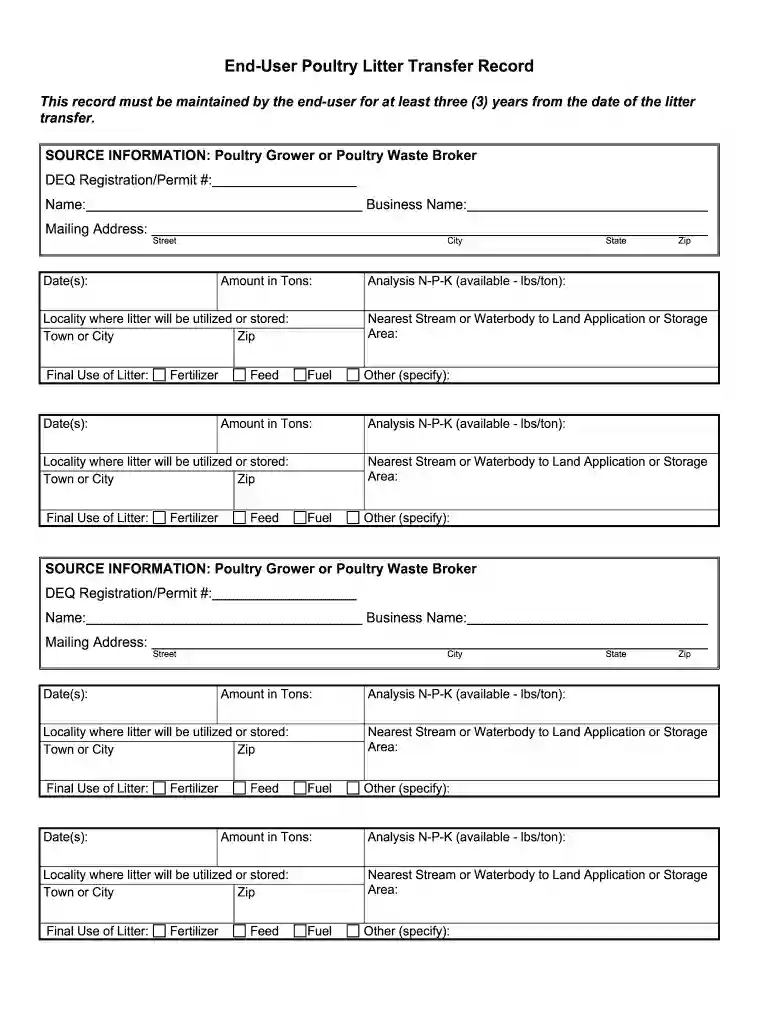
Type text, add images, blackout confidential details, add comments, highlights and more.

Draw your signature, type it, upload its image, or use your mobile device as a signature pad.

Send poultry record keeping templates excel free download via email, link, or fax. You can also download it, export it or print it out.
Poultry record keeping templates in Excel are structured spreadsheets designed to help poultry farmers maintain accurate and comprehensive records of their farming activities. These templates provide a systematic approach to tracking various aspects of poultry management, including feed consumption, mortality rates, breeding history, and sales data. Utilizing these templates ensures that farmers can monitor their operational efficiency and make informed decisions based on their flock's performance. Excel templates are favored for their versatility, ease of use, and capacity for data analysis, allowing farmers to generate reports and visualize trends over time.
Accurate records are essential for evaluating the success of farming practices, complying with regulatory requirements, and identifying areas for improvement. They help pinpoint trends such as death rates or production declines, which could indicate underlying health or management issues needing attention.
Using poultry record keeping templates in Excel involves several steps to ensure that the data recorded is both accurate and useful for analysis. Follow these guidelines to effectively utilize these templates:
Download the Template: Obtain the appropriate Excel template based on your specific needs—whether for layers (egg-laying hens) or broilers (meat birds).
Set Up Your Spreadsheet: Open the template and customize it by entering your farm's name, location, and any relevant details that may assist in future analyses.
Input Data Regularly: Consistently update the template with data relevant to your operations, including the number of birds, feed rates, and production outputs.
Review and Analyze: Utilize Excel's data analysis tools to review trends, identify anomalies, and generate reports that provide insights into flock performance.
Store and Back Up: Ensure that your completed records are stored securely and backed up regularly, either digitally in cloud storage or on a physical drive.
Maintaining up-to-date records in your Excel template is crucial. Daily input is preferable for extensive data tracking. Allocating specific times for data entry can help in keeping records consistent.
When utilizing poultry record keeping templates in Excel, it's vital to understand the key elements that should be included to create effective and comprehensive records.
Flock Inventory Tracking: This should list each batch of poultry, including details such as the type (e.g., layer or broiler), age, and breed.
Feeding Records: A section dedicated to feed types, amounts consumed, costs, and times of feeding to track feed efficiency and optimize costs.
Mortality Logs: Maintain records of bird losses, identifying dates, causes, and preventive measures to further investigate patterns over time.
Production Statistics: Capture measurements of eggs produced per hen or weight gain metrics for broilers, aiding in assessing productivity.
Sales Records: Document the sales of poultry, including dates, quantities sold, and revenue generated, helping assess the overall profitability of the farm.
Different poultry operations might require templates tailored to their specific needs, such as templates for organic farms, commercial-layer operations, or small-scale backyard poultry farms. Selecting the right one can significantly enhance the efficacy of record-keeping efforts.
Real-world scenarios illustrate how effective poultry record keeping can enhance farm management. For instance:
Managing Layer Production: A farmer operates a layer farm with two hundred hens. Using an Excel template, they track daily egg production, logging an average of one hundred fifty eggs per day. By analyzing this data weekly, they identify a dip in production related to a feed change, allowing them to adjust feed accordingly.
Broiler Performance Tracking: A broiler farmer records weight gains of their birds over six weeks using an Excel template. Each week, the average weight of the broilers is logged, leading to informed decisions on feed strategies that help maximize growth rates.
Cost Analysis: By maintaining a detailed record of all input costs (feed, medication, bedding) in a separate section, the farmer can calculate the cost per bird and evaluate profitability against sales data, assisting in budgeting for future flock purchases.
Incorporating Excel into daily operations not only streamlines the record-keeping process but also enables various types of analysis, promoting efficiency and better decision-making throughout the production cycle.
Poultry record keeping templates in Excel are utilized by a variety of stakeholders in the poultry industry, including:
Commercial Poultry Farmers: Large producers who manage extensive flocks and require continuous monitoring of production metrics for economic viability.
Small Farm Operators: Independent farmers focusing on niche markets (e.g., organic or free-range) who need accurate records to build consumer trust and ensure compliance with regulations.
Agricultural Researchers: Individuals conducting studies on poultry health or production systems who utilize data from these templates for research analysis and publication.
Consultants and Advisors: Agricultural consultants who assist farmers in improving operational efficiency and profitability by analyzing data trends recorded in templates.
Educational institutions teaching agriculture often utilize these templates to prepare students for real-world poultry farming scenarios, reinforcing the importance of thorough record-keeping practices.
In the United States, legal compliance is a critical aspect of poultry farming. Utilizing poultry record keeping templates in Excel helps ensure adherence to various regulations and standards, including:
Health Regulations: Documentation of health checks, vaccinations, and treatments is vital for regulatory compliance and to track any issues that may arise, providing proof of due diligence in animal care.
Environmental Compliance: Farmers are often required to maintain records regarding waste management and nutrient management to adhere to state and federal environmental regulations.
Business Licenses: Accurate records are often needed when applying for or renewing business licenses and permits. Having organized and detailed records can facilitate these processes.
Farmers should periodically review their records to ensure they meet all current legal requirements, which may change with evolving agricultural laws. Consider consulting legal advisors to confirm compliance in your operations.
To maximize effectiveness when completing poultry record keeping templates in Excel, follow these systematic steps:
Select the Right Template: Identify and choose a template that aligns with your specific poultry operation (layers, broilers, etc.).
Input Baseline Data: Enter essential baseline data, including the start date, flock type, initial inventory, and any pre-existing health issues.
Regular Updates: Schedule routine updates—daily or weekly—where you input data regarding feed, mortality, egg production, and health records.
Analyze Trends: Periodically review your records to assess performance trends and identify issues that require immediate attention or ongoing monitoring.
Backup & Store: Ensure your records are securely backed up to prevent data loss. Use cloud services or external drives for redundancy.
Consider establishing dedicated sections within the template for analyzing key performance indicators related to your farm operations, making it simpler to assess productivity levels and financial health.
Each of the sections provided elaborates extensively on relevant aspects of poultry record keeping templates in Excel, ensuring farmers have a comprehensive understanding of the importance, practical usage, and compliance implications.
Of course, electronically drawing your signature is acceptable, but only if you use a tool that complies with industry regulations and policies. Consider DocHub, which ensures eSignature validity under ESIGN and UETA requirements. All you need to eSign your poultry farm record keeping excel template is an account with DocHub and an internet connection. When you open your document in our editor, click Sign and choose the Draw option.
If you need to edit your broiler record keeping templates excel online swiftly, it does not matter what internet browser you use. DocHub’s straightforward editing instruments are accessible using any internet browser. Simply open the appropriate tab within our editor, add your document, and fill it out without stress.
At DocHub, your data security is our priority. We follow HIPAA, SOC2, GDPR, and other standards, so you can work on your documents with confidence.
Therefore, as a result of our research, we decided to include a survey on avian influenza in the poultry industry and GMOs, in the light of our solution.Read more
The Farm Records Book for Management spreadsheet is a tool designed to help farmers get a better understanding of their financial situation.
Sample Template Overview for Poultry Farm Excel Sheet Benefits of Using an Excel Sheet Over Traditional Record-Keeping While many poultry Yes, there are


