Minnesota ifp102 2026

Get Form
copy request Preview on Page 1

Here's how it works

01. Edit your copy request online
Type text, add images, blackout confidential details, add comments, highlights and more.
02. Sign it in a few clicks
Draw your signature, type it, upload its image, or use your mobile device as a signature pad.
03. Share your form with others
Send it via email, link, or fax. You can also download it, export it or print it out.

How to use or fill out minnesota ifp102 with our platform

Form edit decoration
9.5
Ease of Setup
DocHub User Ratings on G2
9.0
Ease of Use
DocHub User Ratings on G2
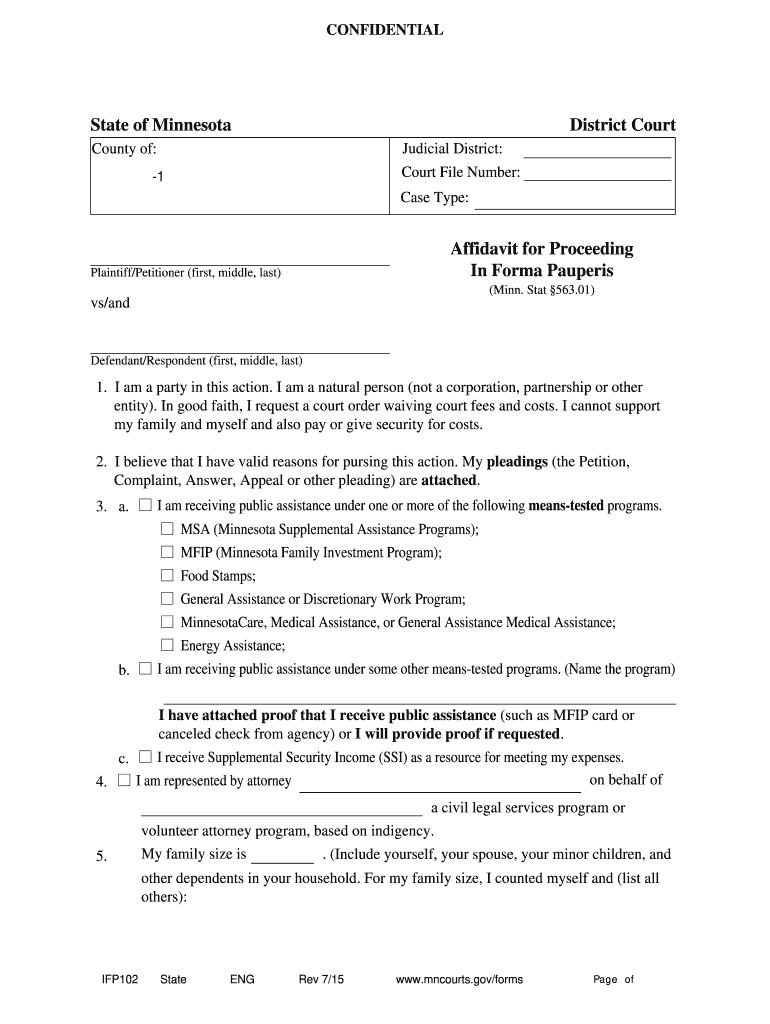
  1. Click ‘Get Form’ to open the Minnesota IFP102 in the editor.
  2. Begin by filling in the 'Judicial District' and 'County' fields at the top of the form. This information is essential for identifying your case.
  3. In the 'Plaintiff/Petitioner' and 'Defendant/Respondent' sections, enter your full names as required. Ensure accuracy to avoid any delays.
  4. Proceed to section 1, where you will affirm your status as a natural person and explain your financial situation. Be honest and clear about your inability to pay court fees.
  5. In section 3, check all applicable public assistance programs you are enrolled in. Attach proof of assistance as indicated.
  6. Complete sections regarding income, family size, and any debts. Provide accurate figures and attach necessary documentation for verification.
  7. Finally, review all entries for accuracy before signing the affidavit at the end of the form. This certifies that your statements are true under penalty of perjury.

Start using our platform today to fill out your Minnesota IFP102 form easily and for free!

See more minnesota ifp102 versions

We've got more versions of the minnesota ifp102 form. Select the right minnesota ifp102 version from the list and start editing it straight away!
Versions Form popularity Fillable & printable
2015 4.8 Satisfied (61 Votes)
2009 4 Satisfied (21 Votes)
be ready to get more

Complete this form in 5 minutes or less

Get form

Got questions?

We have answers to the most popular questions from our customers. If you can't find an answer to your question, please contact us.
Contact us
A default judgment may be vacated by the judge upon a proper showing by the defendant that: (1) the defendant did not receive a summons before the trial within sufficient time to permit a defense and did not receive notice of the order for default judgment within sufficient time to permit application for relief within
Minnesotas legal identity was created as the Minnesota Territory in 1849, and it became the 32nd U.S. state on May 11, 1858.
Affidavits often require notarization to enhance their legal validity and credibility. While not always mandatory, notarization adds significant weight to an affidavit in legal proceedings. It verifies the identity of the signer and confirms that they willingly signed the document under oath.
Affidavits generally carry greater formal weight and are typically preferred for court filings or formal proceedings. Declarations, while signed under penalty of perjury, lack notarization, making them suitable for less formal settings or jurisdictions that permit unsworn statements.
Rule 56. Summary Judgment A party may move for summary judgment, identifying each claim or defense - or the part of each claim or defense - on which summary judgment is sought.

Security and compliance

At DocHub, your data security is our priority. We follow HIPAA, SOC2, GDPR, and other standards, so you can work on your documents with confidence.

Learn more
ccpa2
pci-dss
gdpr-compliance
hipaa
soc-compliance
be ready to get more

Complete this form in 5 minutes or less

Get form

People also ask

In forma pauperis (IFP) is Latin for in the form of a pauper. IFP status is available to those who the Court determines do not have the resources to pay the $405.00 filing fee. To apply for IFP status, you must use the Courts Application to Proceed in District Court Without Prepaying Fees or Costs form.
358.116 COURT DOCUMENTS. Unless specifically required by court rule, a pleading, motion, affidavit, or other document filed with a court of the Minnesota judicial branch, or presented to a judge or judicial officer in support of a request for a court order, warrant, or other relief, is not required to be notarized.

Related links