




01. Edit your nordic musculoskeletal questionnaire pdf online
Type text, add images, blackout confidential details, add comments, highlights and more.

Type text, add images, blackout confidential details, add comments, highlights and more.

Draw your signature, type it, upload its image, or use your mobile device as a signature pad.

Send nordic questionnaire pdf via email, link, or fax. You can also download it, export it or print it out.
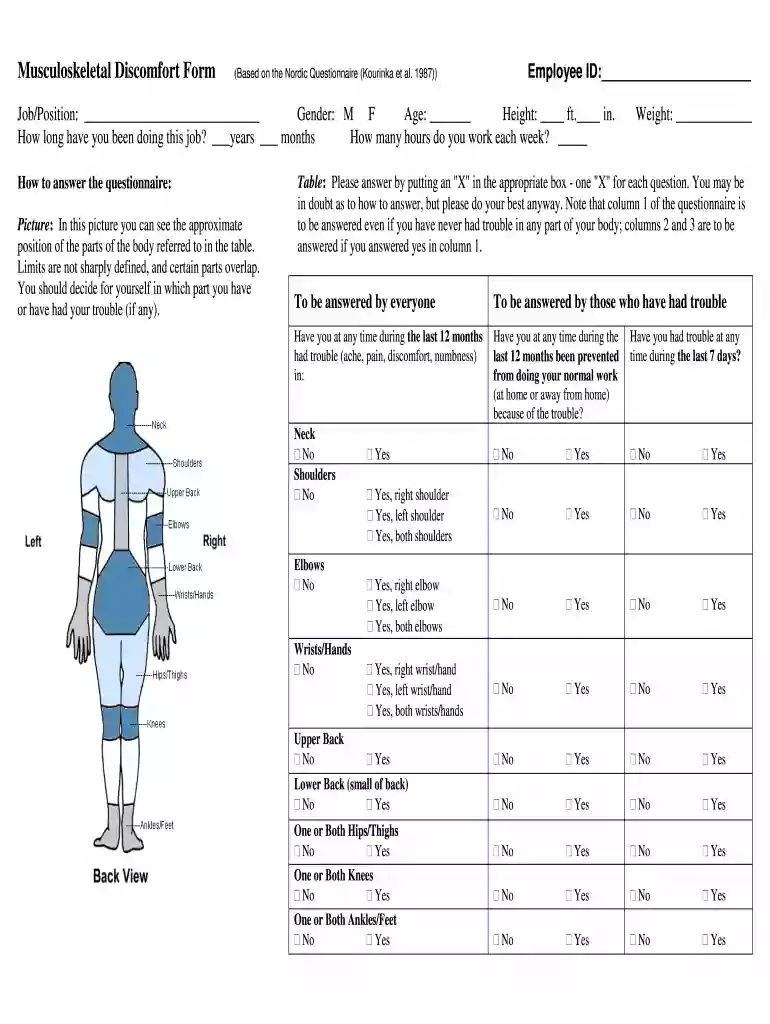
The Nordic Musculoskeletal Questionnaire (NMQ) is a standardised tool widely used to assess musculoskeletal discomfort. It focuses on various body parts and is designed to identify issues that may affect an individual's work performance. Respondents typically report on any aches, pains, or discomfort they have experienced over the past year, making it an invaluable resource for both healthcare professionals and employers.
The NMQ serves several essential functions in evaluating musculoskeletal health:
The questionnaire is broken down into several key sections:
Each section's answers help provide a comprehensive picture of the respondent's musculoskeletal health.
Administering the NMQ is straightforward, regardless of the method chosen for distribution:
Interpreting the results is crucial to understanding the overall musculoskeletal health of the assessed population:
Integrating the NMQ into workplace health programs can yield positive outcomes:
When using the NMQ, legal and ethical considerations must be addressed:
There are several versions and adaptations of the NMQ. Variations might include:
These variants help ensure that the tool remains relevant to diverse user groups and situations.
The NMQ is accessible as a digital PDF, often available for free download:
Each version of the questionnaire provides a structured approach to monitoring and understanding musculoskeletal health and can be adapted according to the specific needs of the user or a study's requirements.
At DocHub, your data security is our priority. We follow HIPAA, SOC2, GDPR, and other standards, so you can work on your documents with confidence.
The Nordic Musculoskeletal Questionnaire (NMQ) is a standardized tool designed for epidemiological studies to assess musculoskeletal complaints.Read more
questionnaire. Overall, 4% of men had ED as assessed by questionnaire, interviews identified a higher frequency of. ED (40%). Not reported. 1994 Feldman et alRead more
by CG Horn 2024 Cited by 5 The Nordic Musculoskeletal Questionnaire (NMQ) was explicitly designed to evaluate the prevalence and consequences of MSK pain, it has highRead more


