Pc 213 2026

Get Form
pc 213 Preview on Page 1

Here's how it works

01. Edit your form online
Type text, add images, blackout confidential details, add comments, highlights and more.
02. Sign it in a few clicks
Draw your signature, type it, upload its image, or use your mobile device as a signature pad.
03. Share your form with others
Send it via email, link, or fax. You can also download it, export it or print it out.

How to use or fill out pc 213 with our platform

Form edit decoration
9.5
Ease of Setup
DocHub User Ratings on G2
9.0
Ease of Use
DocHub User Ratings on G2
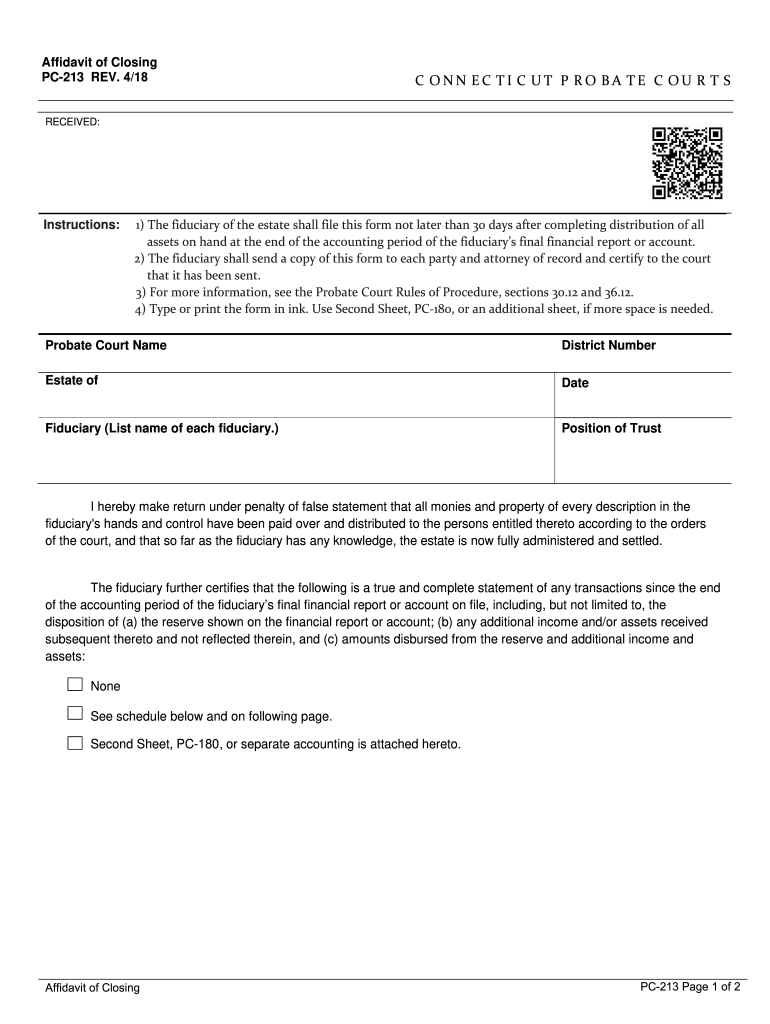
  1. Click ‘Get Form’ to open the PC-213 in the editor.
  2. Begin by entering the Probate Court Name and District Number at the top of the form. This information is crucial for proper filing.
  3. Fill in the Estate of section with the name of the estate being closed, followed by the Date of completion.
  4. List each fiduciary's name in the Fiduciary section, ensuring accuracy as this identifies those responsible for managing the estate.
  5. In the Affidavit section, confirm that all assets have been distributed according to court orders. This statement is made under penalty of false statement, so ensure all information is correct.
  6. If there are any transactions since your last financial report, detail them in the provided space or attach a Second Sheet (PC-180) if more room is needed.
  7. Complete the Certification section by listing names and addresses of individuals who received copies of this affidavit. Sign and date where indicated.

Start using our platform today to streamline your document editing and form completion for free!

See more pc 213 versions

We've got more versions of the pc 213 form. Select the right pc 213 version from the list and start editing it straight away!
Versions Form popularity Fillable & printable
2020 4.8 Satisfied (36 Votes)
2018 3.9 Satisfied (30 Votes)
2015 4.3 Satisfied (159 Votes)
be ready to get more

Complete this form in 5 minutes or less

Get form

Got questions?

We have answers to the most popular questions from our customers. If you can't find an answer to your question, please contact us.
Contact us
Any fixed blade knife can be a dirk or dagger under California law and should be carried openly in a sheath suspended from the waist. Various knives disguised as other objects are prohibited.
Definition and Elements of the Crime The defendant carried on his or her person a dirk or dagger. The defendant knew that he or she was carrying it. The dirk or dagger was substantially concealed on the defendants person. AND the defendant knew that it could readily be used as a stabbing weapon.
Penal Code 213 PC is the California statute that sets forth the punishment for the crime of robbery. Under this law, while robbery in the first degree is a felony offense punishable up to 9 years in state prison, second-degree robbery is a felony punishable by up to 5 years in prison.
Dirks were originally a single-edged weapon. By 1745, however, the weapon more commonly had a double-edged blade; this makes the dirk more or less synonymous with the dagger.
Conspiracy to commit a felony, or Penal Code 182(a)(1), is a felony itself. If the defendant is found guilty of conspiracy to commit a felony, he or she could face up to the same number of years as prescribed by the underlying felony.

People also ask

To convict you for this crime, prosecutors must show the following elements of the crime beyond a reasonable doubt: you carried on your person a dirk or dagger, you knew that you were carrying it, the dirk or dagger was substantially concealed on your person, and.
You Were Illegally Searched for the Dirk or Dagger Sometimes, law enforcement officers in California overreach when performing searches. If you were subjected to an illegal search, the evidence against you could be blocked, resulting in the dismissal of your PC 21310 charges.
Force, fear or fraud. To be convicted of kidnapping, the perpetrator must have used violence, force, threats or sometimes fraud. Californias simple kidnapping laws prohibit moving the victim, without their consent, by way of force or fear.

Related links