




01. Edit your hqp tmf 187 online
Type text, add images, blackout confidential details, add comments, highlights and more.

Type text, add images, blackout confidential details, add comments, highlights and more.

Draw your signature, type it, upload its image, or use your mobile device as a signature pad.

Send authorization letter for pag ibig loan via email, link, or fax. You can also download it, export it or print it out.
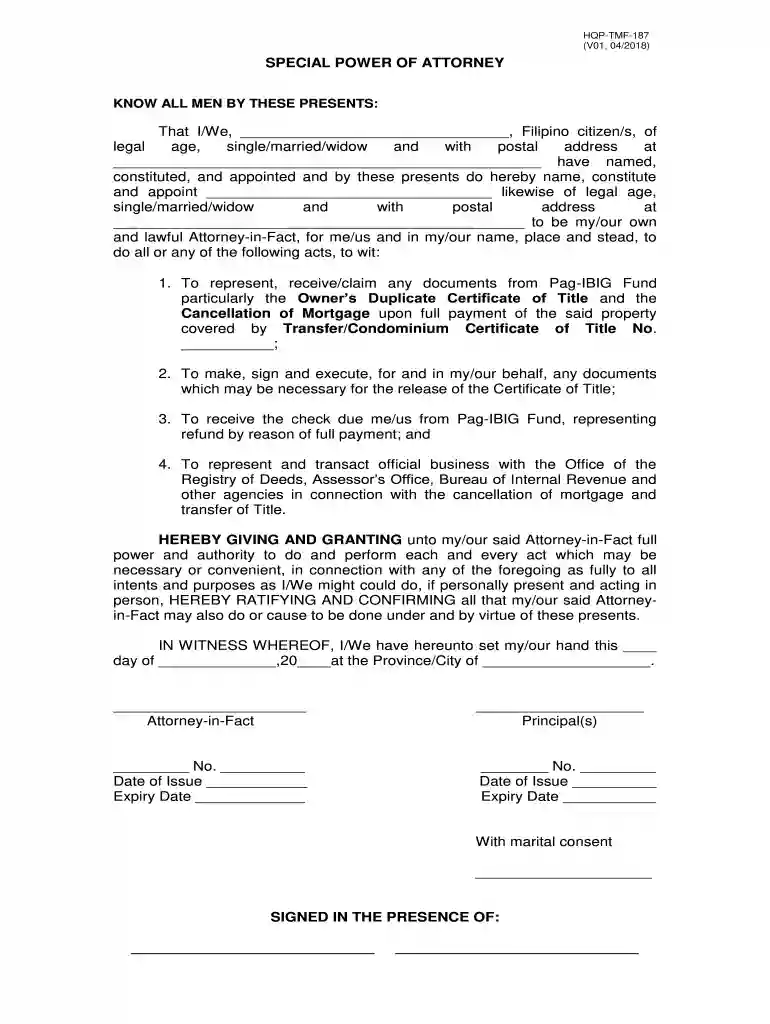
The HQP TMF 187 form is a pivotal document utilized for various financial transactions, primarily within the context of loan applications and financial authorizations. Understanding its structure and purpose is essential for effective usage.
The HQP TMF 187 serves as an authorization letter, specifically tailored for Pag-IBIG loans. It allows a designated person, often referred to as the Attorney-in-Fact, to handle specific transactions on behalf of the principal. This is particularly relevant when the principal is unable to directly attend to financial matters, which can include loan processing, submission of documents, and communication with financial institutions.
Understanding the components of the HQP TMF 187 is crucial for effective completion and execution. Each section of the form serves a specific purpose and must be accurately filled out.
Filling out the HQP TMF 187 adequately can prevent legal issues and streamline the process of loan application. Follow these steps for effective completion:
Legal compliance is a critical aspect of using the HQP TMF 187. The form must adhere to applicable laws to ensure that it is enforceable in court.
Several scenarios warrant the use of the HQP TMF 187, each with specific nuances that may affect how the form is employed.
Staying informed about the nuances of the HQP TMF 187 can assist in utilizing the form effectively.
Understanding the HQP TMF 187 is vital for facilitating important financial transactions while ensuring compliance with legal requirements. Being meticulous in completing and managing this document can provide peace of mind and facilitate smoother interactions with financial institutions.
We've got more versions of the hqp tmf 187 form. Select the right hqp tmf 187 version from the list and start editing it straight away!
Signing paperwork on a mobile device is fast, straightforward, and doesn’t require software installation when you have an account with DocHub. Sign in from any browser, complete your empty fields with your information, and click on Sign → Create your signature. You can draw your eSignature the same way you usually do on paper, add its image to your tmf date, or type in your name and stylize its look. Whatever option you select, your document will be valid.
You can easily edit and complete your hqp tmf 187 on any iOS device. Open an internet browser of your liking, visit the DocHub website, authorize or create a new account, add your file for editing, and make your desired changes. Our service is mobile-friendly, so using its features on your phone will be a no-brainer, even on the first try.
At DocHub, your data security is our priority. We follow HIPAA, SOC2, GDPR, and other standards, so you can work on your documents with confidence.


