




01. Edit your form online
Type text, add images, blackout confidential details, add comments, highlights and more.

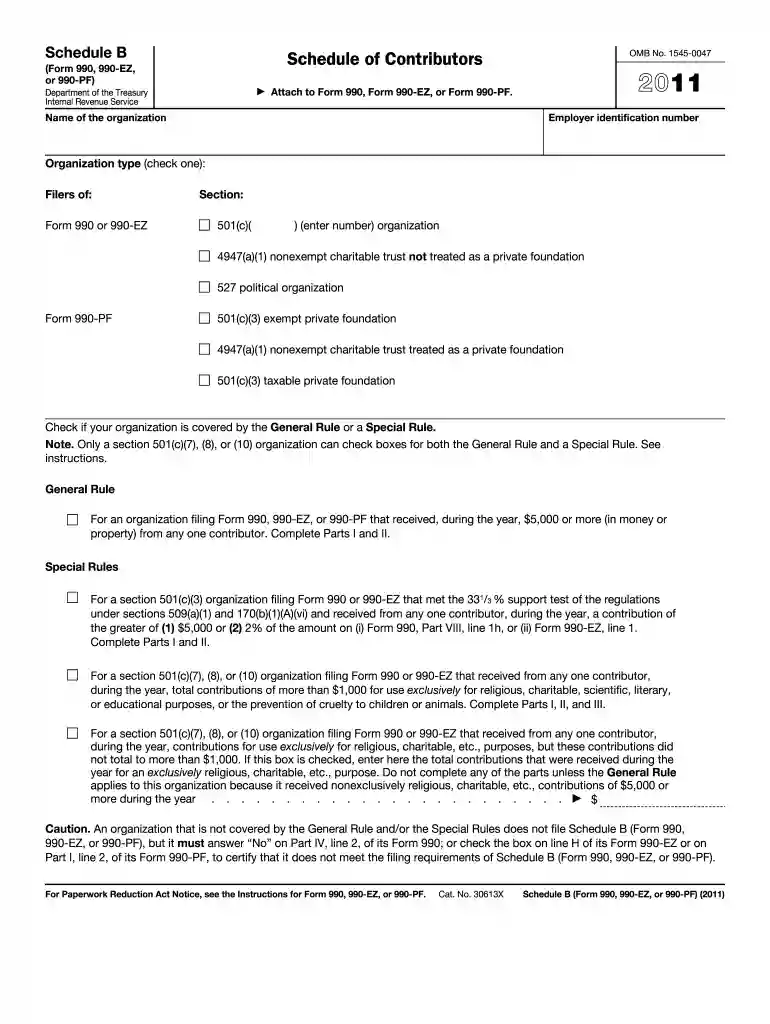
Type text, add images, blackout confidential details, add comments, highlights and more.

Draw your signature, type it, upload its image, or use your mobile device as a signature pad.

Send it via email, link, or fax. You can also download it, export it or print it out.
The 2011 Form 990-EZ is a short-form return of organization exempt from income tax, primarily used by small to medium-sized nonprofit organizations. It serves as a public document designed to provide the Internal Revenue Service (IRS) and other stakeholders with essential information about an organization's financial and operational activities.
Organizations eligible to file Form 990-EZ include certain nonprofit entities that meet specific financial thresholds.


Completing the 2011 Form 990-EZ involves several key steps. Understanding these can help ensure accurate and timely submission.
Understanding IRS guidelines is crucial for compliance and to maintain the tax-exempt status of an organization.
Understanding the legal implications associated with the 2011 Form 990-EZ is vital for compliance.
Non-compliance with filing requirements can lead to several penalties.
Organizations have the option to file the 2011 Form 990-EZ both electronically and on paper.
We've got more versions of the 2011 form 990 ez form. Select the right 2011 form 990 ez version from the list and start editing it straight away!
| Versions | Form popularity | Fillable & printable |
|---|---|---|
| 2024 | 4.5 Satisfied (23 Votes) | |
| 2023 | 4.7 Satisfied (51 Votes) | |
| 2022 | 4.7 Satisfied (34 Votes) | |
| 2021 | 4.8 Satisfied (140 Votes) | |
| 2020 | 4.3 Satisfied (48 Votes) | |
| 2019 | 4.4 Satisfied (102 Votes) | |
| 2018 | 4.1 Satisfied (85 Votes) | |
| 2017 | 4.2 Satisfied (58 Votes) | |
| 2016 | 4.3 Satisfied (186 Votes) | |
| 2015 | 4 Satisfied (43 Votes) | |
| 2014 | 4.4 Satisfied (53 Votes) | |
| 2013 | 4 Satisfied (49 Votes) | |
| 2012 | 4.2 Satisfied (39 Votes) | |
| 2011 | 4 Satisfied (36 Votes) |
At DocHub, your data security is our priority. We follow HIPAA, SOC2, GDPR, and other standards, so you can work on your documents with confidence.
A Form 990-EZ or Form 990 return is not required though Form 990-N (e-postcard) may be required (see instructions). But if the Form 990-EZ (2011)Read more
Schedule E (Form 990 or 990-EZ) is used by an organization that files Form 990 or Form 990-EZ to report information on private schools. Who Must File. AnRead more
May 15, 2014 For a section 501(c)(7), (8), or (10) organization filing Form 990 or 990-EZ that received from any one contributor, during the year, totalRead more


