




Here's how it works

01. Edit your form online
Type text, add images, blackout confidential details, add comments, highlights and more.

02. Sign it in a few clicks
Draw your signature, type it, upload its image, or use your mobile device as a signature pad.

03. Share your form with others
Send it via email, link, or fax. You can also download it, export it or print it out.
How to use or fill out 2018 Canada INTER 83-168E with our platform

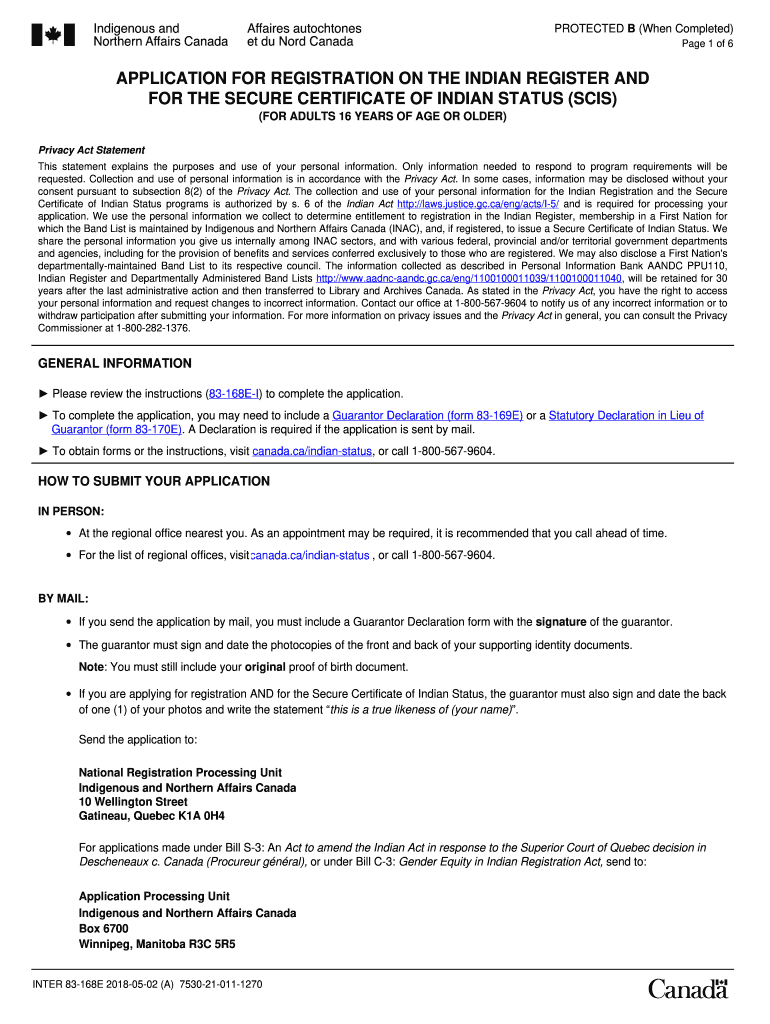
- Click ‘Get Form’ to open the 2018 Canada INTER 83-168E application in the editor.
- Begin with Section 1: Personal Information. Fill in your family name, given names, and any aliases. Ensure that your date of birth is entered in the correct format (YYYYMMDD).
- Proceed to Section 2: First Nation/Band Choice. Indicate your preferred First Nation or Band if applicable.
- In Section 3: Document Requirements, provide proof of birth documents and any name-linking documents if necessary. Make sure to check off what you are including.
- Complete Section 4: Adoption Information only if you were adopted. Provide details about your adoptive and birth parents as required.
- Fill out Section 5: Family Information, detailing information about your parents and grandparents as needed.
- In Section 6, include two identical Canadian passport-style photos if requesting a Secure Certificate of Indian Status (SCIS) and sign where indicated.
- Finally, complete Section 7 by signing and dating the declaration to confirm all information is accurate before submitting your application.
Start filling out your application for free today using our platform!
Fill out 2018 Canada INTER 83-168E online
It's free
It's free
See more 2018 Canada INTER 83-168E versions
We've got more versions of the 2018 Canada INTER 83-168E form. Select the right 2018 Canada INTER 83-168E version from the list and start editing it straight away!
Security and compliance
At DocHub, your data security is our priority. We follow HIPAA, SOC2, GDPR, and other standards, so you can work on your documents with confidence.
Learn more




