
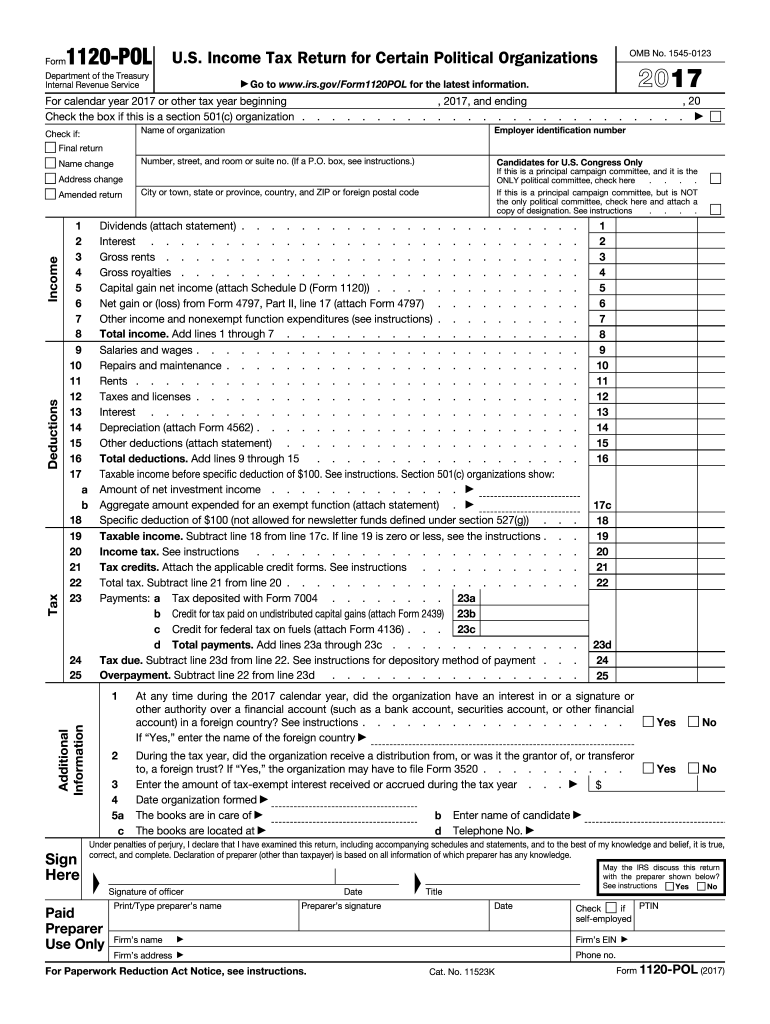







Definition and Purpose of the 2017 Form 1120
The 2017 Form 1120, known as the U.S. Corporation Income Tax Return, is a federally mandated document used by domestic corporations to report their financial information, calculate income tax liability, and provide the Internal Revenue Service (IRS) with a detailed overview of their financial health. Corporations use this form to report gross income, gains, losses, deductions, credits, and to calculate the resulting tax due. This form is essential for compliance with federal tax obligations and serves as a primary tool for documenting the financial activities of a corporate entity within a tax year.
How to Obtain the 2017 Form 1120
Corporations can access the 2017 Form 1120 through various office options. The IRS website is a primary source where businesses can download a blank version of the form. Another convenient method is through tax preparation software, like TurboTax or QuickBooks, which typically include a digital version of the form. Corporations may also opt to order a paper version through the IRS, providing flexibility depending on the preferred filing method. Access through professional tax preparers is another option, ensuring accuracy and compliance with the latest tax regulations.
Steps to Complete the 2017 Form 1120
-
Gather Financial Documents: Collect all relevant financial records, including income statements, balance sheets, and receipts for expenses and deductions.
-
Complete Basic Information: Fill in the corporation's name, address, Employer Identification Number (EIN), and other preliminary information on the form's first page.
-
Report Income and Deductions: Enter gross receipts or sales, cost of goods sold, and deductions. Special attention should be given to accurately calculating business expenses to determine net income.
-
Calculate Tax Liability: Deduct operating expenses from gross income to reach taxable income. Apply the applicable tax rates to calculate total tax liability.
-
Attach Schedules: Include additional schedules if your corporation has specific deductions, credits, or international transactions.
-
Review and Submit: Review for accuracy, sign the form as required, and submit by the due date to avoid penalties.
Importance of Filing the 2017 Form 1120
Filing the 2017 Form 1120 is crucial for corporations to remain compliant with IRS regulations. Accurate completion helps avoid legal issues and ensures that corporations only pay the taxes they owe, potentially saving money on penalties and interest. Furthermore, a thorough and precise tax report can provide clarity on the financial health of the business, aiding in strategic decision-making. This form's submission is not only a legal requirement but also a reflection of a corporation’s due diligence in financial reporting.
Who Typically Uses the 2017 Form 1120
The 2017 Form 1120 is primarily used by domestic corporations doing business in the United States. These include C corporations, which are taxed separately from their owners. Businesses that form under state law as corporations or that elect to be treated as C corporations for tax purposes are required to file this form. Exempt organizations with unrelated business income might also need to file this form to report and pay taxes on such earnings.


Key Elements of the 2017 Form 1120
- Schedule C: Reports dividends, interest, royalties, rents, and other types of income excluding sales.
- Schedule J: Calculates tax liability based on reported income and deductions.
- Schedule K: Provides additional information on the corporation, including methods of accounting used.
- Schedule L: Includes balance sheets at the beginning and end of the year to assess the financial position.
- Schedule M-1: Reconciles income per books with income per the return to account for differences.
- Schedule M-2: Details changes in retained earnings on the balance sheet.
Filing Deadlines and Important Dates
The 2017 Form 1120 was due on April 15, 2018, coinciding with the standard federal tax deadline for individuals and corporations. However, corporations might apply for an automatic six-month extension, requiring the form to be filed by October 15, 2018. Timely filing is critical to prevent penalties and interest charges on any unpaid taxes.
Penalties for Non-Compliance
Failure to file the 2017 Form 1120 or to pay the full amount owed can result in substantial penalties. The IRS imposes a penalty of 5% per month on the amount due for late filing, capping at 25% of the unpaid tax. Additionally, late payments incur a 0.5% penalty per month, also limited to 25% of the due tax. Corporations must ensure punctuality and accuracy to avoid these repercussions.
State-Specific Rules and Regulations
While the 2017 Form 1120 addresses federal tax obligations, corporations must also comply with state tax laws. Each state may have specific requirements, forms, and deadline nuances that corporations must follow. For instance, some states conform closely to federal tax forms, while others require distinct forms and calculations. Businesses are responsible for understanding and filing state taxes separately, often utilizing state-specific guidelines to ensure full compliance.




