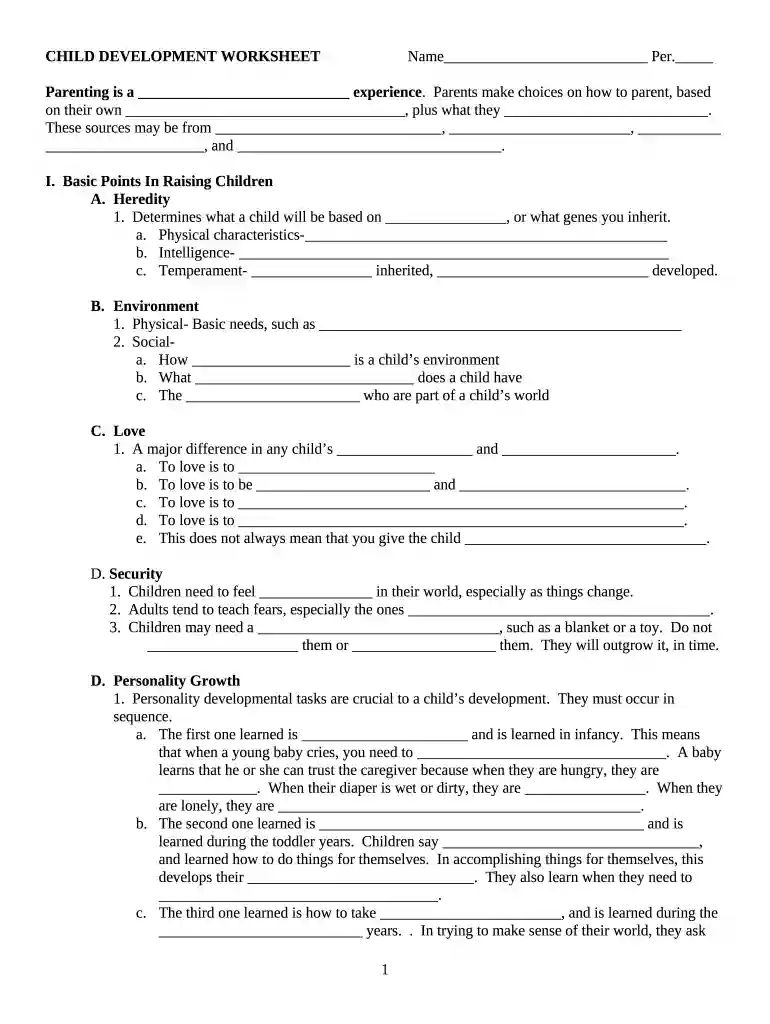
CHILD DEVELOPMENT WORKSHEETName Per 2026

Get Form
CHILD DEVELOPMENT WORKSHEETName Per Preview on Page 1

Here's how it works

01. Edit your form online
Type text, add images, blackout confidential details, add comments, highlights and more.

02. Sign it in a few clicks
Draw your signature, type it, upload its image, or use your mobile device as a signature pad.

03. Share your form with others
Send it via email, link, or fax. You can also download it, export it or print it out.

How to use or fill out CHILD DEVELOPMENT WORKSHEETName Per with our platform

Form edit decoration
9.5
Ease of Setup
DocHub User Ratings on G2
9.0
Ease of Use
DocHub User Ratings on G2
  1. Click ‘Get Form’ to open the CHILD DEVELOPMENT WORKSHEET in the editor.
  2. Begin by entering your name and period at the top of the form. This personalizes your worksheet.
  3. In Section I, reflect on your parenting experiences. Fill in the blanks regarding heredity, environment, love, and security based on your insights.
  4. Continue through each section, providing thoughtful responses about personality growth, cognitive development, and physical growth as they relate to your child.
  5. For toddler and preschool development sections, note specific milestones and changes you’ve observed in your child’s behavior and skills.
  6. Complete the final sections on discipline and positive guidance through play by filling in examples that resonate with your parenting style.

Start using our platform today to easily fill out your CHILD DEVELOPMENT WORKSHEET for free!

See more CHILD DEVELOPMENT WORKSHEETName Per versions

We've got more versions of the CHILD DEVELOPMENT WORKSHEETName Per form. Select the right CHILD DEVELOPMENT WORKSHEETName Per version from the list and start editing it straight away!
Versions Form popularity Fillable & printable
2017 4.1 Satisfied (41 Votes)
be ready to get more

Complete this form in 5 minutes or less

Get form

Got questions?

We have answers to the most popular questions from our customers. If you can't find an answer to your question, please contact us.
Contact us
Developmental Domains Communication Development. Physical Development. Cognitive Development. Social-Emotional Development. Adaptive Development.
Here are the Seven Stages of Child Development which are necessary for a childs growth. Physical Development: Fine Motor Skills Development: Gross Motor Skills Development: Cognitive Development: Communication Development: Speech and Language Development: Social and Emotional Development:
The five stages of child development include the newborn, infant, toddler, preschool, and school-age stages. Children undergo various changes in terms of physical, speech, intellectual and cognitive development gradually until adolescence. Specific changes occur at specific ages of life.
Those domains are social, emotional, physical, cognitive and language. The five critical domains inform the JBSA CDPs approach to early childhood education, but they also can provide a blueprint for parents as they facilitate their childrens development.
The checklists provide a quick method to identify a childs development in each emotional/social domain. The information from the Developmental Checklists can be collated to create a Developmental Profile for the child, approximating their development across each emotional and social domain.

Security and compliance

At DocHub, your data security is our priority. We follow HIPAA, SOC2, GDPR, and other standards, so you can work on your documents with confidence.

Learn more
ccpa2
pci-dss
gdpr-compliance
hipaa
soc-compliance
be ready to get more

Complete this form in 5 minutes or less

Get form

People also ask

Those domains are social, emotional, physical, cognitive and language.
All domains of child developmentphysical development, cognitive development, social and emotional development, and linguistic development (including bilingual or multilingual development), as well as approaches to learningare important; each domain both supports and is supported by the others.
School-age. School-age is the age between 6-17 years old. During this age, children learn to become independent and form their own opinions.

Related links