
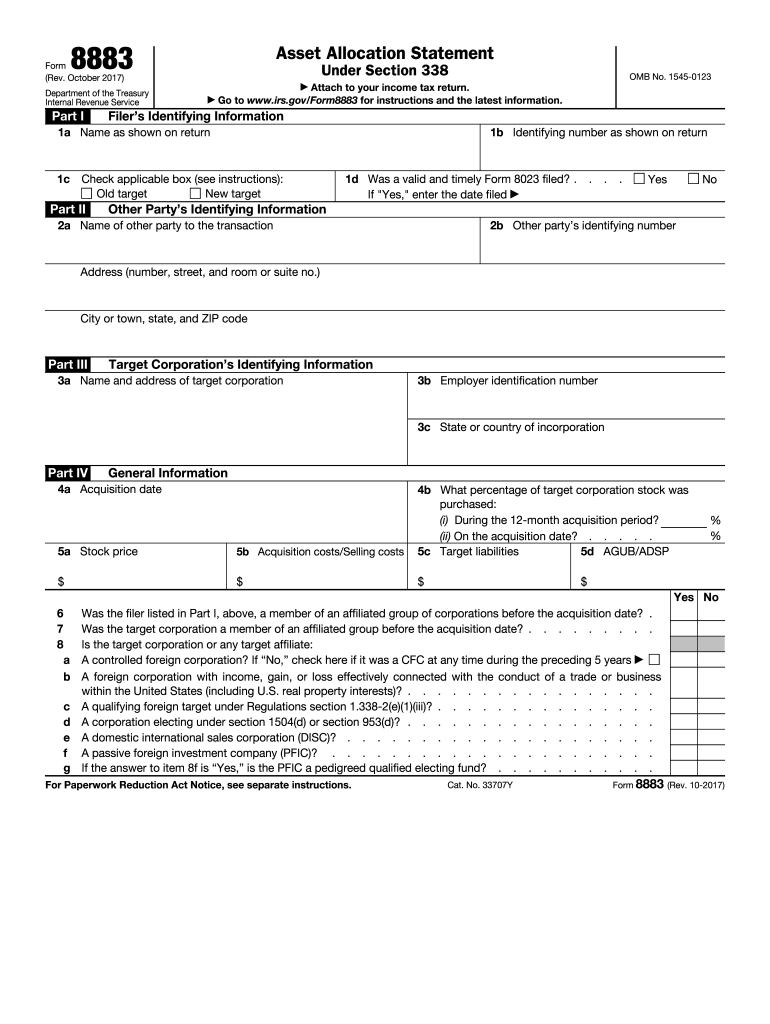







Definition and Meaning of Form 8883
Form 8883, officially known as the "Asset Allocation Statement Under Section 338," is a crucial document utilized by corporations undergoing corporate acquisitions. This form is mandated by the Internal Revenue Service (IRS) to collect detailed information on the acquisition of target corporations. It is essential for determining tax implications and efficiently allocating assets from the acquisition, including the allocation of purchase prices to different classes of assets, which impacts future tax considerations.
Steps to Complete Form 8883
Filing Form 8883 involves several definitive steps to ensure accuracy. To begin, gather comprehensive details about the involved parties, including the names, addresses, and employer identification numbers (EINs) of the purchasing and target corporations. Assess and categorize the different types of assets transferred in the acquisition. The next step involves filling in the form with precise information about stock purchases and acquisition costs. Lastly, verify all data for accuracy to prevent potential penalties or the need for amendments due to discrepancies.
Key Elements of Form 8883
Form 8883 comprises several key sections, each requiring distinct information. These sections include details about the purchaser and target corporation, asset classifications, and purchase prices. The form also requires specific data regarding related corporate affiliations to aid in calculating adjustments to tax bases. Additionally, it necessitates information on the allocation of the acquisition’s purchase price amongst the transferred classes of assets. Ensuring that each section is thoroughly completed is vital for the document’s legitimacy and the taxpayer's compliance.
How to Obtain Form 8883
Obtaining Form 8883 is straightforward. You can download it directly from the IRS website in a PDF format, which supports digital completion and printing. Alternatively, if needed, a paper version can be requested from a local IRS office. Some tax preparation software may also include Form 8883 within their package, allowing you to fill it out digitally as part of your tax filing process.
Who Typically Uses Form 8883
Form 8883 is primarily utilized by corporations involved in acquisition transactions that qualify under IRS Section 338. It is essential for businesses looking to recognize corporate restructuring through stock purchases as a qualified stock purchase election. Typically, tax professionals who aid corporations in acquisition transactions complete the form to ensure compliance with IRS requirements.
IRS Guidelines for Form 8883
The IRS provides detailed guidelines for completing Form 8883, emphasizing accuracy and thoroughness. Key instructions include adhering to strict deadlines for submission, maintaining meticulous records of asset allocation to support figures stated in the form, and ensuring that all involved entities are correctly reflected. Violations of these guidelines can result in penalties or delays in processing.
Required Documents for Filing Form 8883
To file Form 8883 accurately, gather various documents, including contracts detailing the acquisition agreement, a list and valuation of assets transferred, and pertinent corporate financial statements. These documents provide the foundational data necessary for completing the form. Maintaining organized records is imperative to verify the information reported on Form 8883 as it may undergo IRS audits.
Penalties for Non-Compliance with Form 8883
Strict adherence to the requirements of Form 8883 is crucial, as non-compliance can result in substantial penalties. Such penalties can arise from late filings or inaccuracies within the form. To mitigate these risks, corporations should engage experienced tax professionals and verify that all information reported is precise and complete. Furthermore, keeping abreast of filing deadlines and IRS updates regarding Form 8883 can prevent inadvertent non-compliance.
Business Types That Benefit Most from Form 8883
Corporations engaging in acquisitions where asset allocation impacts tax outcomes benefit most from Form 8883. Specifically, those contemplating a qualified stock purchase election under Section 338 will find this form indispensable in their tax planning strategies. Properly leveraging Form 8883 permits these entities to facilitate accurate tax treatment of acquisitions, fostering better management of capital assets and liabilities associated with corporate growth initiatives.




