






Understanding the Importance of Thermometer Readings
Reading thermometer values accurately is a fundamental skill across various educational levels, particularly in grade levels that include practical science and math. This skill enables students to connect theoretical knowledge of temperature scales with real-world applications. Understanding how to read thermometers involves not only recognizing the scale but also converting between different temperature units when necessary.
Types of Thermometers and Their Scales
Thermometers can employ different scales, with the most common being Celsius and Fahrenheit. Understanding these scales is essential for interpreting temperature readings accurately.
- Celsius (°C): Widely used in scientific contexts, Celsius is based on the freezing point (0°C) and boiling point (100°C) of water.
- Fahrenheit (°F): Commonly used in the United States, Fahrenheit sets the freezing point of water at 32°F and boiling point at 212°F.
Students learning to read temperatures should familiarize themselves with both scales to ensure they can read a variety of thermometers.
Practical Steps for Reading Thermometers
To effectively read the temperature shown on each thermometer, students should adhere to these practical steps:
- Identify the Scale: Determine whether the thermometer is marked in Celsius, Fahrenheit, or both.
- Locate the Meniscus: For liquid thermometers, find the meniscus, which is the curve at the surface of the liquid. Ensure your eyes are level with the meniscus to avoid parallax error.
- Read the Value: Look at the nearest line below the meniscus to record the temperature. This number represents the temperature shown on the thermometer.
- Convert if Necessary: If a different temperature scale is required, use the conversion formula:
- From Celsius to Fahrenheit: F = C × 9/5 + 32
- From Fahrenheit to Celsius: C = (F - 32) × 5/9
Example Scenarios: Reading Different Thermometers
- Outdoor Thermometer: An outdoor thermometer may display a reading of 15°C. To convert this to Fahrenheit for a better understanding of the temperature in a more familiar context, apply the Fahrenheit conversion formula. The temperature converts to 59°F.
- Clinical Thermometer: A clinical thermometer indicates a reading of 100°F. To find the Celsius equivalent, apply the reverse conversion, resulting in approximately 37.8°C.
Utilizing Thermometer Worksheets in Education
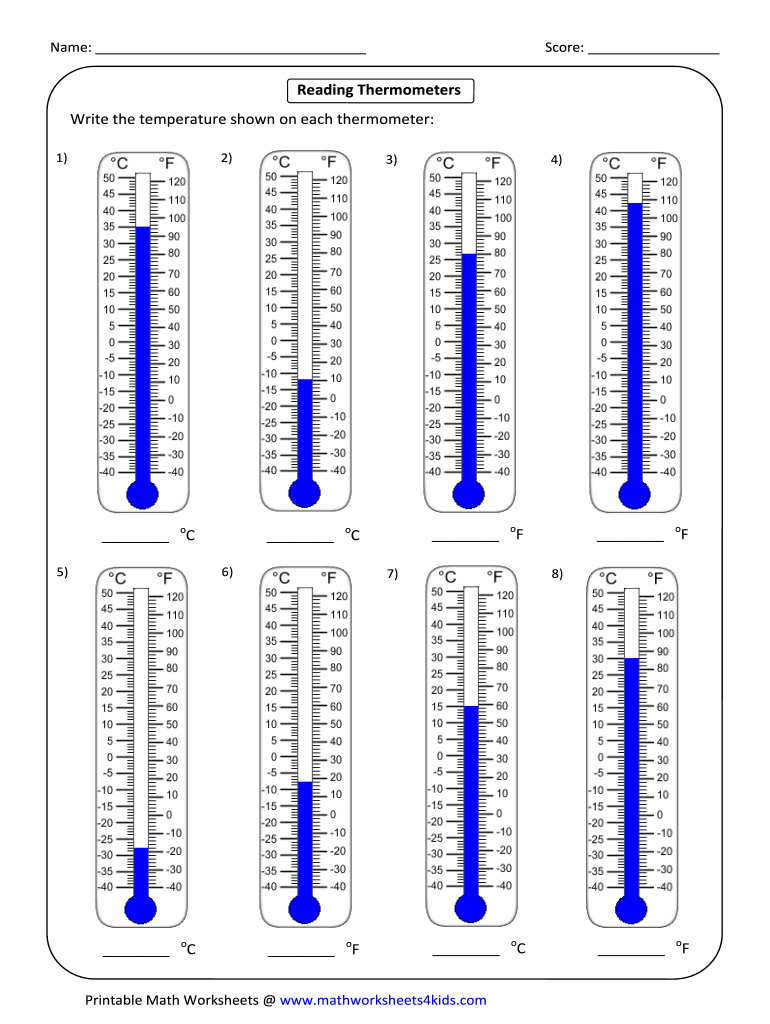
Worksheets designed for reading thermometers serve as an excellent educational tool, enhancing students' understanding through practice. A thermometer worksheet for third graders, for example, might present a series of thermometers marked with varying temperatures. Students would write the temperature shown by each thermometer, enhancing their reading skills.
- Activities Included:
- Fill in the blanks with the appropriate temperature based on the thermometer images.
- Convert temperatures from Celsius to Fahrenheit and vice versa.
- Answer key provision to allow for self-assessment.
Conclusion on Thermometer Literacy
Reading and writing the temperatures indicated on each thermometer is not only a critical academic skill but also an essential life skill. It fosters a deeper understanding of scientific concepts related to temperature and enhances math skills through conversions and applications. Engaging with thermometer worksheets further aids in mastering this fundamental aspect of science education, making it both practical and interesting for students.