KWL Chart Template 2026

Get Form
kwl Preview on Page 1

Here's how it works

01. Edit your kwl online
Type text, add images, blackout confidential details, add comments, highlights and more.

02. Sign it in a few clicks
Draw your signature, type it, upload its image, or use your mobile device as a signature pad.

03. Share your form with others
Send kwl chart pdf via email, link, or fax. You can also download it, export it or print it out.

Definition & Purpose of the KWL Chart Template

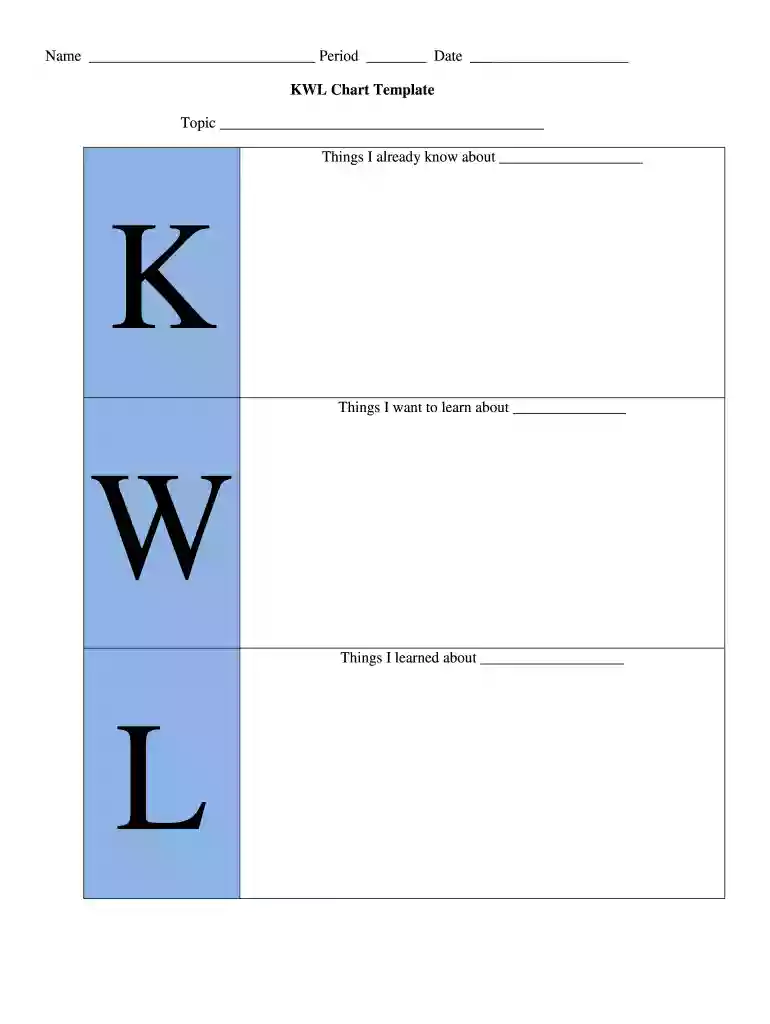
A KWL Chart Template is an educational tool designed to help users organize their knowledge about a specific topic efficiently. The acronym "KWL" stands for three components: what you Know, what you Want to learn, and what you have Learned. This structured approach allows individuals to clarify their existing knowledge, identify gaps in their understanding, and reflect on what they have acquired after exploring the subject.

Structure of the KWL Chart

  • What I Know (K): This section serves as a brainstorming area where users list their current understanding or experiences related to the topic.
  • What I Want to Learn (W): Users articulate questions or specific areas of interest they wish to investigate further.
  • What I Learned (L): This part is meant to be filled in after research or study, summarizing key takeaways and new insights gained.

The design of the KWL chart promotes active learning and self-directed inquiry, encouraging individuals to take ownership of their educational journey.

Practical Uses of the KWL Chart Template

KWL charts can be applied in numerous settings, making them versatile learning tools. Some common applications include:

  • Classroom Settings: Teachers can use KWL charts to assess prior knowledge before introducing new topics, fostering student engagement and participation.
  • Research Projects: Students can outline their research objectives and track their learning process by filling in the chart at various stages of their projects.
  • Professional Development: Individuals can utilize KWL charts for self-assessment and goal setting, helping to identify areas for skill advancement in their careers.

Examples of KWL Chart Application

  • In a science class focused on ecosystems, students may note their existing knowledge of food chains and express a desire to learn about specific biomes. After the unit, students document what they learned about the interdependence of organisms in various habitats.
  • A marketing professional could create a KWL chart to explore a new digital marketing strategy, identifying their current practices, research questions about analytics tools, and insights gained from a workshop.

Steps to Create an Effective KWL Chart

Creating a KWL chart can be straightforward and rewarding. Here are the steps to develop a comprehensive chart:

  1. Select a Topic: Choose a subject matter that you want to explore or learn more about.
  2. Create the Chart: Use a simple template or draw three columns on paper or in a digital document.
  3. Fill in the Sections:
    • In the K column, jot down everything you currently know.
    • In the W column, list the questions or topics you want to explore.
    • After your research or study, fill in the L column with the new information you have learned.
  4. Review and Reflect: Regularly revisit the chart to update your knowledge and reflect on your learning journey. This iterative process reinforces retention and clarity.

Tools for Creating KWL Charts

  • Digital Resources: Utilize tools like Google Docs or online templates specifically designed for KWL charts for easy accessibility and collaboration.
  • Printable Formats: Offer PDF versions that can be printed and filled in by hand for in-class activities or workshops.

Customizing KWL Chart Templates

Customization of KWL templates can enhance their effectiveness and relevance to specific learning scenarios. Users may consider the following options:

  • Visual Layout: Alter the design by incorporating graphics or color codes to differentiate between sections, making the chart more engaging.
  • Subject-Specific Prompts: Include guiding questions or prompts tailored to specific fields such as science, literature, or history to drive deeper inquiry.
  • Interactive Formats: Use digital platforms that allow for collaborative inputs, where multiple users can contribute to the same KWL chart in real-time.

Benefits of Customizing Templates

  • Tailored charts can lead to enhanced engagement and a more focused learning experience by directly aligning with users' contexts and interests.
  • Customizable templates promote personalization, fostering a stronger connection between the learner and the material.

Advantages of Using the KWL Chart Template in Learning

Incorporating a KWL Chart Template into educational practices presents several advantages:

  • Active Learning: By encouraging learners to articulate what they know and want to learn, KWL charts foster an active engagement with the material.
  • Facilitation of Critical Thinking: Users must think critically about their existing knowledge and knowledge gaps, enhancing their analytical skills.
  • Progress Monitoring: The template provides a clear framework for tracking learning progress, helping students and professionals alike to measure their growth over time.

Long-Term Educational Impact

Continued use of KWL charts can cultivate lifelong learning habits, encouraging users to consistently assess their knowledge base, set goals, and pursue new learning opportunities, thereby enriching their personal and professional development.

Conclusion on the KWL Chart Template's Role

In summary, the KWL Chart Template serves as a practical and effective educational tool that can enhance learning across various contexts. Its structured approach allows for greater clarity in understanding and helps to motivate both learners and educators alike. By leveraging the unique features and customizable options of KWL charts, individuals can engage deeply with topics of interest, making the learning process both organized and impactful.

be ready to get more

Complete this form in 5 minutes or less

Get form

Got questions?

We have answers to the most popular questions from our customers. If you can't find an answer to your question, please contact us.
Contact us
How do you fill in a KWL chart template? Step 1) Add what you already know in the first column. Begin by listing everything you know about a topic and recording that information in the What I Know column. Step 2) Outline what you want to know in the second column. Step 3) Summarize what you learned in the final column.
K-W-L chart is a three-column graphic organizer that provides space for participants to record what they Know, what they Want to know, and what they have Learned.
KWL, an acronym for Know, Want-to-know, and Learned, is an effective way to read with purpose. KWL is easy to apply and can lead to docHub improvement in your ability to learn efficiently and to retain what you have learned.
Page 1. ABOUT THE STRATEGY. K-W-H-L CHART is a graphic organizer that tracks what a student knows (K), what a student wants to know (W), how a student will find the information, and what a student has learned (L) about a topic. It is used before, during, and after reading a text and/or conducting research.

Security and compliance

At DocHub, your data security is our priority. We follow HIPAA, SOC2, GDPR, and other standards, so you can work on your documents with confidence.

Learn more
ccpa2
pci-dss
gdpr-compliance
hipaa
soc-compliance
be ready to get more

Complete this form in 5 minutes or less

Get form