




01. Edit your controlled substance perpetual inventory log online
Type text, add images, blackout confidential details, add comments, highlights and more.

Type text, add images, blackout confidential details, add comments, highlights and more.

Draw your signature, type it, upload its image, or use your mobile device as a signature pad.

Send c2 perpetual inventory log via email, link, or fax. You can also download it, export it or print it out.
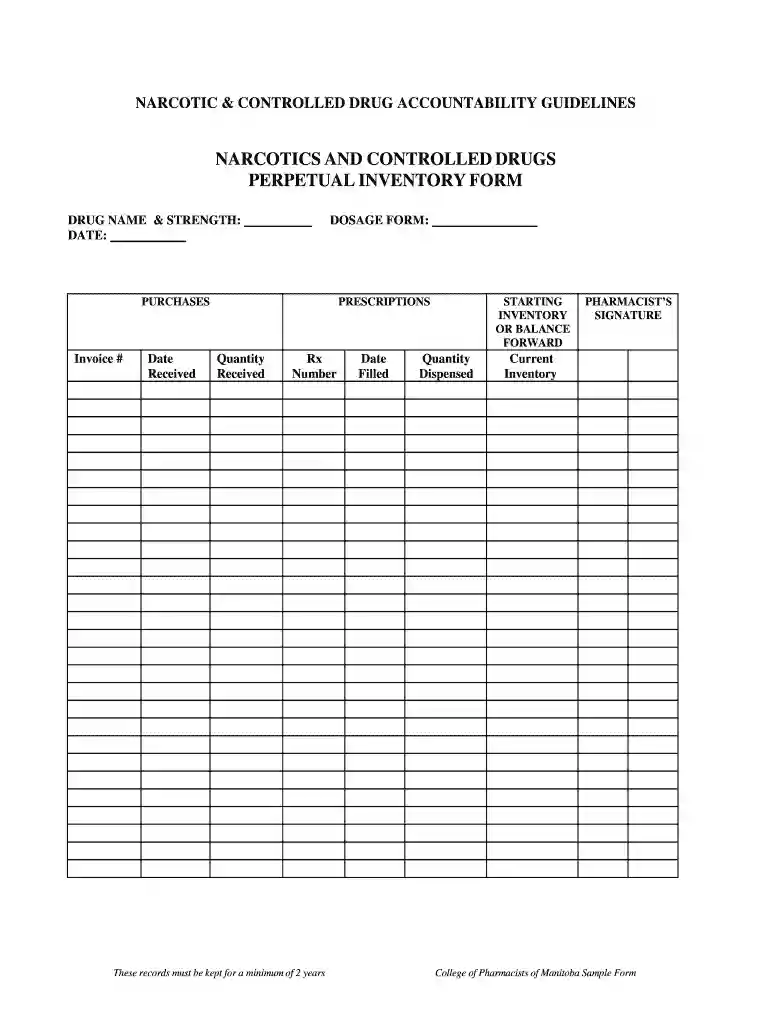
The C2 inventory log sheet is a systematic tool used primarily for tracking controlled substances, specifically Schedule II drugs, in various settings such as healthcare facilities, pharmacies, and research laboratories. This log helps organizations ensure compliance with federal and state regulations by meticulously documenting the receipt, distribution, and usage of these substances. By maintaining an accurate record, facilities can minimize the risks associated with drug abuse, loss, or discrepancies in inventory, which are critical in managing controlled substances.
This inventory log is designed to be straightforward and user-friendly, allowing easy entries of relevant information such as drug names, quantities, dates of transactions, and signatures of authorized personnel. Good practices involve recording any adjustments, discrepancies, or wastage, which are essential for audits and regulatory inspections.
Completing the C2 inventory log sheet requires meticulous attention to detail to ensure regulatory compliance. Here are essential steps to follow for accurate documentation:
Collect necessary information:
Record acquisition information:
Log distribution data:
Monitor and document usage:
Account for discrepancies or wastage:
Consistently following these steps not only aids in maintaining a reliable inventory record but also significantly reduces the risks associated with regulatory violations.
The C2 inventory log sheet is widely utilized by a diverse array of professionals and organizations, including:
Healthcare facilities: Hospitals and clinics that administer controlled substances in patient care often use these logs to manage medications safely and comply with regulations.
Pharmacies: Community and hospital pharmacies typically maintain comprehensive logs to track the dispensing of Schedule II medications, ensuring that all transactions are documented and accessible for audits.
Research laboratories: Facilities engaged in research involving controlled substances are required to track their inventory to comply with federal regulations while conducting experiments safely.
Veterinary practices: Veterinarians that handle controlled substances for animal treatments must keep detailed logs to ensure proper usage and compliance with health regulations.
Understanding the audience helps in crafting the C2 inventory log sheet to meet specific needs, improving compliance and overall management of controlled substances.


The C2 inventory log sheet plays a vital role in adhering to legal requirements surrounding the handling of controlled substances. Its use is mandated by the Drug Enforcement Administration (DEA), which outlines strict regulations regarding documentation for Schedule II drugs.
Key legal aspects include:
Maintaining compliance: Federal law requires comprehensive records of all transactions involving controlled substances, making accurate entries in the log sheet essential.
Audit trails: The log provides an audit trail that facilitates inspections by regulatory agencies and helps organizations demonstrate compliance to avoid penalties.
Retention requirements: Facilities must retain C2 inventory logs for a minimum of two years, as mandated by the DEA, to ensure availability for review during audits.
Failure to comply with these regulations can lead to serious consequences, including fines, loss of licenses, or criminal charges.
Understanding key terminology is crucial for effectively managing a C2 inventory log sheet. Familiarity with these terms aids in maintaining compliance and accuracy:
Controlled Substances: Drugs that are regulated by law due to their potential for abuse and addiction, categorized into schedules (I-V) depending on their risk and medical utility.
Schedule II Drugs: A category of controlled substances that have a high potential for abuse but also have accepted medical uses with severe restrictions, requiring careful monitoring.
Dispensation: The act of distributing prescribed medication to patients, which must be documented accurately in the inventory log.
Wastage: Unusable portions of controlled substances, including expired medications, which need to be recorded for transparency and compliance.
Inventory Adjustment: Entries made to account for discrepancies in stock levels, ensuring that the log reflects the true state of the inventory.
Grasping these terms allows for better communication and understanding within healthcare teams regarding the management of controlled substances.
Practical application of the C2 inventory log sheet can vary across different settings, but essential elements remain consistent. Here are a few examples of its usage:
In a Hospital Environment: A hospital pharmacy receives a new shipment of opioids. The receiving pharmacist logs the quantity received and verifies against the shipment invoice. When a patient is prescribed medication, the pharmacist notes the amount dispensed, records the patient's details, and secures the necessary signatures. Any discrepancies, such as loss during administration, are recorded promptly with justifications.
In a Veterinary Clinic: The veterinary clinic utilizes the C2 inventory log sheet to track controlled substances administered during surgical procedures. For each operation, the veterinarian records the drugs used, documenting the amount administered and the specifics of the animal patient. Post-surgery, all remaining medications are logged back into inventory to maintain accurate counts.
In Research Laboratories: Researchers must account for every gram of a controlled substance as they conduct experiments. The log sheet helps them track receipt, use, and wastage of substances through meticulous recording practices. Regular audits ensure that records are up-to-date and discrepancies addressed immediately.
Through these examples, it becomes clear how essential the C2 inventory log sheet is in maintaining the integrity and compliance of handled controlled substances.
At DocHub, your data security is our priority. We follow HIPAA, SOC2, GDPR, and other standards, so you can work on your documents with confidence.
Section 312 requires an emergency and hazardous chemical inventory form to be submitted to state and local planning commissions and to the local fireRead more
Must immediately inventory all schedule III-V controlled substances when received. Annotate the date received on the record of receipt. Purchase RecordsRead more


