2017 schedule i form-2026

Get Form
2017 schedule i form Preview on Page 1

Here's how it works

01. Edit your form online
Type text, add images, blackout confidential details, add comments, highlights and more.

02. Sign it in a few clicks
Draw your signature, type it, upload its image, or use your mobile device as a signature pad.

03. Share your form with others
Send it via email, link, or fax. You can also download it, export it or print it out.

Definition and Meaning of the 2017 Schedule I Form

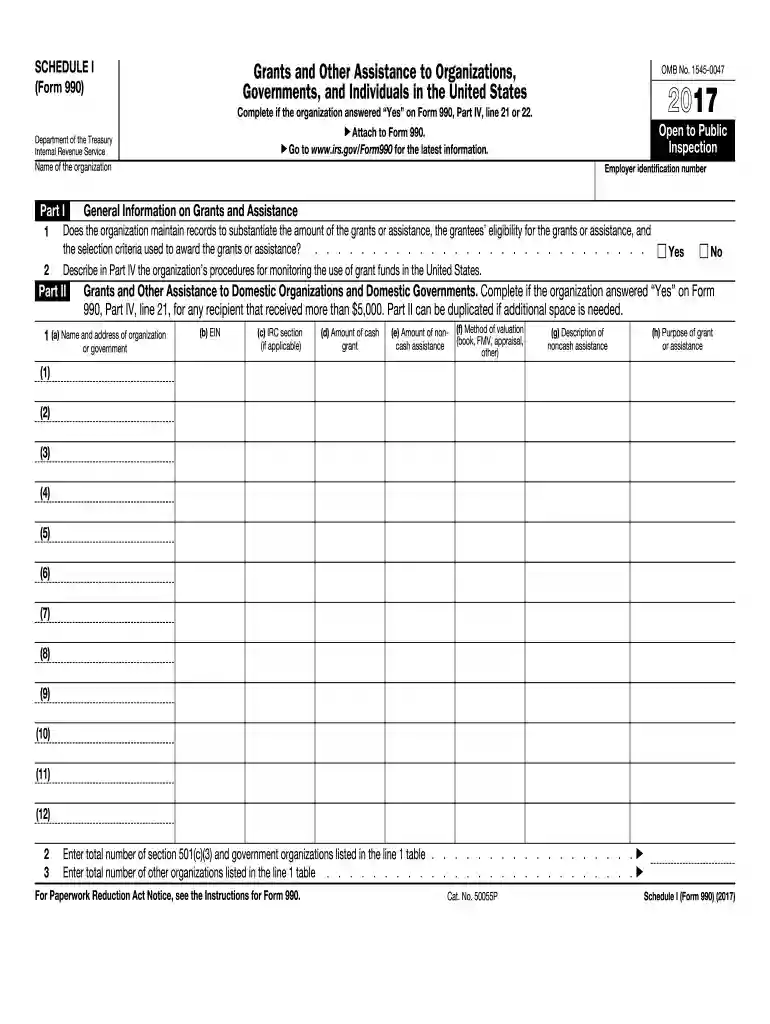
The 2017 Schedule I Form is a supplemental form used in conjunction with Form 990, which is filed by tax-exempt organizations. This form specifically focuses on reporting grants and other assistance provided to domestic entities, individuals, and organizations during the tax year. Its purpose is to ensure transparency and accountability in terms of how these organizations distribute funds. The form requires entities to detail the recipients, types of assistance, amounts granted, as well as any monitoring procedures in place to oversee the effective use of these funds.

Key Elements of the 2017 Schedule I Form

The 2017 Schedule I Form consists of several crucial sections and fields that must be meticulously filled out:

  • Recipient Information: Entities must list each recipient's name, address, and EIN when applicable, ensuring accurate identification.
  • Grant Details: This involves specifying the type of assistance (cash grants, donations of goods or services), the amount provided, and the purpose of the grant.
  • Monitoring Procedures: Organizations are required to describe any procedures they have implemented to monitor the use of granted funds.
  • Additional Information: Space for organizations to elaborate on any nuances or specific conditions concerning the disbursed grants.

Understanding these elements is essential for organizations to remain compliant with IRS regulations and avoid penalties.

Steps to Complete the 2017 Schedule I Form

Completing the 2017 Schedule I Form involves a systematic approach:

  1. Gather Necessary Documents: Collect all records pertaining to grants and assistance, including agreements, financial records, and monitoring reports.
  2. Fill Recipient Details: Accurately input each recipient's name and address, along with any tax identification numbers.
  3. Specify Grant Information: Clearly indicate the amounts given, type of aid, and the purpose behind granting the funds.
  4. Detail Monitoring Procedures: Document the procedures in place for ensuring the proper use of funds.
  5. Review for Accuracy: Carefully review the form for any errors or omissions before submission.

Who Typically Uses the 2017 Schedule I Form

The 2017 Schedule I Form is primarily used by tax-exempt organizations, including:

  • Nonprofit organizations: Such as charities that provide financial help or services to other organizations or individuals.
  • Foundations: Offering grants to spur community development or support educational programs.
  • Religious Organizations: That provide financial assistance or material support to their congregations or outreach initiatives.

These organizations are mandated to file this form if they answered 'Yes' to relevant questions on their Form 990 regarding their grant activities.


decoration image ratings of Dochub

IRS Guidelines for the 2017 Schedule I Form

The IRS provides specific guidelines to ensure proper compliance:

  • Eligibility and Requirements: Only organizations that provide domestic grants and assistance must complete Schedule I.
  • Filing Regulations: Schedule I must be filed along with Form 990, aligning with the general deadlines of the organization’s tax year.
  • Record Keeping: Organizations must maintain comprehensive records to substantiate the information reported on the form.

Non-compliance can lead to penalties, underscoring the importance of following IRS stipulations closely.

Legal Use of the 2017 Schedule I Form

Correct legal usage of the 2017 Schedule I Form is pivotal:

  • Transparency: Organizations must accurately report all financial assistance given to ensure transparency in their operations.
  • Accountability: The IRS uses this form to hold organizations accountable for distributed funds and prevent misuse.
  • Public Disclosure: Schedule I becomes part of the publicly available Form 990, allowing stakeholders to assess the entity’s financial activities.

Adhering to legal norms is critical to protect the organization’s tax-exempt status.

Penalties for Non-Compliance

Failure to properly complete or file the 2017 Schedule I Form can result in:

  • Monetary Fines: The IRS may impose fines for late submissions or incorrect information.
  • Increased Scrutiny: Non-compliance can lead to audits or reviews of the organization’s financial activities.
  • Loss of Tax-Exempt Status: In severe cases, the organization may be at risk of losing its tax-exempt status if compliance issues persist.

Understanding these potential penalties is crucial for maintaining good standing with the IRS.

Examples of Using the 2017 Schedule I Form

Examples of scenarios where Schedule I is relevant include:

  • An educational foundation provides scholarships to students across various states, requiring detailed reporting of funds distributed to each recipient.
  • A charity conducts disaster relief, offering both cash donations and material supplies, necessitating precise documentation of each type of assistance.

These examples illustrate the form’s practical application in ensuring organizations remain accountable to the IRS and the public.

See more 2017 schedule i form versions

We've got more versions of the 2017 schedule i form form. Select the right 2017 schedule i form version from the list and start editing it straight away!
Versions Form popularity Fillable & printable
2023 4.9 Satisfied (43 Votes)
2022 4.8 Satisfied (25 Votes)
2021 4.8 Satisfied (31 Votes)
2020 4.4 Satisfied (161 Votes)
2019 4.2 Satisfied (86 Votes)
2018 4.3 Satisfied (110 Votes)
2017 4.3 Satisfied (278 Votes)
2016 4.4 Satisfied (158 Votes)
be ready to get more

Complete this form in 5 minutes or less

Get form

Security and compliance

At DocHub, your data security is our priority. We follow HIPAA, SOC2, GDPR, and other standards, so you can work on your documents with confidence.

Learn more
ccpa2
pci-dss
gdpr-compliance
hipaa
soc-compliance
be ready to get more

Complete this form in 5 minutes or less

Get form