




01. Edit your form online
Type text, add images, blackout confidential details, add comments, highlights and more.

Type text, add images, blackout confidential details, add comments, highlights and more.

Draw your signature, type it, upload its image, or use your mobile device as a signature pad.

Send it via email, link, or fax. You can also download it, export it or print it out.
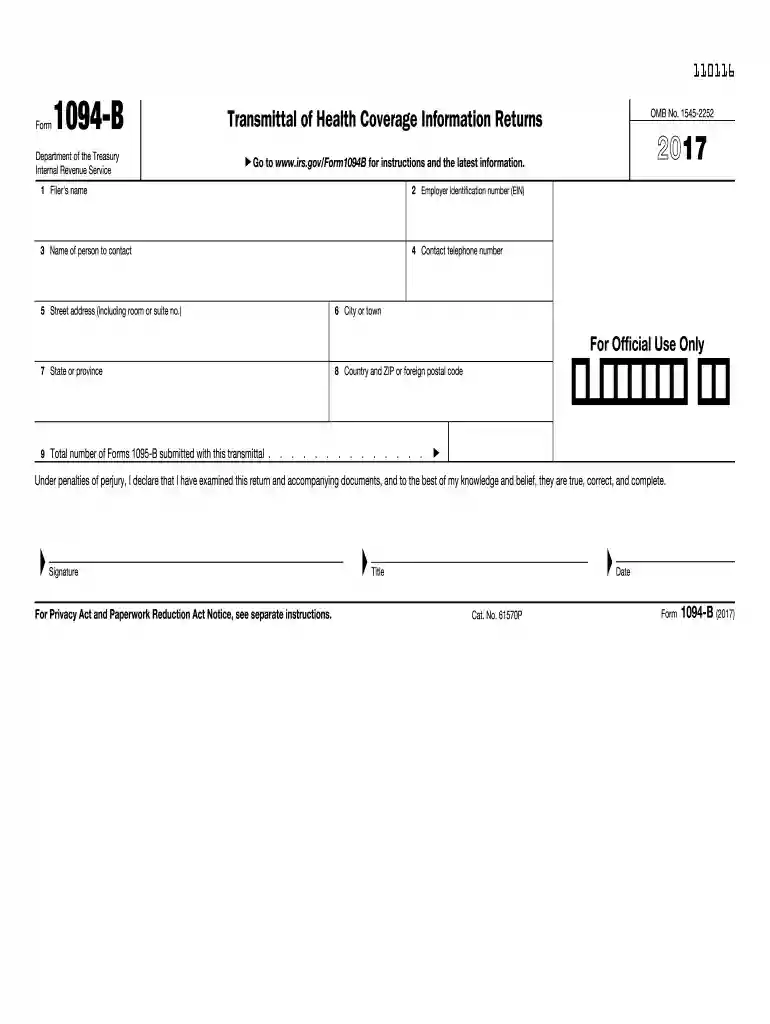
Form 1094-B is a transmittal form used by the Internal Revenue Service (IRS) to report health coverage information annually. It serves as an accompanying document to Form 1095-B, summarizing the individual health coverage provided during the calendar year. This form includes essential details such as the filer’s information and the total number of Forms 1095-B submitted. It functions as a declaration that the information provided is true and accurate under penalty of perjury.
To effectively utilize Form 1094-B, filers need to understand its purpose and connections with Form 1095-B. This form is primarily for insurers and other coverage providers responsible for verifying that individuals have received the required minimum essential coverage. Filers must accurately complete each section to ensure that the IRS receives comprehensive yearly health coverage data.
Preparation: Collect all necessary details from Forms 1095-B. This includes the total number of forms and information about the coverage provided.
Completion: Fill in the filer’s details and the employer's contact information, if applicable. Be sure to certify the accuracy of the information provided.
Submission: Send the completed 1094-B form to the IRS alongside the individual Forms 1095-B. This can be done electronically or via mail, depending on the number of forms submitted and the chosen filing method.
You can acquire Form 1094-B from several sources:
Ensure that you are using the 2017 version to match the specific tax requirements for that year.
Completing Form 1094-B accurately is vital for compliance with IRS reporting requirements.
Filer Information: Enter the filer’s name, mailing address, and contact number to start the process.
Employer Information: Provide details about the employer when they are offering the health coverage. This section is crucial for associating the coverage with the correct legal entity.
Forms Count: Indicate the total number of Forms 1095-B accompanying the transmittal form.
Certification: Certify the accuracy of the information provided, understanding that false reporting can lead to significant penalties.
Sign and Date: The form must be signed and dated by an authorized representative to be valid.
Using Form 1094-B is mandatory for entities that provide health coverage to individuals to ensure compliance with the Affordable Care Act (ACA) reporting requirements. This form plays a critical role in the IRS’s ability to verify that individuals are receiving the required minimum essential coverage. Proper filing not only supports regulatory compliance but also avoids potential penalties associated with non-compliance.
Understanding the essential components of the 1094-B form is necessary for accurate completion:
The IRS provides detailed instructions that outline how and when to file Form 1094-B. According to IRS requirements, the form must align with specific annual deadlines to maintain compliance with federal tax laws. The IRS mandates the accurate and timely submission of these forms to ensure proper documentation of health coverage, preventing future discrepancies or audits.
Failure to submit Form 1094-B on time or with incorrect information can result in significant penalties imposed by the IRS. These penalties increase if the omission or error is deemed intentional. However, if the filer can demonstrate reasonable cause for the failure, penalties might be waived. To remain compliant, filers should double-check information accuracy and ensure that all deadlines are met.
We've got more versions of the 2017 1094 b form form. Select the right 2017 1094 b form version from the list and start editing it straight away!
| Versions | Form popularity | Fillable & printable |
|---|---|---|
| 2025 | 4.4 Satisfied (33 Votes) | |
| 2024 | 4.2 Satisfied (32 Votes) | |
| 2023 | 4.8 Satisfied (39 Votes) | |
| 2022 | 4.7 Satisfied (47 Votes) | |
| 2021 | 4.8 Satisfied (71 Votes) | |
| 2020 | 4.2 Satisfied (104 Votes) | |
| 2019 | 4.2 Satisfied (27 Votes) | |
| 2018 | 4.3 Satisfied (152 Votes) | |
| 2017 | 4.4 Satisfied (146 Votes) | |
| 2016 | 4.4 Satisfied (317 Votes) | |
| 2015 | 4 Satisfied (28 Votes) | |
| 2014 | 4 Satisfied (24 Votes) |
At DocHub, your data security is our priority. We follow HIPAA, SOC2, GDPR, and other standards, so you can work on your documents with confidence.
Sep 11, 2017 Health insurance issuers and carriers must file Form 1095-B for most health insurance coverage, including individual market coverage and insuredRead more
Dec 1, 2017 Electronic filing of Forms 1094-C and. 1095-C and Forms 1094-B and 1095-B. If youre an Applicable Large Employer, file electronic Forms 1094-CRead more
Summary transmittal filed annually with the IRS for the Affordable Care Act. UI retention guidelines. 10 Years. Confidential.Read more


