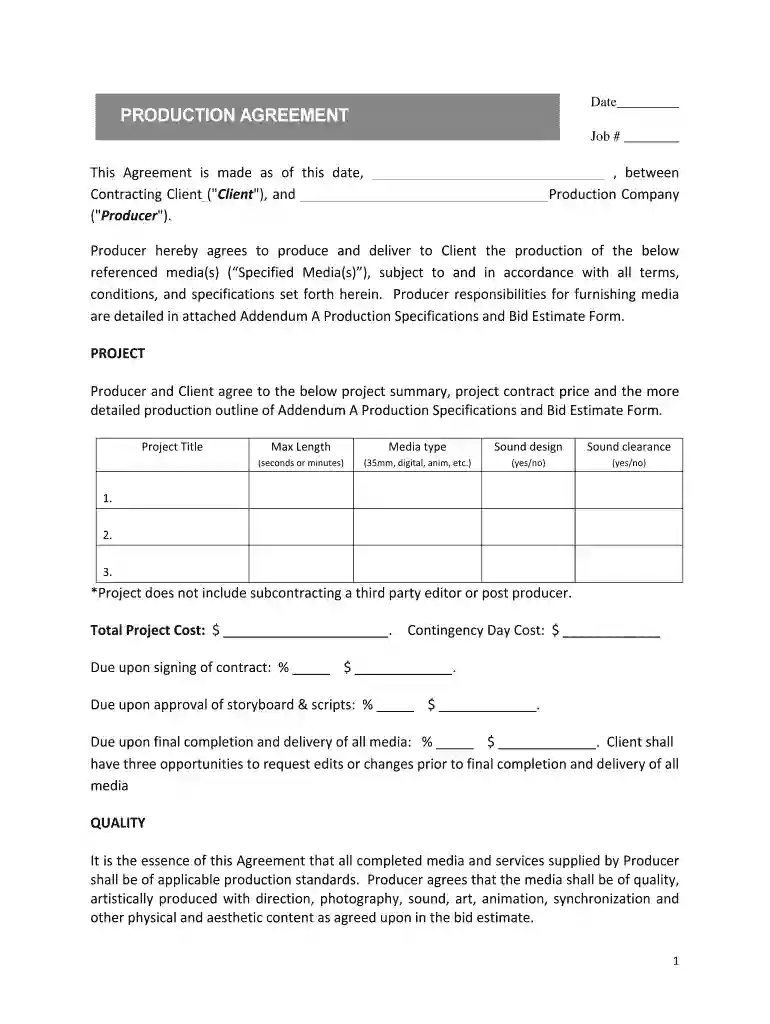
Definition and Meaning of Film Production Partnership Agreement
A film production partnership agreement is a legally binding contract between two or more parties who collaborate on producing a film or media project. This document outlines essential terms, including project responsibilities, payment structures, and ownership rights. It serves as a foundational blueprint that governs the relationship between producers, investors, and filmmakers, ensuring that expectations and obligations are clearly articulated.
The agreement typically includes:
- Responsibilities of each party: Detailing what each partner is expected to handle during production, from pre-production planning to post-production tasks.
- Project specifications: Descriptions of the type of film, target audience, budget estimates, and timelines are crucial components included in this section.
- Payment terms: Indicating how and when payments will be made, potentially outlining revenue-sharing structures or profit distribution channels.
- Confidentiality clauses: Ensuring that proprietary or sensitive information shared during the production is kept confidential.
- Cancellation and postponement terms: Clearly defining the conditions under which either party can withdraw from the agreement, along with any penalties that may apply.
Key Elements of a Film Production Partnership Agreement
Understanding the critical components of a film production partnership agreement is essential for all parties involved. Here are major elements that should be detailed within the document:
- Scope of Work: This section should precisely outline the film's concept, narrative structure, and logistical aspects, ensuring all partners have the same vision.
- Financial Contributions: Clearly define the monetary commitments each partner is responsible for, including funding sources and investment returns.
- Intellectual Property Rights: Address who owns the rights to scripts, footage, and other creative elements produced during the project, which is pivotal for future distribution.
- Dispute Resolution: A method for resolving conflicts that may arise during production should be established, whether through mediation, arbitration, or litigation.
- Duration of Agreement: Specifying the term of the partnership, how it can be extended, or conditions under which it can be terminated.
How to Obtain a Film Production Partnership Agreement PDF
Acquiring a film production partnership agreement in PDF format can be accomplished through several avenues:
- Legal Templates and Resources: Many websites offer templates that can be customized to fit specific partnership needs. These resources often include fillable PDF options for ease of use.
- Professional Legal Assistance: Consulting with a lawyer who specializes in entertainment law can help ensure that the agreement complies with applicable regulations and protects all parties involved.
- Industry Organizations: Groups focused on film production often provide standardized agreement templates as resources for their members, which can be valuable for ensuring industry standards are met.
These avenues provide a range of options based on the specific requirements of the partnership.
Steps to Complete the Film Production Partnership Agreement PDF
Completing a film production partnership agreement requires careful attention to detail. Here is a step-by-step guide:
- Identify Parties: Clearly list all partners involved, including their legal names and contact details.
- Outline Project Details: Define the film's concept, budget, production schedule, and specific roles each partner will play.
- Detail Financial Contributions: Clearly state how much each party is contributing financially and the terms for payment, including any timelines or conditions.
- Include Legal Provisions: Ensure clauses addressing confidentiality, dispute resolution, and termination are defined and agreed upon by all parties.
- Review and Edit: All parties should review the agreement for clarity, accuracy, and completeness. Adjustments may be made before finalization.
- Sign and Date: All involved parties should sign the document on a specified date, establishing the agreement as legally binding.
By following these steps, all partners can create a solid agreement that facilitates smooth collaboration throughout the production process.
Important Terms Related to Film Production Partnerships
Several key terms are commonly associated with film production partnerships, each reflecting critical aspects of the partnership:
- Equity Financing: Refers to funds raised through the sale of shares in the film project, giving investors a stake in profits.
- Pre-Production: The phase involving planning and preparations before filming begins, including casting, location scouting, and scheduling.
- Post-Production: The phase after filming, where editing, sound design, and visual effects are applied.
- Liability: Legal responsibility defined in the agreement, outlining who is accountable in cases of disputes or financial losses.
- Non-Disclosure Agreement (NDA): Often included within the partnership agreement, this protects sensitive information shared between partners.
Understanding these terms aids in navigating the complexities of the film production process while ensuring no critical elements are overlooked.
Legal Use of the Film Production Partnership Agreement PDF
Film production partnership agreements must adhere to specific legal standards to ensure their validity. Considerations include:
- State Laws: Each state may have distinct laws governing contract enforceability, necessitating that the agreement conforms to local regulations.
- Contractual Elements: The essential components, such as mutual consent, capacity to contract (age and mental competence), and lawful purpose, must be present for legal enforceability.
- Electronic Signatures: In many jurisdictions, electronic signatures are legally binding if they comply with regulations like the ESIGN Act, providing a modern alternative to traditional signing methods.
- Registration Requirements: While most partnership agreements do not require formal registration, considering whether your state mandates notice of partnership might be crucial.
Understanding these legal aspects ensures all parties are protected under the law while engaging in film production endeavors.
Examples of Using the Film Production Partnership Agreement PDF
Practical applications of a film production partnership agreement highlight its importance. Here are a few scenarios:
- Independent Film Projects: A filmmaker collaborates with a producer and a financial backer to create an indie film. The partnership agreement details contributions and profit sharing, defining each party's role in the creative and financial aspects.
- Documentary Collaborations: When multiple parties come together to produce a documentary, the agreement specifies story ownership, fundraising commitments, and deadlines for filming and editing.
- Music Video Productions: In producing a music video, artists and directors establish a production partnership agreement to outline creative direction, payment schedules, and distribution rights, ensuring all collaborators are aligned.
These examples illustrate how the film production partnership agreement serves as a vital tool for clarity and alignment among involved parties in diverse production contexts.