




01. Edit your ss 4 form pdf online
Type text, add images, blackout confidential details, add comments, highlights and more.

Type text, add images, blackout confidential details, add comments, highlights and more.

Draw your signature, type it, upload its image, or use your mobile device as a signature pad.

Send ss 4 via email, link, or fax. You can also download it, export it or print it out.
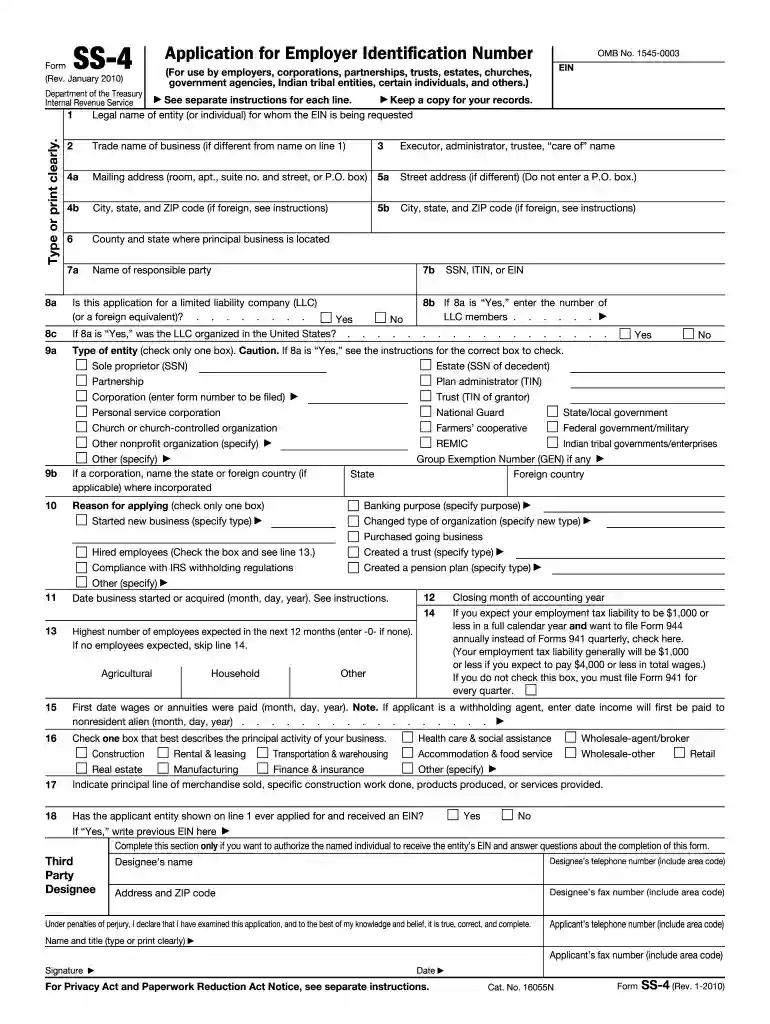
Form SS-4 is an application used to obtain an Employer Identification Number (EIN) from the Internal Revenue Service (IRS). An EIN is a unique identifier assigned to businesses and other entities operating in the United States. This form is essential for entities that need an EIN for tax filing purposes, opening business bank accounts, or establishing credit. The EIN functions similarly to a Social Security Number for businesses, enabling the IRS and other agencies to identify entities for tax purposes.
To acquire Form SS-4, businesses can access it through several methods:
Filling out Form SS-4 involves several key steps:
Each section requires careful attention to detail to prevent delays in processing.
Form SS-4 comprises several critical elements that need to be accurately completed:
Mistakes in key elements can lead to EIN assignment delays or denials.
The IRS outlines specific guidelines for entities applying for an EIN through Form SS-4:
Compliance with IRS guidelines ensures smooth processing and reduces the likelihood of application rejections.
Various types of entities regularly use Form SS-4:
Understanding the typical users of Form SS-4 can inform applicants about its wide range of applications.
While there is no strict deadline to obtain an EIN using Form SS-4, it is recommended to apply well in advance of any business activities that require it:
Timely application avoids business disruptions and ensures compliance with regulatory obligations.
Failure to obtain an EIN when required can result in several penalties and business operation challenges:
Businesses are encouraged to complete Form SS-4 promptly to avoid these negative consequences.
At DocHub, your data security is our priority. We follow HIPAA, SOC2, GDPR, and other standards, so you can work on your documents with confidence.
File Form SS-4 if the applicant entity does not already have an EIN but is required to show an EIN on any return, statement, or other document. See also theRead more
Oct 17, 2025 File Form SS-4 if the applicant entity doesnt already have an EIN but is required to show an EIN on any return, statement, or other document.1Read more


