Type text, add images, blackout confidential details, add comments, highlights and more.
02. Sign it in a few clicks
Draw your signature, type it, upload its image, or use your mobile device as a signature pad.
03. Share your form with others
Send swppp inspection form via email, link, or fax. You can also download it, export it or print it out.
How to use or fill out printable swppp inspection form with our platform
Ease of Setup
DocHub User Ratings on G2
Ease of Use
DocHub User Ratings on G2
Click ‘Get Form’ to open the printable SWPPP inspection form in the editor.
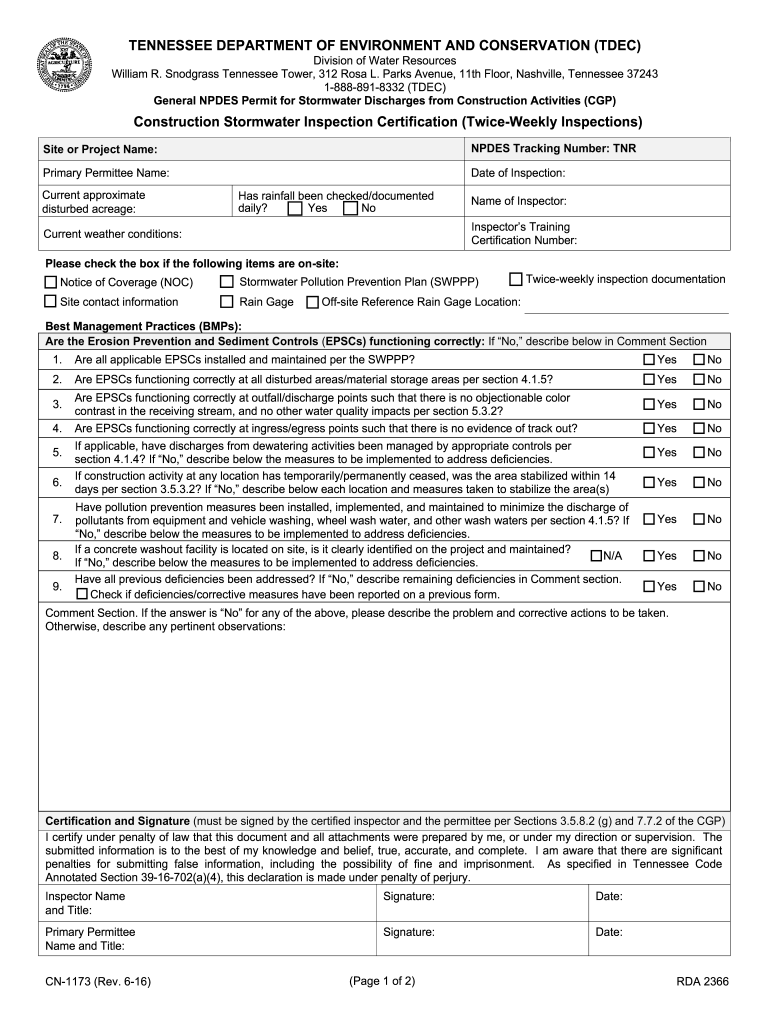
Begin by entering the 'Site or Project Name' and 'NPDES Tracking Number' at the top of the form. This information is crucial for identifying your project.
Fill in the 'Primary Permittee Name', 'Date of Inspection', and 'Current approximate disturbed acreage'. Ensure accuracy as this data is essential for compliance.
Indicate whether rainfall has been checked/documented daily by selecting 'Yes' or 'No'. This helps track weather conditions affecting site management.
Complete the inspector's details, including their name and certification number, ensuring that only qualified personnel are documenting inspections.
Review and check off items present on-site, such as Notice of Coverage (NOC) and Stormwater Pollution Prevention Plan (SWPPP).
In the Best Management Practices (BMPs) section, assess if Erosion Prevention and Sediment Controls (EPSCs) are functioning correctly. If not, provide comments detailing issues.
Finally, ensure both the inspector and primary permittee sign and date the certification section to validate the inspection report.
Start using our platform today to streamline your SWPPP inspection process for free!
Fill out printable swppp inspection form online It's free
We've got more versions of the printable swppp inspection form form. Select the right printable swppp inspection form version from the list and start editing it straight away!
How much does an underground stormwater detention system cost?
Underground systems are certainly not the most affordable option. Creating an underground system costs roughly $10 to $12 per cubic foot while the EPA estimates that a traditional detention pond costs less than $1.00 per cubic foot to construct.
How long is a SWPPP good for?
The SWPPP, prepared in ance with State or EPA permit requirements, is a dynamic document, and does not expire.
How do you create a SWPPP?
7 Steps of SWPPP Planning and Implementation Step 1: Perform a Worksite Assessment. Step 2: Develop a Site Plan. Step 3: Identify Sediment and Erosion Control BMPs. Step 4: Develop Training Procedures Proper BMPs. Step 5: Implement Good Housekeeping BMPs. Step 6: Conduct Frequent Inspections. Step 7: Stabilize the Area.
What is the difference between BMP and SWPPP?
What is a BMP or Best Management Practice? Compared to a SWPPP which is a high-level overview, a BMP provides a closer look at a specific pollution mitigation technique that will be used on the job site. A BMP will specify minimum standards when applicable for the technique to work properly.
What is the inspection report form?
It is used to record observations and any problems or issues that are discovered during the inspection. The report is typically used to document and assess the safety and condition of the workplace, and can be used to make recommendations for improvements.
Individual stormwater permits usually cost anywhere from a few hundred dollars to upwards of $5,000+. Individual stormwater permits typically grant you a little more freedom since they will be tailored specifically to your operation and its stormwater (and sometimes process water) discharge needs.
Who creates a SWPPP?
Who creates a SWPPP? Construction SWPPPs are created by a Qualified SWPPP Developer (QSD) and Industrial SWPPPs are developed by a Qualified Industrial Storm Water Practitioner (QISP).
How much does a stormwater drainage system cost?
The average cost to a yard drainage system is $4,615, but this project can range from as low as $800 for small-scale fixes to $15,000 for full-scale solutions. The average cost to a drainage system in a yard is $4,615, though most homeowners spend between $2,119 and $7,111.
swppp form
SWPPP INSPECTION REPORT
1. Are all erosion control devices in-place and functioning in accordance with the. SWPPP and erosion control site map? 2.Read more
Mar 25, 2026 Construction Stormwater Pollution Prevention Plan (SWPPP) Template Site Inspection Report Template (docx) (91.85 KB) - This inspection reportRead more
Cookie consent notice
This site uses cookies to enhance site navigation and personalize your experience.
By using this site you agree to our use of cookies as described in our Privacy Notice.
You can modify your selections by visiting our Cookie and Advertising Notice.