




01. Edit your esl progress report template online
Type text, add images, blackout confidential details, add comments, highlights and more.

Type text, add images, blackout confidential details, add comments, highlights and more.

Draw your signature, type it, upload its image, or use your mobile device as a signature pad.

Send esl progress report samples pdf via email, link, or fax. You can also download it, export it or print it out.
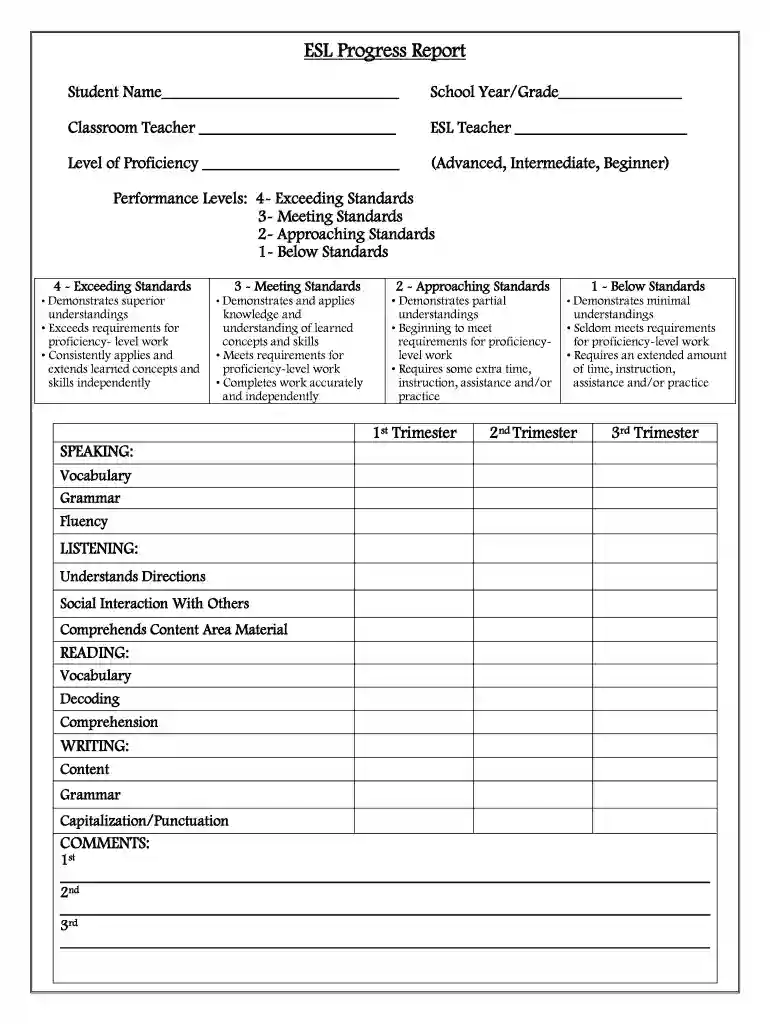
The ESL Progress Report serves as a vital tool for monitoring and documenting a student's development in English as a Second Language. It provides a comprehensive overview of a student's proficiency in key language skills: speaking, listening, reading, and writing. The report crucially categorizes proficiency levels into four key groups:
These categories help educators quickly evaluate where a student stands in their learning journey and determine the necessary supports to facilitate their advancement. The format also typically includes sections for trimester evaluations, which offer snapshots of a student's performance over specific periods. Additionally, it contains comments from both classroom and ESL teachers, providing a holistic view of a student's progress.
The report is particularly essential for English Language Learners (ELL) as it outlines areas needing improvement and identifies a student's strengths, guiding future instructional decisions tailored to each learner's unique needs.
To maximize the utility of the ESL Progress Report, educators and administrators need to understand how to leverage its various components.
Assessment of Skills: Teachers can utilize the categorized sections to identify a student’s strengths and weaknesses in specific language skills. This might include targeted interventions for students who are approaching or below standards.
Goal Setting: The report acts as a foundation for setting realistic language learning goals. By knowing which areas a student excels in or struggles with, educators can create tailored objectives that foster improvement.
Communication with Stakeholders: The comments from educators can be valuable when discussing a child's progress with parents or guardians. Clear communication supported by data empowers families to engage in their child's learning process.
When completed accurately and regularly, the ESL Progress Report becomes a living document that tracks growth, informs instruction, and fosters ongoing dialogue among teachers, students, and families.
Completing an ESL Progress Report involves a systematic approach to ensure that all necessary information is captured effectively.
Gather Student Data: Compile information regarding the student's performance in speaking, listening, reading, and writing. This may include past assessments, teacher observations, and anecdotes highlighting the student’s use of English in various contexts.
Evaluate Proficiency Levels: Using assessment tools and rubrics, categorize the student into one of the four proficiency levels. Each level should be supported by evidence from the student's work or participation in class.
Provide Constructive Feedback: Incorporate comments that reflect not only where the student is excelling but also areas for growth. These comments should be specific, actionable, and encourage the student to continue improving.
Review and Finalize: After compiling all sections, review the form for accuracy and completeness. Ensure all voices - classroom and ESL teachers - are represented in the comments.
Distribute the Report: Share the finalized report with the student, their parents or guardians, and other relevant parties. Make sure to discuss the findings and any next steps collaboratively.
Through this structured method, the ESL Progress Report can be both informative and supportive, helping all involved to foster better learning outcomes.
An effective ESL Progress Report should consist of several critical components to deliver comprehensive insights into a student's language proficiency.
Student Information: Basic details such as the student’s name, grade, and class section, ensuring the report can be easily referenced and linked to other school records.
Skill Assessments: Specific evaluative criteria for each language skill – speaking, listening, reading, and writing – should be outlined, including a scoring rubric when possible.
Proficiency Levels: Clear statements indicating whether a student is at the Exceeding, Meeting, Approaching, or Below Standards level for each skill assessed.
Trimester Evaluations: Evidence of progress over time, allowing a clear view of how students are advancing through various evaluations and changes in proficiency levels.
Teacher Comments: Insightful feedback from classroom and ESL teachers, providing personal reflections on student effort, participation, and language use in real-world situations.
These components make the ESL Progress Report a powerful resource, enabling stakeholders to make informed decisions regarding educational support and intervention.
When utilizing the ESL Progress Report, practical examples can highlight its value in real educational settings.
Parent-Teacher Conferences: During conferences, teachers can refer to the ESL Progress Report to discuss a student's achievements and challenges, thereby fostering a unified approach to supporting the child’s language development.
Individual Learning Plans: Schools can utilize insights from the report to formulate Individualized Learning Plans (ILPs) tailored to help students who may need additional resources for improvement.
Professional Development: Educators can analyze aggregate data from multiple ESL Progress Reports to identify patterns within the student population, discussing areas for curriculum improvement and targeted professional development.
Each of these examples showcases how the ESL Progress Report serves as an indispensable tool for continuous learning and improvement, influencing not just individual students but entire educational strategies and policies.
We've got more versions of the esl progress report template form. Select the right esl progress report template version from the list and start editing it straight away!
| Versions | Form popularity | Fillable & printable |
|---|---|---|
| 2012 | 4.7 Satisfied (21 Votes) |
At DocHub, your data security is our priority. We follow HIPAA, SOC2, GDPR, and other standards, so you can work on your documents with confidence.
This section includes links to a few articles that may be useful to users who are new to modding or are looking to create mods for Fallout 4.Read more
Feb 25, 2026 Template for Monitoring Academic Progress of Former ELs (FELs) Template for Monitoring Academic Progress of Opt-out Students Template forRead more


