




01. Edit your time clock correction form online
Type text, add images, blackout confidential details, add comments, highlights and more.

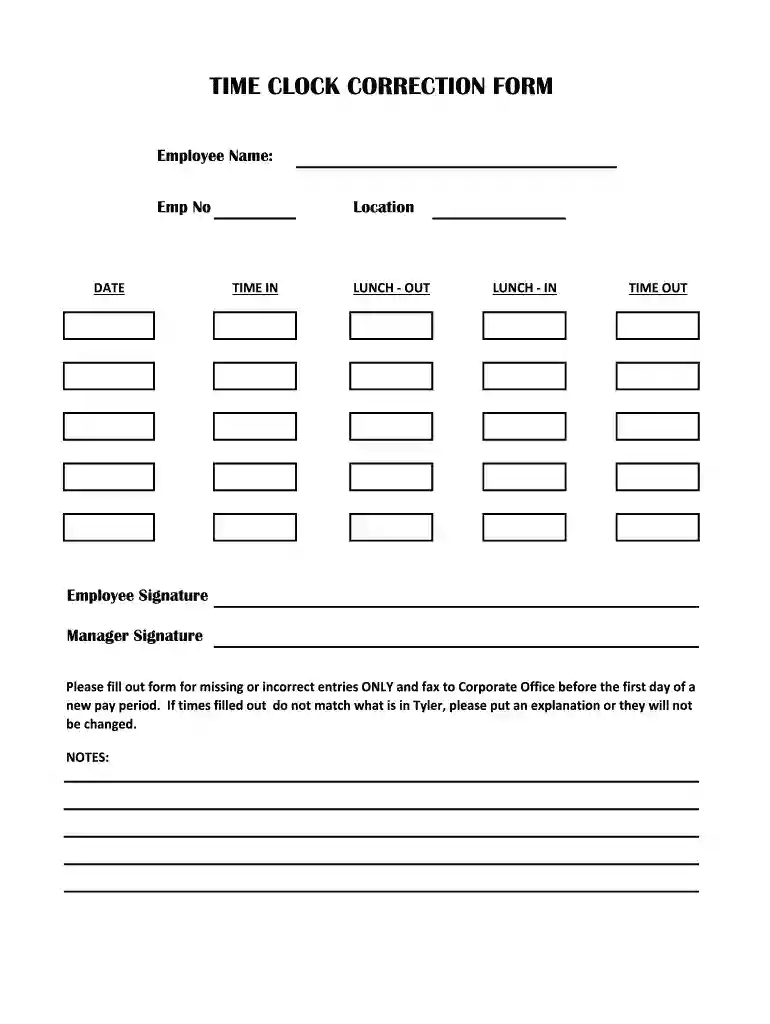
Type text, add images, blackout confidential details, add comments, highlights and more.

Draw your signature, type it, upload its image, or use your mobile device as a signature pad.

Send time correction form via email, link, or fax. You can also download it, export it or print it out.
The time correction form is a crucial document used by employees to correct discrepancies in their recorded work hours. Errors in time entries can occur due to various reasons, including manual mistakes, malfunctioning punch clocks, or miscommunication. This form can be adapted to different formats, such as the time clock correction form, time card correction form, or timesheet adjustment form. Its primary purpose is to facilitate accurate payroll processing by addressing any inaccuracies before payroll is finalized.
The form captures essential data such as the employee's name, employee number, date of the correction, specific clock-in and clock-out times, and validation signatures from both the employee and their manager. This documentation serves as a record of the adjustment request and is vital for auditing purposes. Filing accurate time corrections is not only a best practice but also ensures compliance with labor laws.
Completing the time correction form requires careful attention to detail to ensure all necessary information is included. Here is a step-by-step guide to properly fill out the form:
Employees can typically obtain the time correction form through various channels, ensuring accessibility for all staff members. Here are common methods for acquiring the form:
Having a readily accessible time correction form is essential for encouraging employees to report errors promptly.
Various roles within an organization use the time correction form, primarily those involved in recording and maintaining employee work hours. Typical users include:
Understanding who typically utilizes the time correction form aids in streamlining the correction process and ensures that all stakeholders are aware of their responsibilities.


When dealing with the time correction form, several key elements are essential to its function. Being familiar with these components can enhance the form-usage experience:
These elements collectively establish a clear and verifiable record of the correction process, crucial for both employee protection and organizational compliance.
Practical examples provide clarity on how to correctly use the time correction form in real scenarios:
These instances highlight the versatility and functionality of the time correction form in maintaining accurate records and ensuring compliance with fair labor practices.
Ensuring the proper use of the time correction form can have significant legal implications. Compliance with labor laws is paramount, as discrepancies in reported hours can lead to:
Understanding the legalities associated with the time correction form can guide employers in maintaining fair practices and protecting the interests of employees.
Submitting the time correction form timely is critical for ensuring accurate payroll processing. Here are key deadlines to keep in mind:
Awareness of these dates not only aids employees in timely submissions but also ensures that the payroll department can process corrections effectively.
At DocHub, your data security is our priority. We follow HIPAA, SOC2, GDPR, and other standards, so you can work on your documents with confidence.
Jun 4, 2024 Campus Time Attendance Time Correction Form to be completed by non-exempt employees requesting changes to their Campus Time Attendance timecard.Read more
May 15, 2025 The employee will forward their time card to their Supervisor, who must review the time card and notify the employee of any corrections thatRead more
In cases of employee error, employees must Log onto the API Time and Attendance Web Portal to submit a request or complete a Time and Attendance Correction


