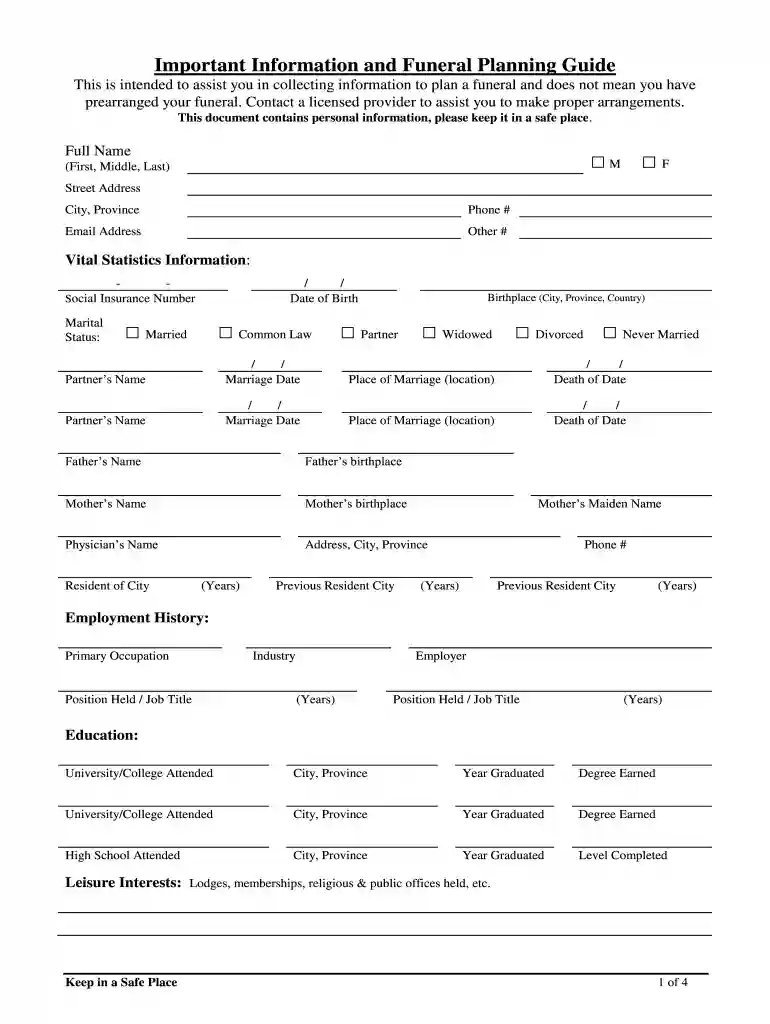
Important Information and Funeral Planning Guide 2026

Get Form
funeral planning worksheet pdf Preview on Page 1

Here's how it works

01. Edit your funeral planning worksheet pdf online
Type text, add images, blackout confidential details, add comments, highlights and more.

02. Sign it in a few clicks
Draw your signature, type it, upload its image, or use your mobile device as a signature pad.

03. Share your form with others
Send printable funeral pre planning worksheet via email, link, or fax. You can also download it, export it or print it out.

Definition and Purpose of the Funeral Planning Guide

The Important Information and Funeral Planning Guide is a comprehensive resource intended to assist individuals and families in organizing essential personal and legal information for funeral arrangements. This guide integrates a variety of components, including personal details, preferences regarding services, and legal documentation that streamline the planning process.

  • Key Features:
    • Vital Statistics: Collection of personal details such as full name, date of birth, and Social Security number.
    • Family Information: Space for documenting family members' contact information and roles in the planning process.
    • Funeral Preferences: Sections for outlining specific wishes regarding burial, cremation, and memorial services.

Understanding the purpose of this guide can greatly alleviate the stress associated with making funeral arrangements during a difficult time. By having this information readily available, individuals can ensure their preferences are respected and streamline the planning process for loved ones.

How to Use the Funeral Planning Guide Effectively

Utilizing the Important Information and Funeral Planning Guide involves several key steps to ensure a smooth and effective process. This includes gathering necessary documents, filling out each section carefully, and making your preferences clear.

  1. Gather Documentation: Collect essential documents such as birth certificates, marriage licenses, and military records. This foundational information is important for legal accuracy in planning.
  2. Complete Each Section: Fill in all required fields in the guide. Be thorough in documenting vital statistics and funeral preferences to provide clear guidance for your family.
  3. Review and Update Regularly: It is essential to revisit the guide periodically to ensure that the information remains current. Significant life changes, such as marriages, births, or relocations, should prompt a review.

Providing clear instructions and being detailed in the guide increases the likelihood that your wishes will be followed.

Steps to Complete the Funeral Planning Guide

Completing the Important Information and Funeral Planning Guide involves a series of steps that help ensure all necessary information is documented. This is a practical approach that can be systematically followed.

  1. Identify Key Information: Start by listing out vital statistics, family member details, and employment history. Utilizing legal names and accurate dates contributes to a well-organized guide.
  2. Document Funeral Preferences: Specify your thoughts on burial or cremation, venue choices, and any religious or cultural traditions you wish to honor. This section should reflect your personal values and beliefs.
  3. Compile Important Contacts: Create a list of individuals or organizations that need to be contacted once the plan is activated, including funeral homes and clergy.

Following these steps supports clarity and organization, which aids in the implementation of your funeral plans.

Legal Use of the Funeral Planning Guide

The Important Information and Funeral Planning Guide holds significant legal weight as it encapsulates your personal wishes for end-of-life arrangements. While this guide does not replace a legally binding will, it serves as an important document in the funeral planning process.

  • Expressing Wishes: The guide can help convey personal preferences to family members and influence decisions made at the time of need.
  • Compliance with State Laws: Different states may have specific requirements regarding funeral arrangements. Understanding those legal contexts ensures that your planning adheres to regional regulations.

Explaining the legal uses of the guide helps individuals recognize its importance as part of a comprehensive estate plan.

Key Elements of the Funeral Planning Guide

The Important Information and Funeral Planning Guide contains various key elements that are essential for effective planning. Each component is designed to facilitate a complete understanding of personal wishes and necessary logistical arrangements.

  • Personal Information: Includes full legal name, date of birth, Social Security number, and residence address.
  • Family Details: Information about survivors, including their contact details and relationships to the deceased.
  • Funeral Arrangements: Specific instructions on preferred funeral homes, services, and merchandise, such as caskets or urns.
  • Financial Considerations: Details regarding pre-paid arrangements or life insurance policies designated for funeral costs.

By pinpointing these elements, you can ensure a detailed and clear representation of your wishes, which aids those responsible for carrying them out.

Common Scenarios for Using the Funeral Planning Guide

Many individuals may benefit from utilizing the Important Information and Funeral Planning Guide in various life situations. Understanding these scenarios enhances the practicality of the guide.

  • Elderly Individuals: Seniors may find value in documenting their funeral wishes, thus reducing burden on family members making decisions later.
  • Family Caregivers: Those responsible for elderly relatives can assist in completing the guide, ensuring that their loved one's preferences are communicated clearly.
  • Health Issues: Individuals facing serious illnesses may want to proactively document their wishes, ensuring clarity before any decisions become urgent.

Recognizing these scenarios can help individuals appreciate the versatility and importance of the funeral planning guide in different contexts.

be ready to get more

Complete this form in 5 minutes or less

Get form

Got questions?

We have answers to the most popular questions from our customers. If you can't find an answer to your question, please contact us.
Contact us
Step-by-Step Guide to Planning a Funeral Service Contact the decedents legal representative. Arrange for transportation of the decedent. Carry out any pre-arranged funeral plans. Decide on funeral type, service and burial. Confirm cemetery arrangements. Decide on any other memorial service details. Arrange for an obituary.
Specific misrepresentations in six areas: embalming, casket for direct cremation, outer burial container, legal and cemetery requirements, preservative and protective vault claims, cash advance items and other misrepresentations.
Complete and collect all official paperwork, including the processing of the death certificate. Prepare and transport the deceased. Make decisions and understand options regarding religious or ceremonial requirements. Get the support you need in making funeral arrangements.
Martin Lewis sees value in funeral plans but advises caution in some cases. He suggests plans are good if you can pay upfront / in the shorter-term. He warns against long-term payment plans with high interest. There is state support for those who may not be able to afford to pay for a funeral.
Simply put, funerals are expensive and should not be taken lightly. That being said, if you or a loved one has final expense insurance, that can offset the cost for funeral arrangements. A low-cost (bold low-cost) funeral may cost $3,000 to $5,000, An average (bold average) funeral may range from $8,000 to $15,000.

Security and compliance

At DocHub, your data security is our priority. We follow HIPAA, SOC2, GDPR, and other standards, so you can work on your documents with confidence.

Learn more
ccpa2
pci-dss
gdpr-compliance
hipaa
soc-compliance
be ready to get more

Complete this form in 5 minutes or less

Get form

People also ask

FAQs About Funeral Costs $10,000 could certainly be enough for a funeral, depending on the nature of the ceremony and the area where you live.
Decide if continuing accounts need names added. File claims to receive death benefits from life insurance. If necessary, change beneficiaries on your own life insurance. Ask for help processing health insurance claims for the deceased person.
Your Advance Funeral Planning Checklist Secure vital statistics. Express preferences for services. Decide on disposition and memorialization. Record obituary preferences and information. Make payment arrangements. List friends and family members to notify of death. Keep family members informed of your plans.

free funeral planning guide pdf