
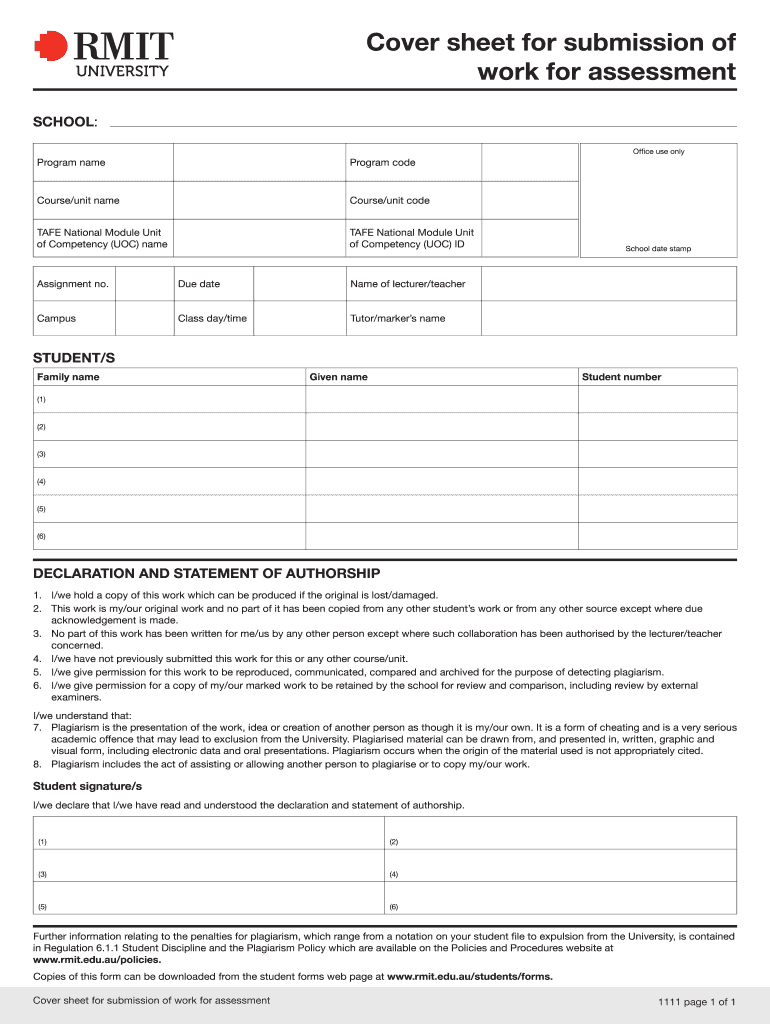







Overview of the RMIT Cover Sheet
The RMIT cover sheet is essential for students submitting assignments as part of their academic assessment. This document provides a structured way to identify the student, course, and assignment details, ensuring that submissions are clearly organized for evaluators.
Components of the RMIT Cover Sheet
An RMIT cover sheet typically includes the following key components:
- Student Information: Name, student ID, and contact details.
- Course Details: Course code and title, as well as semester information.
- Assignment Title: Clear identification of the assignment being submitted.
- Declaration of Authorship: A statement affirming that the work is original and has not been plagiarized. This is critical as it upholds academic integrity.
- Signatures: Students must sign to confirm their understanding of plagiarism policies and their commitment to the declaration of authorship.
Importance of the RMIT Cover Page
Using the RMIT cover page is significant for both students and instructors, as it:
- Ensures Academic Integrity: By including the declaration of authorship, the cover sheet helps maintain the institution's standards regarding originality and proper citation practices.
- Facilitates Assessment: Teachers can quickly ascertain who submitted each assignment and the relevant course information, which streamlines the grading process.
Filling Out the RMIT Assignment Cover Sheet
When filling out the RMIT cover sheet, follow these steps for accurate submission:
- Enter Personal Information: Input your full name, student ID, and email address clearly.
- Provide Course Information: Fill in the course code and title corresponding to the assignment.
- Specify the Assignment Title: Clearly state the title of your assignment as it appears in the syllabus.
- Complete the Declaration: Read and understand the plagiarism policy, then sign where indicated to affirm your commitment to academic honesty.
- Review for Accuracy: Ensure all information is correct before submitting the cover sheet with your assignment.
Examples of RMIT Cover Page Templates
RMIT provides templates for students to ensure compliance with formatting requirements. A sample structure might include:
- Header: RMIT logo (if required)
- Title: “RMIT Cover Page” in a bold font
- Alignment: Ensure text is properly aligned and legible.
- Spacing: Adequate spacing between sections to prevent clutter.
- Footer: Space for signatures, if applicable.
Common Variants and Templates Available
Different faculties at RMIT may have specific variations of the cover sheet based on their requirements. Common variants include:
- RMIT cover page sample: Available for students to reference and customize.
- RMIT report cover page: Tailored for comprehensive project submissions.
- RMIT cover page template: A pre-formatted document that can be filled digitally or printed for manual completion.
Submission Methods for RMIT Cover Sheets
Students can submit their RMIT cover sheets in various ways depending on course requirements:
- Online Submission: Through RMIT’s Canvas system.
- In-Person Drop-off: At designated submission points within the university.
- Email Submission: In specific cases, as directed by course coordinators.
Final Considerations for Effective Use
To ensure effective use of the RMIT cover sheet, consider the following:
- Timely Submission: Adhere to submission guidelines and deadlines as outlined by your course instructors.
- Maintain Copies: Keep a copy of submitted cover sheets and work for your records.
- Verify with Your Instructor: Check any specific requirements or variations that may apply to your course.
Understanding the nuances of the RMIT cover sheet plays a crucial role in the academic journey, helping students to present their work professionally while upholding the principles of academic honesty.




