




01. Edit your 4 year old assessment checklist pdf online
Type text, add images, blackout confidential details, add comments, highlights and more.

Type text, add images, blackout confidential details, add comments, highlights and more.

Draw your signature, type it, upload its image, or use your mobile device as a signature pad.

Send 4 year old academic checklist via email, link, or fax. You can also download it, export it or print it out.
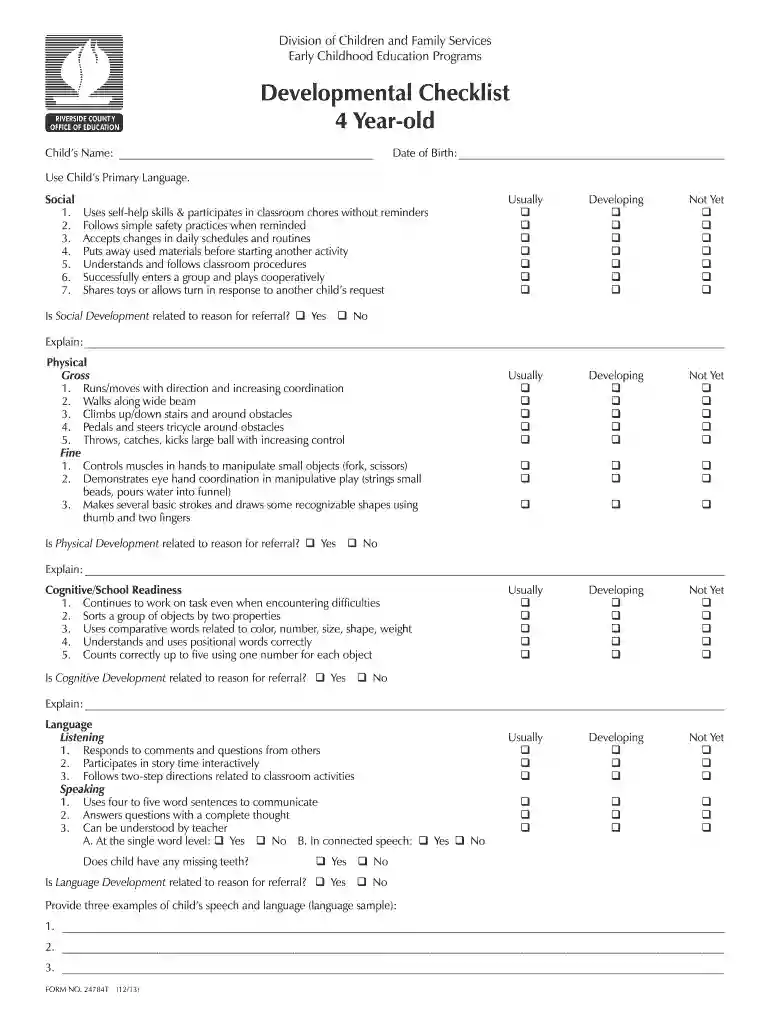
The four-year-old assessment checklist is a vital tool used in early childhood education to evaluate various developmental milestones of children. This checklist assesses social, physical, cognitive, and language skills, providing a comprehensive view of a child's readiness for school and overall growth. It's typically used by educators, parents, and specialists in childcare settings to monitor development and identify any areas where further support may be needed.
The checklist is structured to include several key areas of development:
Social Development
Physical Development
Cognitive Development
Language Skills
To effectively use the four-year-old assessment checklist, it is recommended to follow these steps:
Gather Information: Collect observations from various settings where the child interacts, including home, school, and community activities.
Complete the Checklist: Engage with the child in natural settings and complete the checklist detailing observed behaviors and skills in each developmental area.
Evaluate Results: Compare the child’s abilities against established milestones. This evaluation will help identify areas where the child excels and where further development may be needed.
Documentation: Keep a record of the assessment, noting specific observations and skills evidenced during the checklist completion. This documentation can be beneficial for future evaluations and discussions with educators or specialists.
The four-year-old assessment checklist offers numerous advantages:
Identifies Developmental Needs: It helps in identifying developmental delays or challenges, allowing for timely intervention.
Guides Curriculum and Activities: The checklist aids educators in crafting appropriate learning experiences tailored to the developmental levels of children.
Facilitates Communication: It provides a standardized method for discussing children's development with parents, caregivers, and other professionals.
When utilizing the assessment checklist, here are specific examples to look for in each developmental area:
Social Skills: Does the child exhibit the ability to initiate play with others? Are they able to resolve conflicts with minimal adult intervention?
Physical Skills: Is the child able to skip or hop on one foot? Can they manipulate small objects like beads or blocks with dexterity?
Cognitive Skills: Can the child count to ten or recognize shapes? Do they demonstrate the ability to follow multi-step instructions?
Language Skills: Is the child able to recount a simple story in sequence? Do they use words effectively to express their needs and feelings?
For additional guidance, consider referring to:
Developmental Checklist PDF: Many educational resources offer downloadable checklists tailored for four-year-olds, providing structured formats for assessments.
Professional Consultations: Engage with child development specialists or educators for comprehensive assessments and tailored strategies. They can provide insights that enrich the use of the checklist and augment developmental support.
Through thorough evaluation and structured observation, the four-year-old assessment checklist serves as a powerful tool in supporting children's development, ensuring they are prepared for their next academic steps.
We've got more versions of the 4 year old assessment checklist pdf form. Select the right 4 year old assessment checklist pdf version from the list and start editing it straight away!
| Versions | Form popularity | Fillable & printable |
|---|---|---|
| 2013 | 4.8 Satisfied (304 Votes) |
At DocHub, your data security is our priority. We follow HIPAA, SOC2, GDPR, and other standards, so you can work on your documents with confidence.
The developmental milestones below will give you a general idea of the changes you can expect as your child gets older, but dont be alarmed if your child takesRead more
Feb 16, 2026 Movement/Physical Development Milestones Catches a large ball most of the time Serves herself food or pours water, with adult supervisionRead more


